
Making a Rocking Chair with a Scroll Saw: What the Saw Can and Cannot Do
Making a Rocking Chair with a Scroll Saw: What the Saw Can and Cannot Do
A rocking chair is a furniture project that involves multiple tools, a bandsaw for rough curves, a spokeshave or router for shaping, a drill press for mortises, and a lathe if the chair has turned spindles. A scroll saw has a role in some rocking chair builds, but it is not the primary tool for the whole project, and trying to do everything on a scroll saw is an exercise in frustration.
Understanding where the scroll saw contributes and where it hands off to other tools is what makes a scroll saw owner’s rocking chair project successful rather than abandoned.
Direct answer
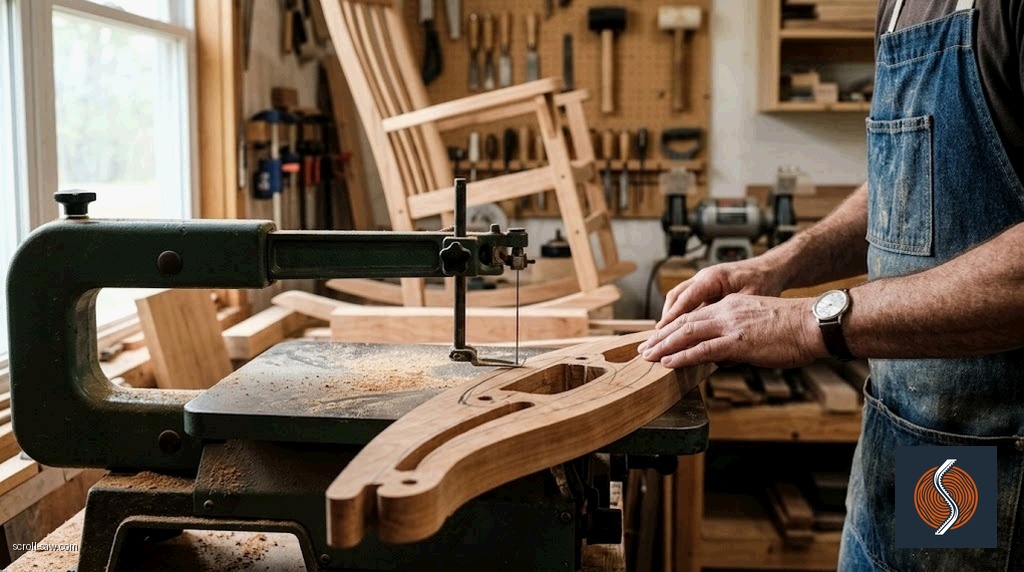
A scroll saw contributes to a rocking chair build by cutting decorative elements (back splat, crest rail details, scrolled arm profiles, and decorative cutouts), cutting pattern templates for curved parts, and occasionally rough-cutting gentle curves in thin stock before shaping. The structural parts (rockers, seat, legs) are better cut on a bandsaw and shaped with other tools.
What a scroll saw actually contributes to a rocking chair
Back splat. Many traditional and Shaker-style rocking chairs have a central back splat (the flat piece between the back legs, visible between the back spindles or as the full back panel). When the splat has decorative cutouts, scrollwork, or an open fretwork design, a scroll saw is exactly the right tool. Splats are typically 1/2 inch to 3/4 inch thick, within the scroll saw’s comfortable working range.
Crest rail decoration. The top rail of the chair back often has a scroll-cut profile or decorative cutouts. The curved upper edge can be rough-cut on a bandsaw, but the fine decorative detail at the center belongs on a scroll saw.
Arm profiles. Some rocking chair arm designs have a scrolled or carved profile that can be partially executed on a scroll saw for the through-cuts, with shaping done by hand afterward.
Decorative aprons. Some chair styles have decorative apron pieces under the seat. Scrollwork in these fits the scroll saw’s capability well.
Templates. Paper or thin plywood templates for curved parts (the rocker profile, the seat shape, the arm curve) can be cut precisely on a scroll saw and then used to mark the actual stock.
What a scroll saw cannot do on a rocking chair
Rockers. The curved rocker at the base is typically 1 to 1.5 inches thick, 3 to 4 inches wide, and several feet long. This is a bandsaw job. A scroll saw’s throat depth cannot accommodate a rocking chair’s rocker length.
Seat. A solid wood seat is typically 3/4 inch to 1 inch thick and 14 to 18 inches wide. Too wide for the scroll saw’s throat on most models, and not a fine detail job.
Structural legs and posts. These are typically turned (lathe) or squared on a table saw.
Spindles. Turned on a lathe.
Heavy shaping. Any operation that removes significant material from a curved structural piece belongs to a spokeshave, drawknife, router table, or sander.
Setting up the scroll saw for chair back splat work
The back splat is the most common scroll saw contribution to a rocking chair. A typical approach.
1. Prepare the splat blank. Mill or purchase the splat stock to final thickness and rough width. Typical dimensions: 1/2 inch thick, 5-8 inches wide, 12-20 inches tall depending on chair design.
2. Transfer the pattern. Spray-mount a printed pattern or trace a template onto the stock. Include all interior detail and the outer silhouette.
3. Drill starter holes for interior cuts. Use a 1/8-inch bit at the waste side of every enclosed interior shape. Mark each hole clearly.
4. Blade selection. #7 reverse-tooth for 1/2-inch hardwood. If the design has fine interior detail, use a #5 for those cuts and a #7 for larger areas.
5. Cut interior shapes first. Thread the blade through starter holes and cut all interior shapes before the outer silhouette. The workpiece is most rigid at this stage.
6. Cut outer silhouette. After all interior work is done, cut the outer profile. This releases the piece from the waste.
7. Sand. Sanding sticks for interior cuts, hand sanding for the outer profile. The splat’s show face should be smooth before fitting to the chair.
8. Test fit. The splat fits into mortises in the bottom rail and crest rail. Verify fit before finishing.
Designing the scroll-cut back splat
Design considerations for a back splat.
Strong bridges. The splat must be structurally sound in its final position. Bridges (wood between cut areas) should not be thinner than about 1/8 inch in 1/2-inch stock. Thinner bridges look elegant but can break under normal seating stress.
Structural integrity. Think about how the forces on the chair will travel through the splat. The splat bears load when someone leans back. Designs that leave vertical continuity from top to bottom through the main elements are stronger.
Traditional proportions. Traditional chair back splats use specific proportions that relate to the chair’s overall design. Study historical chairs for proportions before designing from scratch.
Match the chair style. A splat with Victorian-style scrollwork belongs in a Victorian chair. A simple Shaker-inspired cutout belongs in a simpler chair. The scroll work should look like it belongs.
Verdict
A scroll saw makes a specific and valuable contribution to a rocking chair build: the decorative and detail cutting that the bandsaw cannot do cleanly. The back splat, crest rail detail, and decorative aprons belong on the scroll saw. The structural parts (rockers, seat, legs) belong on other tools.
Understanding where the scroll saw’s role begins and ends allows a rocking chair build to use each tool for what it does best. The result is a chair where the scroll saw’s contribution is visible in the detail, not limited by what the scroll saw cannot do.
FAQ
Can a scroll saw cut the rockers for a rocking chair? Not practically. Rockers are too long for most scroll saw throat depths. A bandsaw is the correct tool for cutting rocker curves.
What is a back splat? The central panel or decorative element in the chair back, between the two back posts. On many traditional chairs, the splat has carved or scroll-cut decorative detail.
What thickness should a back splat be? Typically 1/2 inch to 3/4 inch for a hardwood splat. Thinner splats are possible in a modern design where the splat is not load-bearing.
What wood works best for a scroll-cut chair splat? Cherry, walnut, mahogany, and hard maple are traditional choices. All cut well on a scroll saw and take finish beautifully.
How do I prevent the back splat from breaking under use? Design bridges at least 1/8 inch wide in 1/2-inch stock. Ensure vertical continuity through the main structural elements. Avoid designs where only one or two thin pieces span the full height.
Do I need a full furniture-making shop to make a rocking chair? For a simple spindle-back rocker: bandsaw, drill press, lathe (or purchased turned parts), scroll saw for detail work, hand tools. A full shop helps but the basic tool list is achievable.
Can beginners scroll-cut a chair back splat? Yes, with a simple design. Start with a design that has large, open interior cuts and strong bridges. Save the intricate fretwork splat for after the basic splat cutting technique is comfortable.


