
Mantel Scroll Saw Work: Decorative Pieces That Hold Their Own on a Fireplace
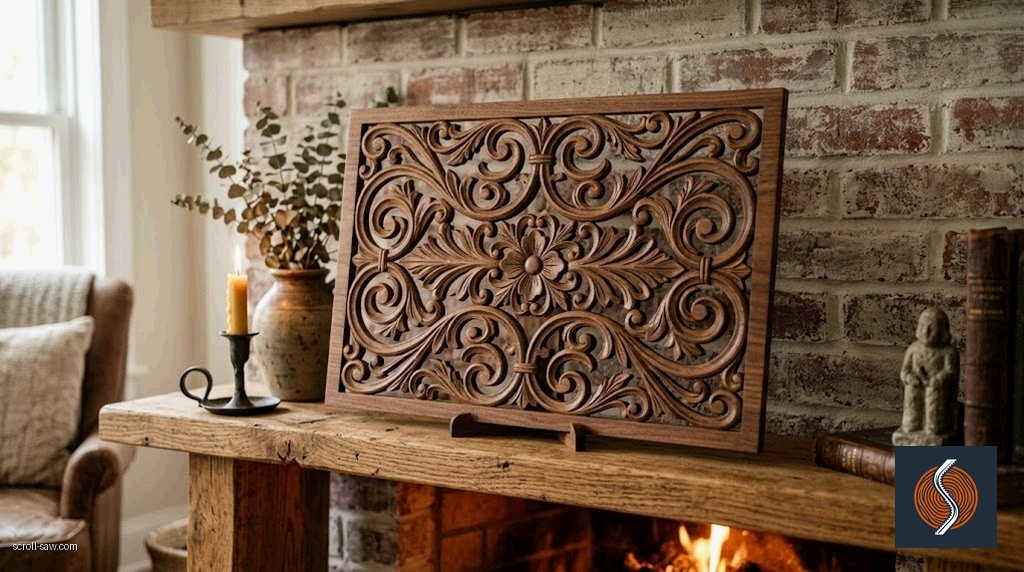
Mantel Scroll Saw Work: Decorative Pieces That Hold Their Own on a Fireplace
The mantel is a specific kind of display environment. It is at eye level for anyone standing in the room. It gets viewed from a distance and up close. The pieces on it compete with framed photos, candlesticks, and whatever else the homeowner has decided deserves prominent position. A scroll saw piece that goes on a mantel has to be worth that position.
This article covers the design and finishing requirements for scroll saw mantel pieces: what works at scale, what finishes hold up near a fireplace, how to make pieces stand rather than lean, and the specific categories that work best in this context.
Direct answer
Mantel scroll saw pieces work best as freestanding single pieces or grouped compositions with enough visual weight to hold the position, cut from solid wood or quality hardwood plywood, finished with a clear or natural oil finish that reads well at 6-8 feet, and at a scale between 8 and 20 inches tall. Thin-stock plywood ornament work is too small and light for the mantel. Silhouette landscapes, portrait fretwork panels, religious scenes, and architectural silhouettes are the strongest performing categories.
Scale considerations for mantel work
The mantel is typically viewed from 6 to 15 feet in the center of a room.
Minimum usable height: about 8 inches. Below this, the piece reads as a small object rather than a display piece from a distance.
Strong range: 10 to 18 inches. At this height, a scroll-cut freestanding piece has enough visual presence to hold the mantel position.
Wider is sometimes better. A horizontal landscape silhouette at 18 inches wide by 10 inches tall can anchor a mantel as effectively as a single tall piece.
Multiple pieces as a composition. Three pieces of graduated heights (12, 10, 8 inches, for example) in a related design set work well together on a mantel, especially flanking a central feature.
Design categories that work on the mantel
Landscape silhouettes. Mountains, trees, farmscapes, cabin-in-the-woods scenes. These read clearly at distance and in natural hardwood look like art rather than craft.
Portrait fretwork panels. A framed fretwork portrait of a person, animal, or scene. The frame gives visual weight. Backlit or mounted on a dark backing increases presence.
Religious and seasonal scenes. Nativity scenes for Christmas, crosses, Star of David designs. These are among the most requested mantel scroll saw pieces.
Architectural silhouettes. A city skyline, a hometown barn, a specific building (a family’s first house, a church, a courthouse). These are meaningful and look good at mantel scale.
Family established signs. “Smith Family Est. 2008” in a freestanding format. These combine personal meaning with visual impact.
Freestanding wildlife. A deer, elk, or bear silhouette cut in 3/4-inch hardwood and base-mounted. Classic, clean, looks at home above a fireplace.
Materials for mantel work
Solid hardwood at 1/2 to 3/4 inch. Cherry, walnut, and mahogany are the most popular. Solid wood has visual weight and depth that thin plywood cannot match. At mantel scale, the thickness matters: a 3/4-inch walnut silhouette looks substantive.
1/2-inch Baltic birch. For layered panels with backing, Baltic birch is the standard substrate. Finishes cleanly and paints or stains well.
Avoid 1/4-inch plywood for freestanding mantel pieces. Too light visually. Acceptable for a framed panel with backing, but a freestanding silhouette in 1/4-inch plywood looks like an ornament that escaped the Christmas tree.
Finishes for mantel pieces
The mantel is near a fireplace. Finish considerations.
Heat from a working fireplace. Most wood finishes are not damaged by the ambient heat of a normal fireplace from several feet away. Direct heat exposure (a piece leaning against a working fire screen) would be a different story, but that is not a typical display situation.
Soot and smoke. Near a working fireplace, a hard film finish (polyurethane) is easier to clean than a penetrating oil finish. Both work; the film finish protects better.
Natural oil finish (Danish oil, walnut oil, tung oil). Brings out the natural wood color beautifully. Wipe on, wipe off, simple maintenance. Less protective than film finishes but more appropriate for natural-look displays.
Clear spray lacquer or polycrylic. Fast-drying, hard finish. Very transparent. Standard for scroll saw work that needs a quick sealed finish.
Dark stain on birch. A walnut or ebony stain on Baltic birch creates a dramatic dark piece that reads well against a light-colored mantel.
Natural wood contrast. Two pieces of the same design cut from contrasting woods (light maple and dark walnut, for example) mounted together create strong visual contrast without any applied color.
Making pieces freestanding
Mantel pieces need to stand without leaning, even with some vibration from family life.
Wide base. A base that extends at least half the height of the piece provides good stability.
Low center of gravity. Heavy parts of the design near the bottom, lighter parts up top. Landscape silhouettes follow this naturally (heavy ground, lighter sky).
Rabbeted or slotted base. The main piece slides into a routed slot in the base. Very stable; the slot holds the piece straight.
Feet. Small rubber or felt feet under the base prevent sliding on smooth mantel surfaces.
Backing mount. For panel pieces, the frame provides stability. Mount to the wall if the piece is tall relative to its base width.
Verdict
Mantel scroll saw work rewards going bigger, heavier, and better finished than typical craft work. A 12-inch walnut landscape silhouette with a Danish oil finish does not look like craft fair work. It looks like something someone chose deliberately.
The design categories that work are specific (landscapes, portraits, architectural silhouettes, religious scenes, family establishment signs). Scale, material, and finish all have to match the context. Within those parameters, a scroll saw can produce some of the most beautiful objects a mantel holds.
FAQ
How tall should a scroll saw mantel piece be? Minimum about 8 inches. Strong range is 10-18 inches. Larger can work in larger rooms with higher ceilings.
What wood is best for mantel scroll saw work? Walnut, cherry, and mahogany are the most popular choices. All have natural color that reads well at distance without any applied stain.
What finish should I use on a scroll saw piece near a fireplace? Hard film finish (polyurethane, lacquer) for easy cleaning near a working fireplace. Natural oil finish for a warmer look where soot is not a concern.
How do I make a scroll saw silhouette freestanding? A wide, stable base with a routed or cut slot that the silhouette slides into. Low center of gravity in the design.
Can I group multiple scroll saw pieces on a mantel? Yes. Three graduated heights in a related design (woodland scene, family signs, etc.) work well as a composition. Keep color and wood consistent across the group.
What is the best subject for a fireplace mantel scroll saw piece? The most meaningful subjects for the homeowner. Landscapes of a meaningful place, wildlife meaningful to the family, a religious symbol, or a family established sign are all strong choices.
Can I sell scroll saw pieces as mantel decor? Yes. Natural wood mantel decor in walnut and cherry sells well at craft fairs, on Etsy, and through local home decor stores. Personalized versions (hometown silhouette, family name) command higher prices.


