
Metal Cutting on a Scroll Saw: Setup, Blade Selection, and What Works
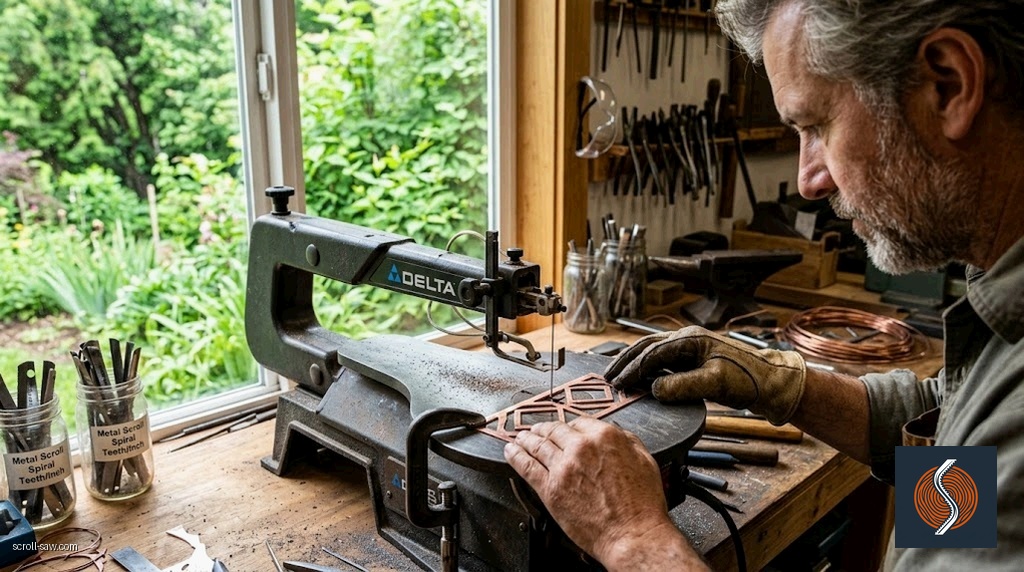
Metal Cutting on a Scroll Saw: Setup, Blade Selection, and What Works
Most scroll saw owners work exclusively in wood and never think about cutting metal. A smaller group, typically jewelers, artisans, and makers who work with both wood and metal, eventually ask the question: can this saw cut metal? The answer is yes, with specific limits, the right blades, and a different approach from wood cutting.
This article covers what metals are practical on a scroll saw, which blades to use, and the setup adjustments that keep the blades intact and the metal from overheating.
Direct answer
A scroll saw can cut thin non-ferrous metal (aluminum, brass, copper, silver) up to about 1/8 inch thick with metal-cutting scroll saw blades (metal-cutting reverse-tooth or spiral blades), slow saw speed, moderate feed rate, and lubrication. Steel and iron are not practical on a hobby scroll saw. Thick metal is not practical either. Within those limits, the results are useful for jewelry, decorative metal fretwork, and mixed-media work.
What metals a scroll saw can handle
Aluminum (soft grades, under 1/8 inch). The most practical scroll saw metal. Soft alloys (3003, 5052) cut cleanly. Harder alloys (6061) are more demanding but possible. Thin sheet aluminum (1/16 inch) cuts well. At 1/8 inch, patience and frequent lubrication are required.
Brass (under 1/16 inch typically). Harder than soft aluminum. Works in thin sheets for jewelry and decorative applications. Over 1/16 inch is slow and hard on blades.
Copper (thin sheet, up to about 1/16 inch). Similar to brass in cutting behavior. Thin copper sheet (26-22 gauge) is practical. Thicker is not.
Silver (thin sheet). Sterling silver sheet for jewelry work is practical in thin gauges. Gold-filled and karat gold thin sheet is also used by jewelers on scroll saws.
What does not work:
Ferrous metals (steel, iron, stainless). A hobby scroll saw is not a metal-cutting machine. Steel work-hardens as it is cut, dulls blades almost immediately, and does not allow the slow lubricated cutting approach. Not practical.
Thick metal over 1/8 inch. The motor, blade tension mechanism, and blades on a hobby scroll saw are not designed for serious metalwork. A metal-cutting bandsaw or jeweler’s saw is the appropriate tool.
Cast metal, pot metal, zamak. Brittle, chips and cracks under a reciprocating blade.
Blades for metal cutting on a scroll saw
Metal-cutting scroll saw blades. Some blade manufacturers produce scroll saw blades specifically labeled for non-ferrous metal. These have fine, set teeth designed for metal rather than wood. Pegas and Flying Dutchman both offer metal-cutting blades. These are the first choice.
Reverse-tooth jeweler’s saw blades. Very fine blades (#2/0 and smaller) designed for jewelry work in a hand jeweler’s saw frame can sometimes be adapted to a scroll saw. They are very fine and break easily on an incorrectly set up scroll saw.
Spiral blades. Spiral scroll saw blades cut in all directions. They do not produce as clean an edge as tooth blades, but they are useful for cutting from any angle, which helps with complex metal shapes.
Do not use standard wood-cutting scroll saw blades. Wood blade teeth are set and sized for wood fiber. On metal, they clog almost immediately and either slip or break.
Setup for metal cutting
Reduce saw speed. Metal cutting requires much slower blade speed than wood. Set the saw to its lowest speed setting (400-600 SPM). Faster speeds heat the metal and dull the blade rapidly.
Lubricate the blade and cut. Cutting oil, beeswax, or even a bar of soap applied to the cut line reduces friction and keeps the blade cooler. For thin aluminum, a light machine oil works. For brass and copper, a proper cutting oil is better.
Support the workpiece. Thin metal sheets flutter and vibrate. Sandwich the metal between two thin pieces of plywood (taped together) for the cut. The sandwich stabilizes the metal, allows normal feed, and reduces vibration that bends or chews the metal edge.
Zero-clearance insert around the blade. The slot in the standard scroll saw throat plate is too wide for thin sheet metal, which can flex and catch. Make a zero-clearance insert from thin plywood that fits tightly around the blade.
Deburr after cutting. All metal scroll saw cuts leave a burr on the bottom face. A deburring tool, file, or fine sandpaper smooths the edges after cutting. This is not optional for any piece that will be handled.
Eye protection. Metal chips are more hazardous than wood chips. Safety glasses minimum; full face shield is better for any extended metal cutting session.
Hearing protection. Metal cutting on a scroll saw is noisier than wood cutting. Hearing protection for extended sessions.
Feed rate and technique
Slower than wood. Metal requires patience. Feed slowly and steadily, allowing the blade to cut at its own pace. Forcing metal causes chattering, which causes edge roughness and blade wear.
Let the blade cool if needed. For cuts over a few inches in metal, pause periodically and let the blade sit in open air for a few seconds. Overheated blades in metal dull faster and can break.
Tight turns require backing out. Tight interior curves in metal are harder than in wood. For very tight corners, cut in to the corner, back the blade slightly, rotate the workpiece, and cut out in the new direction.
Clean chips frequently. Metal chips can accumulate on the work surface and under the workpiece. They are abrasive and can scratch the bottom of the piece. Clear them with a brush between cuts.
Applications
Where scroll saw metal cutting is actually used.
Jewelry. Thin silver, gold-filled, brass, or aluminum sheet in earrings, pendants, and decorative elements. Scroll saw for the rough shape, jeweler’s tools for finishing.
Decorative metal fretwork. Aluminum fretwork panels, decorative grills, and mixed-media pieces (wood and metal combined). Thin aluminum is the best material for this.
Model making. Thin aluminum or brass sheet for scale model parts.
Small architectural metalwork. Thin copper pieces for decorative hardware, lamp parts, and cabinet hardware.
Verdict
A scroll saw can cut thin non-ferrous metal with the right blades, slow speed, lubrication, and a sandwiched workpiece. The results are useful for jewelry, metal fretwork, and mixed-media work. The limits are real: steel is not practical, thick metal is not practical, and a hobby scroll saw is not a replacement for a dedicated metal-cutting machine.
For a woodworker who occasionally needs curved cuts in thin aluminum or brass, the scroll saw setup is worth learning. For serious metalwork, a jeweler’s saw (for very fine work) or a metal-cutting bandsaw (for thicker material) is the appropriate tool.
Set up correctly, thin non-ferrous metal on a scroll saw produces clean results that are difficult to achieve any other way for intricate curved shapes at small scale.
FAQ
Can a scroll saw cut steel? Not practically on a hobby scroll saw. Steel work-hardens during cutting, dulls blades almost immediately, and requires cutting speeds and lubrication systems beyond hobby saw capability.
What blade do I use to cut aluminum on a scroll saw? A metal-cutting scroll saw blade (available from Pegas and Flying Dutchman). Do not use standard wood-cutting blades.
How slow should my scroll saw run when cutting metal? The lowest speed setting available, typically 400-600 SPM. Faster speeds heat the metal and wear the blade rapidly.
Do I need lubrication to cut metal on a scroll saw? Yes. Cutting oil, beeswax, or machine oil applied to the cut line reduces friction and prolongs blade life significantly.
How thick of metal can a scroll saw cut? Practically, up to about 1/16 inch for brass and copper, up to about 1/8 inch for soft aluminum. Beyond these thicknesses, a jeweler’s saw or metal-cutting bandsaw is more appropriate.
How do I reduce vibration when cutting metal on a scroll saw? Sandwich the metal between two thin pieces of plywood held together with tape. This stabilizes the sheet and allows normal feed without vibration.
Can I cut stainless steel on a scroll saw? No. Stainless steel is too hard and work-hardens too quickly for hobby scroll saw use.


