
Mini Scroll Saw: What It Can Do and Where It Stops
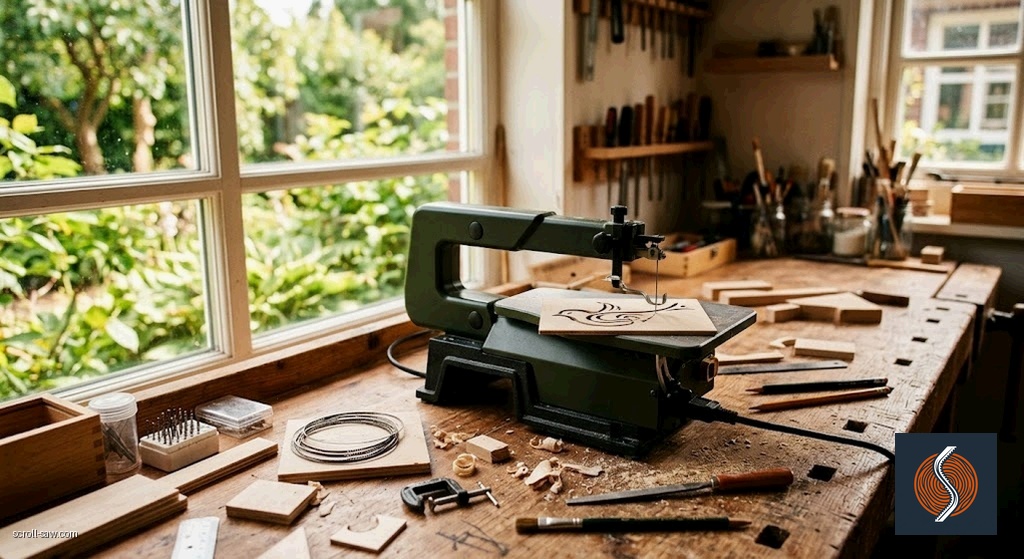
Mini Scroll Saw: What It Can Do and Where It Stops
A mini scroll saw shows up in two situations. Either someone buys one thinking it is a cheaper entry point to scroll saw work and then wonders why it cuts poorly, or someone buys one knowing exactly what they need it for (small-scale detailed cuts, portability, tabletop use) and gets exactly what they expected. The machine is fine. The expectations need matching.
This article covers what a mini scroll saw actually is, what tasks it handles well, and the clear boundary where a full-size saw is the right tool.
Direct answer
A mini scroll saw is a compact scroll saw, typically with a 12-16 inch throat depth and a lighter motor, designed for thin stock (up to about 3/4 inch), small workpieces, and precision detail in jewelry-scale to small ornament-scale work. It is not a substitute for a full-size saw for standard hobby work. Its advantages are size, portability, and often lower vibration for very small workpieces.
What “mini” means in practice
Mini scroll saws vary by manufacturer but share common characteristics.
Throat depth: 12-16 inches. Compared to a full-size hobby saw at 18-24 inches. The reduced throat limits the maximum workpiece size.
Motor: smaller. Lighter motors cut thin stock cleanly but bog down in hardwood over 1/2 inch.
Table: smaller. Less support for larger workpieces.
Weight: lighter. A mini saw can be moved easily; some are designed for use on a desk or small bench.
Price: lower. Mini saws typically cost less than full-size saws at equivalent build quality.
Where a mini saw performs well
Jewelry and small craft work. A 2-inch pendant, a miniature house, a tiny puzzle piece. The reduced throat and lighter construction are not limiting factors when the workpiece is small.
Thin stock (1/8 to 1/4 inch). Mini saws cut thin stock cleanly. The light motor is appropriate for the material.
Portability. A mini saw travels easily to workshops, shows, classrooms, and shared spaces where a full-size machine would be impractical.
Teaching environments. A mini saw is less intimidating for a first-time user. The blade is the same; the overall machine feels more approachable.
Second saw for a specific role. In a two-saw shop, a mini saw dedicated to jewelry-scale work and thin-stock detail can free the primary saw for larger projects.
Very small interior cuts. A smaller throat makes it easier to work on small pieces that otherwise move around on a large table.
Where a mini saw stops working
Thick stock. 3/4 inch and above in hardwood is beyond most mini saws. The motor bogs down and blades dull faster.
Large workpieces. A 12-inch throat depth means workpieces over about 11 inches across the narrowest dimension cannot be fully interior-cut without repositioning.
Long production sessions. Lighter motors are not designed for continuous use. A mini saw as a primary production saw in a busy craft operation will wear faster than a full-size saw.
Portrait and fretwork work requiring maximum blade tension. Mini saws often cannot hold fine blades at the same tension as a full-size saw because the tension mechanism and arm rigidity are scaled down with the rest of the machine.
Stack cutting of multiple thick pieces. The combination of thin material, multiple layers, and a light motor pushes the saw past its intended range.
Setup for a mini scroll saw
Setup fundamentals are the same as any scroll saw, with a few specific points.
Mounting. A mini saw on a hard desk or table transmits vibration upward into the workpiece. Place it on a rubber pad or a small piece of dense foam. Some mini saws include rubber feet; verify they are doing their job.
Blade tension. Mini saw tension mechanisms have less range than full-size saws. Use the full available tension. Pluck the blade; it should ring, not thud.
Blade selection. Use the blade size matched to the material, not the smallest available just because the saw is small. A mini saw cutting 1/4-inch plywood still needs a #5 blade.
Hold-down. Adjust for the actual material thickness, not left at a default position.
Blower. Aim carefully; mini saw blowers sometimes have less output. A small supplemental blower (a rubber-bulb blower or small aquarium pump) helps if sawdust obscures the line.
Popular mini scroll saw categories
Dremel scroll saw (Moto-Saw and similar). Compact, low-cost, designed for craft work in thin materials. Not a replacement for a hobby saw but fits its intended use well.
Generic mini scroll saws (various importers). Entry-level mini saws from various brands. Quality varies widely. Look for parallel-arm design, positive blade holders, and adequate table flatness.
Portable variable-speed units. Some mini saws include variable speed in a compact package. More expensive than fixed-speed units but more useful for varying materials.
Mini saw vs. full-size saw: the honest decision tree
Buy a mini saw if:
-
Your work is primarily small-scale (ornaments under 6 inches, jewelry-scale pieces)
-
Portability is a real requirement
-
Space is genuinely limited
-
Budget is constrained and the work fits a mini saw’s capability
-
It is a second saw in a shop that already has a full-size primary
Buy a full-size saw if:
-
Your work includes any standard hobby project (ornaments, signs, portrait work, puzzles)
-
You want a single saw for varied work
-
You plan to work in 1/2-inch stock or thicker
-
You want long-term reliability under regular use
Most beginning hobbyists should buy a full-size entry-level saw, not a mini saw. The full-size saw handles the work the beginner will actually want to do. The mini saw will limit them within a few months.
Verdict
A mini scroll saw is a useful tool when its capability matches the work. Small-scale detail cuts in thin stock, portability, teaching, and second-saw roles are all legitimate uses. Treated as a cheaper substitute for a full-size saw on standard hobby projects, it disappoints.
Before buying, map your actual project list against the mini saw’s real capability: 12-16 inch throat, thin stock, light motor. If the projects fit, the saw fits. If not, a full-size entry-level saw is the better investment.
FAQ
Can a mini scroll saw do fretwork? Light fretwork in thin stock, yes. Fine portrait fretwork in hardwood with #2/0 blades requires more tension than most mini saws can hold.
What blades fit a mini scroll saw? Most mini saws accept standard 5-inch pin-less blades. Some proprietary mini saws use specific blade sizes. Check before ordering.
Is a mini scroll saw good for kids? The compact size and approachable scale can make it easier to use for older children with supervision. The blade is still the same hazard as a full-size saw.
How thick can a mini scroll saw cut? Most mini saws are comfortable up to about 1/2 inch in soft wood. Hardwood above 1/4 inch is challenging for most mini saw motors.
Can a mini scroll saw replace a full-size one? Not for standard hobby project range. A mini saw is a complement to a full-size saw, not a replacement.
What is the throat depth on most mini scroll saws? Typically 12 to 16 inches. Compare to 18-24 inches on full-size hobby saws.
Are mini scroll saws quieter than full-size saws? Often yes, because smaller motors and lighter construction generate less noise. Depends on the specific models compared.


