
Pegas Scroll Saw Blades: The Lineup, Tooth Patterns, and When They Matter
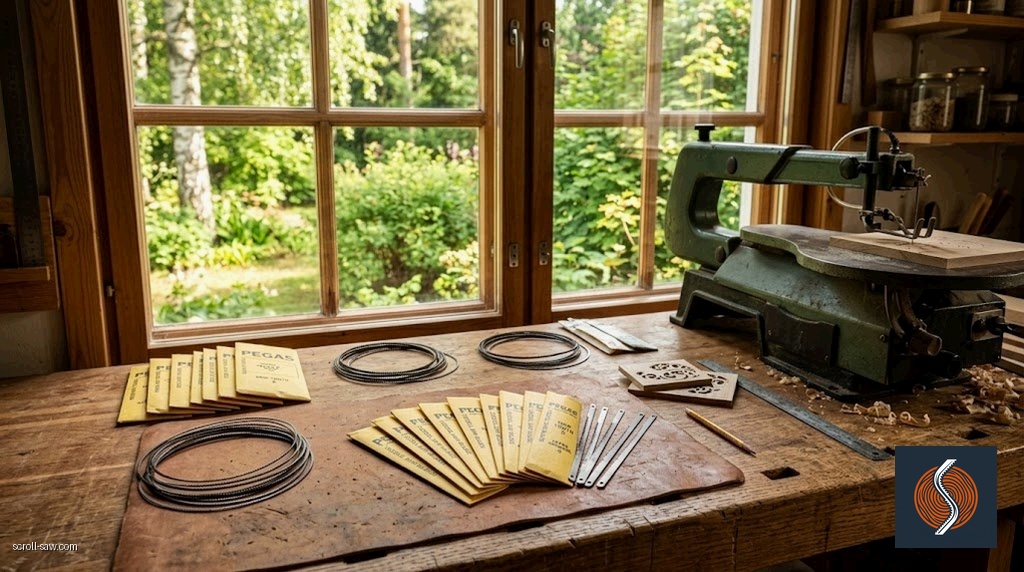
Pegas Scroll Saw Blades: The Lineup, Tooth Patterns, and When They Matter
Most scroll saw hobbyists use whatever blades the local hardware store carries, cycle through them at a reasonable pace, and produce good work. A smaller group of scrollers, usually the ones doing portrait work or fine hardwood fretwork, become very specific about their blades. Pegas comes up in that group consistently, and not as a brand preference. As a performance observation: Pegas blades produce cleaner cuts in fine work and last longer than most alternatives, and the difference is visible in the cut.
For other work, the difference is smaller. This article covers what makes Pegas blades exceptional, where the difference matters, and where a quality domestic blade like Olson is entirely sufficient.
Direct answer
Pegas scroll saw blades are Swiss-made precision ground blades known for consistent tooth geometry, long edge life, and the cleanest available cut in fine to medium sizes. They are the reference blade for fretwork and portrait work. For general hobby use in 1/4-inch plywood, the difference from Olson FR series is real but not always worth the added cost and sourcing effort. For fine hardwood work, Pegas is the first choice.
Why Pegas blades are different
Precision ground teeth. Pegas blades are ground rather than stamped. Stamped teeth (used by most budget blades, and some mid-grade blades) are pressed into shape, which can leave small variations in tooth geometry and hardness. Ground teeth are cut to precise angles and depth from the beginning. The result is consistent tooth geometry across the full blade and across the full production run.
Consistent hardness. The heat treatment on Pegas blades is consistent across the length of the blade. Budget blades can have uneven hardness, producing sections of the blade that wear faster or teeth that break at different rates.
Narrow kerf. Pegas blades in the fine sizes (#5 and smaller) are among the narrowest-kerf blades available. Narrow kerf means more precise cuts with less material removal and better fit on pieces that must fit together (intarsia, puzzles, fitted inlay).
Longer life per blade. Because the teeth start sharper and wear more evenly, a Pegas blade lasts noticeably longer than a budget blade in the same work. The premium per blade is partially offset by fewer blade changes.
The Pegas blade lineup
Pegas produces several tooth configurations. The most common:
Modified Geometry (MG) series. Pegas’s most recognized blade configuration. A unique tooth geometry that provides aggressive cutting with clean exit cuts. The standard choice for most scroll saw work. Available in full size range from #2/0 to #12.
Double Reverse (DR) series. Reverse teeth on both the forward and backward sections of each tooth cycle. Even cleaner face cuts on both the top and bottom of the workpiece. Useful for pieces where both faces will be visible.
Skip Tooth series. Aggressive chip clearance for thick soft wood. Standard skip-tooth geometry with Pegas’s precision manufacturing.
Metal-cutting series. Fine-tooth blades for thin non-ferrous metal. Same Swiss precision applied to metal-cutting work.
Size selection with Pegas blades
The same sizing guidelines apply to Pegas as to all standard 5-inch scroll saw blades:
| Size | Stock thickness | Use |
|---|---|---|
| #2/0, #1 | Up to 1/8” | Portrait fretwork, finest detail |
| #3 | 1/8” to 1/4” | Detail, small ornaments |
| #5 | 1/4” to 1/2” | General hobby work |
| #7 | 1/2” to 3/4” | Thicker stock |
| #9 | 3/4” to 1.5” | Thick softwood |
When Pegas blades make a visible difference
Fine fretwork with #3 and smaller blades. The cut edge quality at small sizes is where Pegas separates most clearly from budget blades. The precision ground teeth produce crisp, clean edges without the slight fiber tearing that shows on budget blades at fine sizes.
Portrait cutting in hardwood. Consistent blade life matters in portrait work because a blade that dulls mid-pattern produces a visible shift in cut quality. Pegas blades last long enough to complete most portrait pieces without a mid-pattern change.
Intarsia and fitting work. The narrow kerf of Pegas fine blades produces tighter-fitting pieces for intarsia and inlay work where part-to-part fit is the quality standard.
Long sessions. A Pegas blade that is still cutting cleanly after two hours of work is extending the session productively. A budget blade after two hours in hardwood is burning and drifting.
When budget blades are fine
Standard hobby ornament work in 1/4-inch birch plywood. Olson FR series handles this work cleanly. The difference from Pegas is real but not significant for this application.
Practice cuts. Do not use Pegas blades for learning technique on scrap. Save them for real work.
Thick stock with large blades. #9 and #12 blades in soft wood. All blades in this size perform similarly; the precision advantage of Pegas is less pronounced.
Any work going to sand heavily. If cuts will be sanded clean regardless, the starting cut quality is less critical.
Where to buy Pegas blades
Pegas blades are not in every hardware store. Sources:
-
Specialized woodworking retailers (Woodcraft, Rockler, and online specialty shops)
-
Scroll saw specialty retailers
-
Pegas Tools directly
-
Amazon and other online retailers carry them in some markets
Buy in full gross (144-blade) packs for the sizes you use most. The per-blade cost is significantly lower in bulk, and Pegas blades store well in their packaging.
Verdict
Pegas blades are the best commonly available scroll saw blades for fine detail work, portrait cutting, and hardwood fretwork. The precision ground teeth, consistent hardness, and narrow kerf produce cleaner cuts and longer life than most alternatives.
For general hobby work in standard materials, Olson FR blades are entirely adequate and far more accessible. Save Pegas blades for the work that demands them: fine hardwood detail, portrait patterns, intarsia, and any work where cut edge quality directly affects the finished piece.
Once used for demanding work, the difference from budget blades is not subtle. Most scrollers who try Pegas for fine work do not go back to budget blades for that application.
FAQ
Are Pegas blades really worth the premium? For fine fretwork, portrait work, and hardwood cutting, yes. For standard hobby ornament work in plywood, the difference is real but less compelling.
Where do I buy Pegas scroll saw blades? Woodworking specialty retailers, scroll saw specialty shops, online retailers, and directly from Pegas Tools.
What is the most popular Pegas blade size? #5 Modified Geometry is the most common starting point. #3 MG for detail work.
Do Pegas blades fit all scroll saws? Yes. Standard 5-inch pin-less scroll saw blades fit any scroll saw with pin-less blade holders (all modern quality saws).
How do Pegas blades compare to Flying Dutchman? Both are premium European blades. Flying Dutchman (German) and Pegas (Swiss) are both consistently cited as the top tier for serious scroll saw work. Personal preference among serious scrollers is divided; both are excellent choices.
How long does a Pegas blade last? Depends on material and work. In 1/4-inch birch plywood: several hours. In 3/4-inch hardwood: much shorter. Significantly longer than budget blades in comparable work.
Can I use Pegas blades for metal cutting? Pegas makes a specific metal-cutting blade series for thin non-ferrous metal. Do not use wood-cutting Pegas blades on metal.


