
What Is a Proliant Scroll Saw? History, Specs, and How It Compares
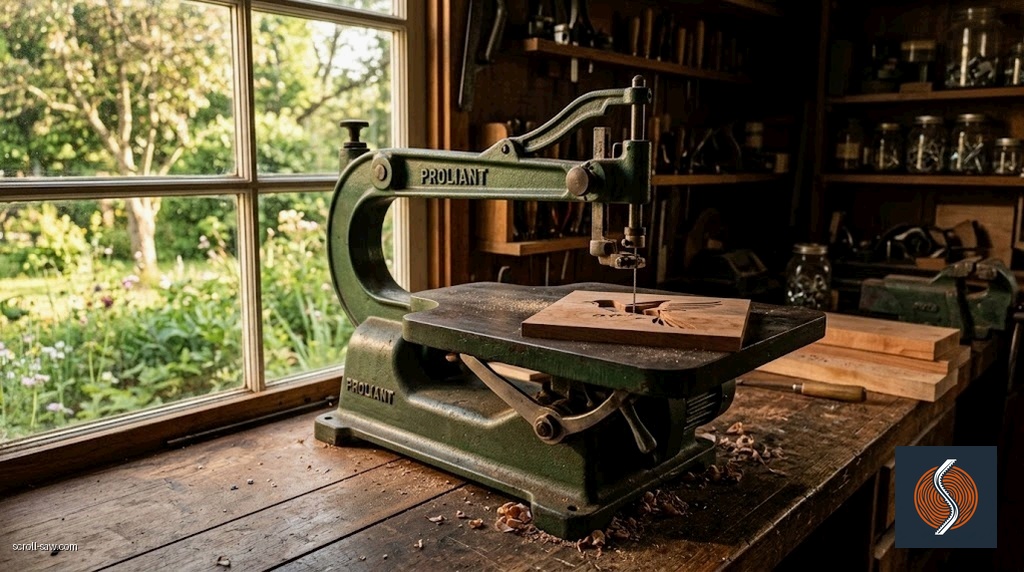
What Is a Proliant Scroll Saw? History, Specs, and How It Compares
The name Proliant scroll saw appears in tool discussions, estate sale listings, and vintage tool forums, but rarely in beginner guides or major reviews. It is one of those machines that hobbyists who have used one will mention specifically, while people who have not used one often have not heard of it. Understanding what it is requires a short history.
Direct answer
The Proliant scroll saw was a line of quality hobby scroll saws marketed in the North American market, known for solid construction and reliable variable-speed performance. The machines are no longer in active production, and they are found primarily on the used market at estate sales and vintage tool listings. Mechanically, they are well-regarded by users who have them; the primary challenge for buyers is parts availability.
Background on Proliant scroll saws
Proliant scroll saws appeared in North American tool catalogs during the 1990s and early 2000s. They were positioned as mid-to-upper-range hobby saws, above entry-level imports but below Hegner or Pegas. The machines were generally well-regarded for their construction quality, smooth operation, and the solid blade holder design that was competitive with other machines in the same tier.
The brand did not maintain the ongoing presence in the North American market that Dewalt, Delta, or Hegner did, and Proliant saws are not commonly found new. The machines that were sold are now circulating on the used market.
What Proliant scroll saws offer
Users who have and use Proliant saws describe consistent characteristics.
Solid construction. The machines were built with cast components rather than sheet metal. Noticeably heavier than budget imports; more comparable to mid-tier American-made saws.
Variable speed. Electronic variable speed with a reasonable range for hobby work.
Blade holders. The blade holder design is generally described as good by users who have used the machines for both ornament-scale and moderate fretwork.
Smooth stroke. The arm design produces a clean, relatively vibration-free stroke for the machine’s tier.
Stability. The weight and construction quality produce a stable cutting platform comparable to other mid-tier saws of the same era.
Limitations and challenges
Parts availability. The main challenge with a used Proliant is finding replacement parts. The brand is not actively distributed in North America and there is no clear authorized service network. Generic parts (belts, switches, cords) may fit; specific components (blade clamps, tension springs, arm pivot bushings) may require creative sourcing.
Service support. Without an active manufacturer or authorized service network, service and repair depend on finding someone familiar with the specific machine.
Documentation. Owner’s manuals and service manuals for Proliant saws are not widely available. The OWWM community and general scroll saw forums sometimes have information from users who have the machines.
Resale value. Without an established collector or restoration community, Proliant saws may not retain or grow in value the way vintage American-made Deltas or Hegners do.
Buying a used Proliant scroll saw
If a Proliant is available at a good price and passes the mechanical inspection, it may be worth purchasing for hobby use.
Inspection checklist:
-
Run the saw under load before committing to purchase
-
Verify blade clamps open, close, and grip firmly
-
Check tension mechanism: blade should ring when tensioned and plucked
-
Listen for smooth operation; grinding or roughness suggests bearing or drive wear
-
Verify variable speed responds smoothly across its range
-
Check table flatness and tilt mechanism function
What to pay: Without an active market, pricing is whatever the seller asks. Compare against a functional entry-to-mid-tier new saw and price the Proliant below that, accounting for the unknown remaining service life and parts challenges.
Alternatives to consider
For someone specifically seeking a used quality scroll saw, the alternatives with better-established support:
Dewalt DW788. Still in production; large user community; parts available. The most sensible choice for someone who wants a reliable mid-tier saw with support.
Used Hegner. Parts available through Hegner’s service network. Machines hold value and are well-supported.
Vintage Delta (American-made, pre-1990s). OWWM community support, some parts still available, excellent construction.
Used Pegas. Swiss-made, long parts availability commitment, excellent resale value.
All of these have better-established support than a used Proliant.
Verdict
The Proliant scroll saw is a solidly built mid-tier machine from an era when several brands competed in the same space. Users who have them describe good performance for hobby work. The challenge for a new buyer is the parts and service picture: without an active manufacturer or established support network, a Proliant is a gamble on the individual machine’s current condition.
If the price is appropriate and the machine passes a full mechanical inspection under load, a Proliant can provide years of hobby use. If parts or service become needed, the options are limited. Price it accordingly.
FAQ
Is a Proliant scroll saw a good machine? Users describe it as a solid mid-tier machine with good construction. Parts availability is the limiting factor for long-term ownership.
Are Proliant scroll saw parts available? Generic parts (belts, switches, cords) may be available. Specific proprietary parts are harder to source without an active manufacturer or service network.
Where can I find information on Proliant scroll saws? General scroll saw forums, OWWM.org, and vintage power tool communities. The brand is not well-documented in mainstream sources.
Is a Proliant scroll saw worth buying? For the right price, with a full mechanical inspection and acceptance of the parts risk, possibly. At any significant price premium over a supported alternative like the Dewalt DW788, no.
What are better-supported alternatives to a Proliant? Dewalt DW788, used Hegner, used Pegas, and American-made vintage Deltas all have better-established service and parts availability.
Can I use modern scroll saw blades in a Proliant? If the machine uses standard 5-inch pin-less blade holders, yes. Verify before purchasing blades.


