
Relief Carving vs Scroll Saw: How They Overlap and Where Each Belongs
Relief Carving vs Scroll Saw: How They Overlap and Where Each Belongs
Someone who makes detailed wooden pieces will eventually have both relief carving tools and a scroll saw in the same shop. They are naturally complementary crafts: one removes material by cutting through, the other removes material from the surface. Many of the most impressive wooden pieces use both. But for a specific project, one approach is usually more appropriate than the other.
This article covers the overlap, the differences, and the decision points that help a maker choose the right approach.
Direct answer
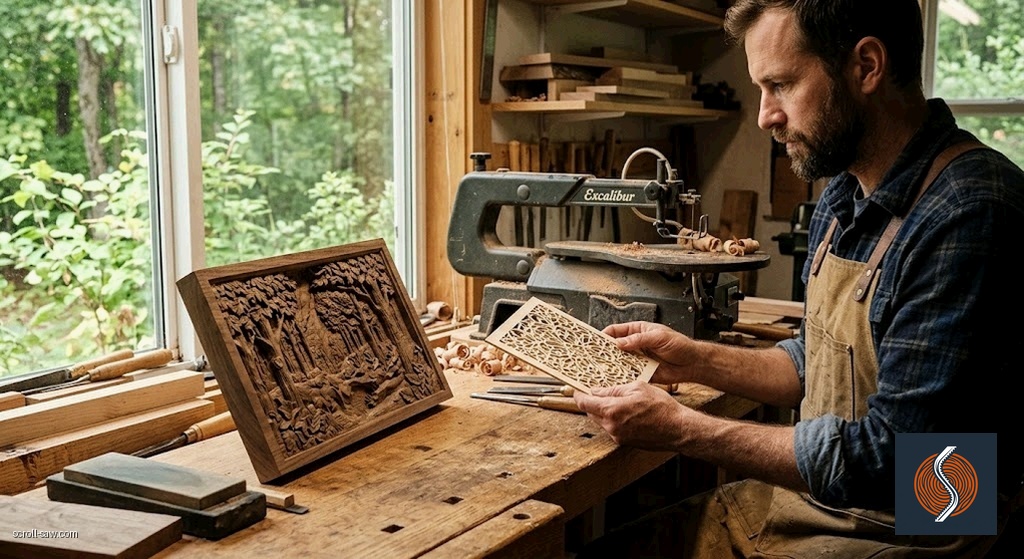
Relief carving creates three-dimensional surface detail by removing material from the face of a piece, producing a raised design on a flat background. Scroll sawing cuts through the material to produce silhouettes, fretwork, and interior shapes. A scroll saw produces flat (or through-cut) detail; relief carving produces depth. The two techniques are often combined: a scroll-cut silhouette or panel with carved surface detail creates both form and depth.
What relief carving does
Relief carving removes wood from a flat panel to create a design that stands above a recessed background. The result has depth and shadow.
Low relief (bas relief). The design stands only slightly above the background. Delicate detail, can represent perspective. Coins and traditional Asian decorative carvings are classic bas relief.
High relief. The design stands substantially above the background. More dramatic shadow. Some elements may be nearly fully rounded.
Applications. Decorative panels for cabinets and furniture, wall art, frames, traditional craft work (chip carving, Scandinavian folk carving), commemorative plaques, decorative boxes.
Tools. Carving knives, gouges, V-tools, veiners, chisels. Power carving with rotary tools or flexible shaft tools.
Learning curve. Longer than basic scroll saw work. Requires understanding of grain direction and tool control in three dimensions.
What scroll sawing does
Scroll sawing cuts through the material with a thin reciprocating blade to produce patterns, silhouettes, and interior shapes.
Fretwork. Interior openings in a flat panel creating decorative patterns.
Silhouettes. Exterior profiles cut from sheet stock.
Intarsia. Fitting pieces of different wood colors together to create a mosaic.
Three-dimensional assemblies. Multiple flat cut pieces assembled into three-dimensional objects.
Applications. Ornaments, portraits, name signs, decorative panels, toys, puzzles, furniture accents.
Tools. A scroll saw, blades, drill press for starter holes.
Learning curve. Basic cuts achievable quickly; fine work takes deliberate practice.
Where they overlap
Relief within a scroll-cut panel. A scroll-cut fretwork panel has relief carving in the individual elements: leaves with veining, feathers with barbs, wood grain texture. The scroll saw creates the form; the carving tools create the surface.
Carved perimeter pieces. A scroll-cut silhouette with carved surface detail. An eagle cut on the scroll saw, with feather texture carved into the body.
Intarsia finishing. Intarsia pieces are scroll-cut to shape, then sometimes carved or shaped slightly to give a smooth transition between pieces.
Traditional decorative panel work. Cabinet doors and furniture panels often combine the two: a scroll-cut outer frame with carved detail elements, or a relief-carved center panel with a scroll-cut border.
Three-dimensional objects. A carved bowl or cup can have scroll-cut decorative panels incorporated.
When to choose scroll sawing over relief carving
The design is primarily two-dimensional. A silhouette, a portrait, or a fretwork panel is fundamentally a two-dimensional piece. Scroll sawing produces it directly.
Speed and volume matter. Scroll sawing is faster for a given piece once the setup is correct. Stack cutting multiplies output. Relief carving is inherently one-piece-at-a-time.
The design has interior openings. Enclosed interior areas (windows, text openings, decorative holes) are a natural scroll saw application. Creating them by carving alone is extremely difficult.
Material is thin. Thin stock (under 1/2 inch) is impractical for significant relief carving. Scroll sawing works at any practical stock thickness.
When to choose relief carving over scroll sawing
The design requires depth. A bas-relief leaf panel or a carved face with real three-dimensional structure belongs to relief carving. A scroll saw cannot create depth; it creates only through-cut shapes.
Sculptural detail in a flat piece. Surface texture (fur, feathers, wood grain, skin texture) is a carving application.
The design has continuous curved surfaces. A carved wave or floral motif with smooth, curved transitions requires carving. Scroll sawing produces flat faces.
Working with thick stock. Relief carving is at home in 1-inch and thicker stock.
The combination approach
Many of the most impressive wooden pieces use both.
Workflow: Scroll saw for rough shaping and through-cuts. Carving for surface detail, depth, and texture. Finishing (sanding, staining, painting) as appropriate.
Example: carved wildlife panel. Scroll saw cuts the outer silhouette and any interior openings (a negative-space pine tree behind a moose, for example). Carving tools add feather or fur texture to the animal’s body, vein detail to leaves, and bark texture to tree trunks.
Example: decorative cabinet door. Scroll saw produces a fretwork center panel. Carving tools detail the individual elements of the fretwork (carving leaf profiles, adding veining, texturing backgrounds).
The scroll saw does the production work; the carving tools do the detail work. This is an efficient combination.
Verdict
Relief carving and scroll sawing complement each other. Scroll sawing creates form, silhouette, and interior cuts. Relief carving creates depth, surface texture, and three-dimensional detail. A maker who is comfortable with both has access to a much wider range of possible work than someone who uses only one tool.
For a specific project: if the result should be flat or through-cut, scroll sawing. If it needs depth and surface dimension, relief carving. If it needs both, use both.
FAQ
Can a scroll saw do any relief carving? Not in the traditional sense. A scroll saw creates through-cuts. Surface relief requires carving tools or a CNC router.
Can I use carving tools on a scroll-cut piece? Yes. Adding surface texture and depth to a scroll-cut silhouette with carving tools is a standard technique in carved scroll saw work.
Is relief carving harder than scroll sawing? Relief carving has a longer skill learning curve. Basic scroll saw cuts are achievable quickly. Fine carving requires understanding of grain direction and tool control developed over more time.
What wood is best for combined scroll saw and relief carving work? Basswood is the standard relief carving wood and also cuts well on a scroll saw. Butternut and American whittle well and scroll easily. Avoid very hard woods (oak, maple) for relief carving; they are very demanding on hand tools.
Can I do relief carving with power tools? Yes. Rotary tools (Dremel), flexible shaft tools, and power carvers all do relief carving work. They are faster and require less strength than hand tools but produce a slightly different result.
Should I scroll saw before or after carving? General practice: scroll saw the shape first (before detailed carving), then carve the surface detail. Trying to scroll saw a piece that already has carved surface detail can be awkward.
Where can I learn combined scroll saw and carving techniques? Fox Chapel Publishing has books specifically on combined techniques. Online communities in both scroll saw and woodcarving discuss the combination approach.


