
Scroll Saw Safety: The Rules That Prevent Real Injuries
Scroll Saw Safety: The Rules That Prevent Real Injuries
Scroll saws are among the safer power tools in a woodworking shop. The blade is small, moves relatively slowly, and the workpiece is controlled by two hands at some distance from the blade. Emergency rooms see far more injuries from table saws, routers, and hand chisels than from scroll saws.
That relative safety record comes with a catch: it depends on specific habits that are easy to develop and easy to neglect. The injuries that do happen on scroll saws are almost entirely preventable by the same three or four habits.
Direct answer
Scroll saw safety rests on five habits: always wear eye protection, keep both hands on the workpiece at all times with fingers curled back, wait for the blade to come to a complete stop before touching anything near it, install and use the hold-down and blade guard, and never use a scroll saw when fatigued or distracted.
Eye protection: non-negotiable
A scroll saw blade breaks occasionally. When it does, pieces fly at speed. A blade fragment in the eye causes permanent damage. Safety glasses with side shields prevent this.
Wear safety glasses every session, every time, before sitting down at the saw. No exceptions. ANSI Z87.1-rated safety glasses are what belongs on your face at the scroll saw.
Hand position: both hands, fingers back
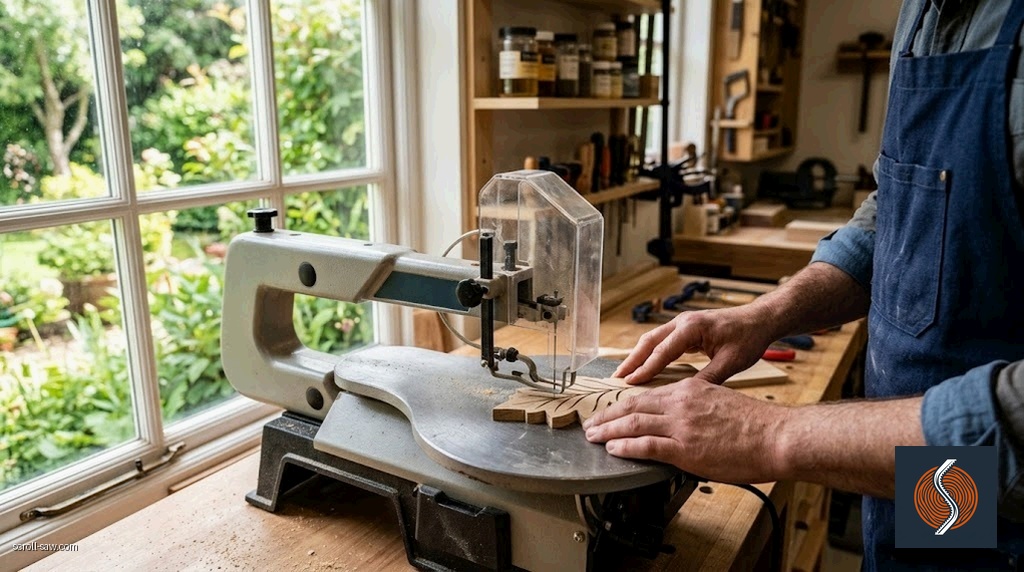
Both hands on the workpiece at all times during cutting. Not one hand. Two hands on the wood.
Fingers curled back. The pads of the fingers and the heel of the palm guide the workpiece; the fingertips stay curled back and away from the blade.
Hold-down in position. It physically limits how close the workpiece can lift toward the blade on the upstroke.
Wait for full stop
After cutting power, wait until the blade is completely motionless before touching anything near the blade. The blade does not stop immediately. Listen and watch. Full stop before reaching.
Guards: use them
Both the blade guard and the hold-down should be adjusted correctly before every session. Hold-down set to just clear the workpiece. Blade guard positioned to cover the blade above the workpiece.
Clothing and setup rules
No loose sleeves, loose cuffs, or dangling jewelry. Tie back long hair. Secure the saw to the bench or confirm stable placement. Adequate lighting. Clean work area.
Fatigue and distraction
More scroll saw incidents happen in the last ten minutes of a long session than in the first ten. Stop before you are tired. If someone speaks to you during active cutting, stop the cut and respond. No cutting under any impairment that slows reaction time.
Children in the shop
Children should not use scroll saws without close adult supervision. Appropriate age depends on the child’s maturity and ability to follow consistent instructions consistently. Close supervision means adult within arm’s reach.
Verdict
Scroll saw safety is not about fear. It is about habits that are easy to build and that prevent the small number of incidents that do occur.
Eye protection, two hands on the workpiece with fingers back, waiting for full stop, using the guards, and stopping before fatigue sets in. Five habits. None of them are onerous.
FAQ
How dangerous is a scroll saw? Among the safer power tools in the shop. Injuries occur but less frequently than with table saws, routers, or band saws.
Do I need safety glasses for a quick cut? Yes. A blade can break on any cut, including short ones.
Can children use a scroll saw? With close adult supervision and proper safety instruction, older children can learn scroll saw basics.
What should I do if the blade breaks mid-cut? Stop. Wait for all motion to stop. Step back. Assess whether any fragments left the saw.
Should I wear a dust mask when scroll sawing? For regular extended sessions, add a dust mask rated N95 or better. Fine wood dust is a long-term respiratory hazard.
Is a scroll saw safer than a jigsaw? Generally, yes. The scroll saw is stationary with two-handed workpiece control.
What is the most important scroll saw safety habit? Eye protection first. Then both hands on the workpiece with fingers back. Then waiting for full stop before reaching near the blade.


