
Scroll Saw Signs: Layout, Blade Choice, and Cutting Sequence
Scroll Saw Signs: Layout, Blade Choice, and Cutting Sequence
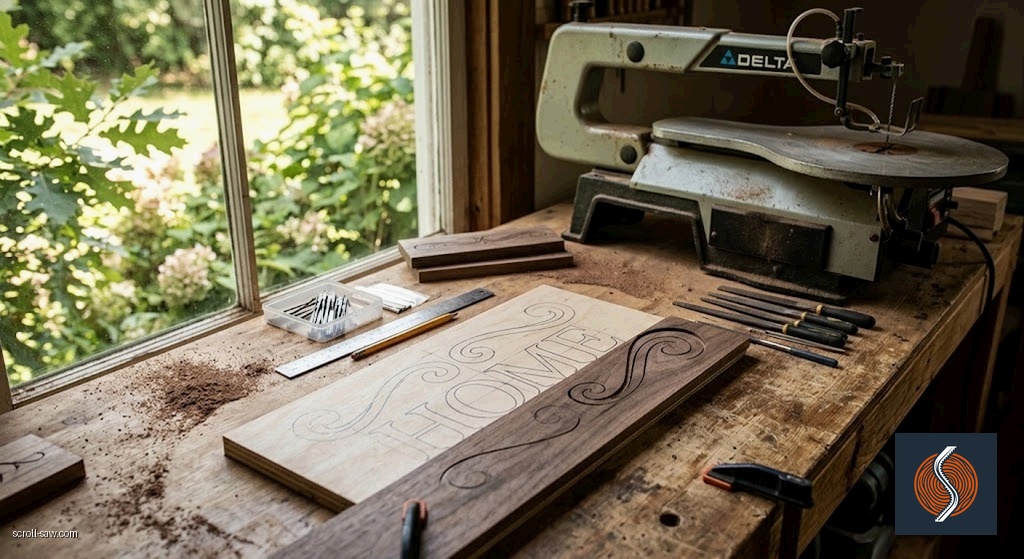
Scroll saw signs cover the broad middle of the sign category: wall-hung decorative signs for the home, kitchen quote signs, family entryway welcome signs, and inspirational quote signs. Where sign patterns cover the full range from small to large and indoor to outdoor, this specific category focuses on the wall-hung indoor sign that most scroll saw hobbyists cut most often.
The geometry that separates a wall-hung sign that reads clean from one that reads amateurish: font choice for the intended distance, consistent border margins around the pierced text, and mounting hardware that keeps the sign flat against the wall.
What wall-hung indoor signs typically look like
Most wall-hung indoor signs fall into a few types. Simple pierced-text panel (rectangular panel with pierced text, no decorative border). Bordered pierced-text panel (rectangular panel with pierced text and a decorative pierced or shaped border). Shaped panel with pierced text (heart, oval, rounded rectangle, or theme-shaped panel with pierced text). Layered sign (multiple thin panels stacked with pierced text on the top layer).
Quick answer: cut from 1/2 to 3/4 inch cherry, walnut, or basswood. Use a #5 skip-tooth for outer perimeter and #3 reverse for pierced text detail. Choose a font with strokes at least 1/4 inch thick for medium viewing distance. Cut interior text before outer perimeter. Cut decorative border (if present) after text and before outer perimeter. Finish with wipe-on oil.
Layout planning
Before cutting:
-
Panel dimensions: match to the intended wall space and text length. Typical wall-hung signs range from 6 by 12 inches (small quote sign) to 18 by 24 inches (family entryway sign).
-
Text placement: centered horizontally on the panel, positioned to leave equal top and bottom margins.
-
Margin width: at least 1 inch of wood between text and panel edges. Wider margins read as formal.
-
Border pattern (if used): 1/2 to 1 inch wide, centered around the text area.
-
Grain direction: horizontal for a horizontally-oriented sign, vertical for a tall sign.
Wood choice
Half to 3/4 inch quartersawn cherry for warm oiled signs.
Half to 3/4 inch walnut for formal or dark-tone signs.
Half to 3/4 inch basswood for painted signs in specific colors.
Half to 3/4 inch maple for pale signs that take stain or paint.
Blade choice
A #5 skip-tooth blade for outer sign perimeter cuts on 1/2 to 3/4 inch stock.
A #3 reverse-tooth blade for pierced text detail and closed counters.
A #1 blade for the finest detail on ornate script text.
Cutting sequence
-
Sand both faces of the panel to 220 grit before cutting.
-
Apply the pattern with painter’s tape and spray adhesive.
-
Drill entry holes for every closed counter and pierced text detail with a 1/32 inch bit.
-
Cut interior text detail smallest to largest. Start with small closed counters (letter interiors), then larger pierced areas.
-
Cut decorative border pierced detail (if present) after text.
-
Cut the outer sign perimeter last in one continuous cutting path.
-
Save fragile detail (fine serif tips, decorative flourishes) for the last cutting strokes.
Font selection
Bold sans-serif fonts (Impact, Arial Black, Bebas): reliable choice for family surname signs, welcome signs, and quote signs.
Slab serif fonts (Rockwell, Roboto Slab): formal choice for family signs and inspirational quote signs.
Script fonts: informal choice for kitchen decor signs, nursery signs, and casual quote signs. Verify script connecting strokes are at least 3/16 inch thick.
Classic serif fonts (Times, Garamond): formal choice. Thicken fine serifs to 3/16 inch minimum.
Where wall-hung signs fail
Text reads muddled at wall distance. Font choice too fine or strokes too thin. Verify stroke thickness at least 1/4 inch for medium viewing distance.
Border margin inconsistent. Layout not measured. Draw layout on paper at final size, measure margins on all four sides.
Fine serif tips shear off. Serifs drawn too thin. Thicken or choose slab serif or sans-serif font.
Sign warps over time. Panel not sealed on both faces. Seal both faces with wipe-on oil.
Sign doesn’t hang flat against wall. Mounting hardware not centered on panel weight. Use two hangers spaced apart for larger signs.
Pierced text reads as solid. Missed entry holes. Verify every closed counter has an entry hole before starting to cut.
Finishing
Wipe-on boiled linseed oil for cherry, walnut, and maple. Two coats over two days.
Oil-varnish blend for slightly more protection.
Painted signs: shellac sanding sealer, acrylic craft paint in specific color, matte water-based polyurethane top coat.
Stained signs: dye stain or gel stain in specific color, sealed with matte water-based polyurethane.
Seal both faces of the sign to prevent warp over time.
Mounting hardware
Small wall-hung signs (under 12 inches wide): sawtooth hanger centered on the back near the top edge.
Medium wall-hung signs (12 to 24 inches wide): picture-frame hanger with wire spanning between two hangers on the back.
Larger wall-hung signs (over 24 inches wide): heavy-duty picture-frame hangers with two mounting points, or French cleat mounting.
Keyhole slot: cut a keyhole slot into the back of the sign before finishing for a cleaner mounting than surface-mounted hangers.
French cleat: cut a beveled cleat from 3/4 inch stock, mount half to the sign’s back and half to the wall.
Comparing three wall-hung sign projects
Simple kitchen quote sign (6 by 12 inches) with pierced text in bold sans-serif, 1/2 inch cherry, oiled, sawtooth hanger mounted. The reliable first wall-hung sign. Cuts and finishes in a weekend.
Family entryway welcome sign (12 by 18 inches) with pierced surname and pierced decorative border in slab serif, 3/4 inch walnut, oiled, picture-frame hanger with wire. The mid-range piece.
Heirloom family sign (18 by 24 inches) with pierced full family name, pierced established date, and pierced decorative floral border in ornate script, 3/4 inch cherry with gold-leafed accents, oiled with gold leaf, French cleat mounting. The signature piece.
Conclusion
A wall-hung scroll saw sign reads clean when the font choice matches the intended viewing distance, the border margins are consistent on all four sides, and the mounting hardware keeps the sign flat against the wall. Half to 3/4 inch cherry, walnut, or basswood. A #5 skip-tooth outline with #3 reverse for pierced text and border detail. Wipe-on oil finish, or sealed acrylic paint for specific colors. Sawtooth hanger, picture-frame hanger with wire, keyhole slot, or French cleat mounting matched to sign weight.
Frequently asked questions
What wood works best for a scroll saw wall-hung sign? Half to 3/4 inch quartersawn cherry for warm oiled signs, walnut for formal, basswood for painted, maple for pale stained.
Which blade cuts pierced text cleanest? A fresh #3 reverse-tooth blade for pierced text detail and closed counters. Drop to a #1 for hair-thin script strokes.
How thin can I safely draw a text stroke? Minimum 1/4 inch for medium viewing distance (3 to 10 feet wall-hung display). Thinner strokes read muddled.
What font is easiest for a wall-hung sign? Bold sans-serif for maximum readability. Slab serif for formal signs. Script fonts for informal kitchen or nursery signs at close viewing distance.
How wide should the border margin be? At least 1 inch of wood between text and panel edges. Wider margins read as formal.
How do I mount a wall-hung sign? Sawtooth hanger for small signs, picture-frame hanger with wire for medium, heavy-duty hangers or French cleat for larger signs.
Paint or oil? Wipe-on oil for cherry, walnut, and maple. Sealed acrylic paint for basswood in specific colors.
References
-
Steve Good, Scrollsaw Workshop sign pattern archive: scrollsawworkshop.blogspot.com
-
Sue Mey, Scroll Saw Artist: scrollsawartist.com
-
Scroll Saw Woodworking & Crafts, Fox Chapel Publishing: foxchapelpublishing.com


