
Scroll Saw Clock Patterns: Designing Around a Movement That Actually Runs
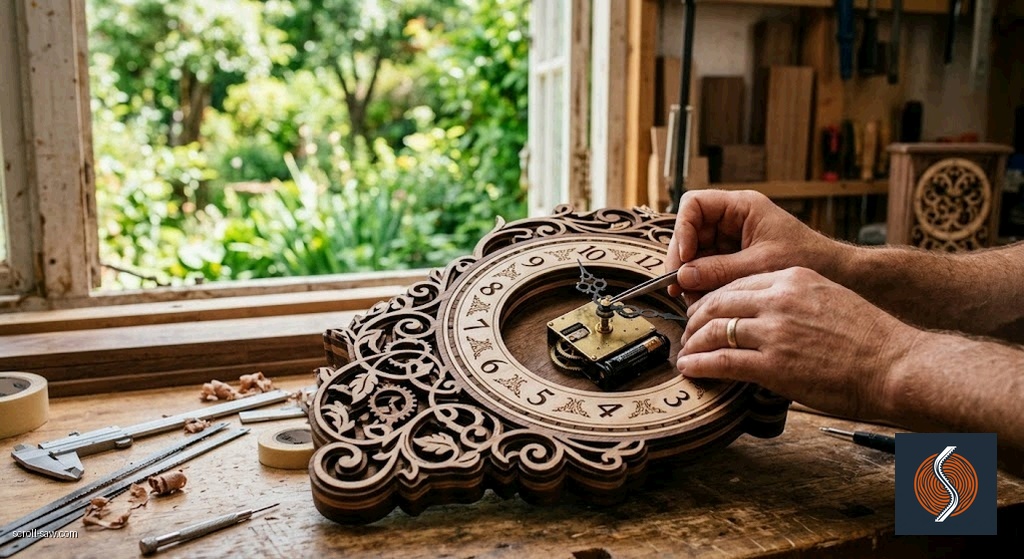
Scroll Saw Clock Patterns: Designing Around a Movement That Actually Runs
A clock from a scroll saw is one of those pieces that earns its place in a room by functioning. An ornament hangs on the wall and looks nice. A clock hangs on the wall and tells the time, every day, for years. The scroll work on the face or the frame is what makes people stop and look; the clock movement is what makes them keep it.
Designing a scroll saw clock means designing for both: the decorative shell around the movement, and the movement itself. Get both right and the piece is functional art. Get only one right and it is either a nonfunctioning decoration or a functioning object that looks like a craft project.
Direct answer
Scroll saw clock patterns are designed around a purchased clock movement: a battery-powered quartz movement with specific shaft length and mounting requirements. The scroll-cut clock face or clock frame accommodates the movement’s shaft in a centered hole, the hands extend outward from the shaft, and the decorative scroll work creates the visual surround. Most scroll saw clock patterns use a 3/4-inch to 1.5-inch thick face with a quartz movement mounted behind it.
Clock movement fundamentals
Before cutting any clock pattern, the movement must be selected and its specifications understood.
Shaft length. The clock movement has a threaded shaft that passes through the clock face. The shaft length must match (or be longer than) the face thickness where the shaft will be mounted. A shaft too short for the face thickness does not reach through; the hands cannot be mounted. Buy a movement after measuring the planned face thickness, or plan the face thickness around the movement’s available shaft length.
Standard shaft lengths. Most quartz clock movements are available in short shaft (for thin faces under 1/4 inch), medium shaft (for 1/2-inch to 3/4-inch faces), and long shaft (for 3/4-inch to 1.5-inch faces). Confirm the shaft length matches the face.
Mounting hole diameter. The shaft passes through a hole in the face, typically 5/16-inch diameter for most standard quartz movements. This hole is drilled precisely at the center of the clock face.
Clearance for the movement body. The movement body itself sits behind the face. The area immediately behind the mounting hole must be flat and unobstructed to allow the movement to seat correctly.
Battery access. The movement needs battery access. For a wall-mounted clock, the movement faces backward and the battery slides in from the back. The clock design must allow the back to be accessed for battery changes without removing the clock from the wall.
Pattern categories
Simple round or geometric clock face with scroll-cut numerals or hour markers. The face is a round, square, or hexagonal piece. The numerals (Roman or Arabic) are scroll-cut into the face, or hour markers are inset separately. Clean, legible, suitable for any room. The most functional category.
Wildlife or nature surround. The clock movement is centered in a decorative scene: a moose standing in a forest opening, a bear with a river background, an eagle with spread wings. The clock face is the opening where the movement is mounted; the scroll work creates the scene around it. Popular in lodge and cabin decor.
Architectural or geometric frame. A decorative frame in a specific architectural style surrounds the clock movement. Mission style, Art Nouveau, Celtic geometric. The clock is centered within the frame.
Fretwork clock face. Intricate fretwork patterns surrounding the clock face opening. The scroll work is the dominant visual element; the time display is nested within it.
Mantel clock. A freestanding clock on a base, designed to sit on a shelf or mantel. The case is built from multiple scroll-cut and joinery pieces; the movement is mounted in the front face. More complex; requires case construction skills.
Anniversary or wedding clock. A clock with personalized elements (names, date, rings) incorporated into the design. Highly giftable.
Cutting a scroll saw clock face
Mark and drill the center hole first. The center hole for the clock movement shaft must be precisely centered. Mark the geometric center of the face, then drill on a drill press (not freehand) with the correct diameter bit. This hole is the reference point for the entire design.
Numeral placement. If the pattern includes scroll-cut numerals or hour markers, their placement must be geometrically precise relative to the center hole. Use a compass and protractor to mark 12, 3, 6, and 9 o’clock positions before cutting.
Interior numeral cuts. Roman numerals with enclosed areas (IV, VI, IX) require starter holes for each enclosed area.
Cut sequence. Numerals and interior detail first; outer clock frame perimeter last.
Test fit the movement. Before finishing, test-fit the clock movement. The shaft passes through the center hole; the movement body seats flat against the back of the face. Verify clearance before applying finish.
Material choices
Solid walnut (3/4 inch). The premium choice for natural-finish clocks. Dark, serious, matches fine furniture.
Cherry (3/4 inch). Warm finish, appropriate for traditional and modern settings.
Baltic birch plywood (3/4 inch). For painted or stained clock faces. Consistent and flat. Less elegant than solid hardwood for natural finish.
Figured maple. For lighter pieces where the wood figure itself is a visual element.
Finishing and assembly
Apply finish before installing the movement. Sand to 220 grit, apply oil finish or lacquer, let cure fully. Then mount the movement.
Movement installation. Thread the shaft through the center hole from the back. Place the mounting nut on the front side. Tighten until the movement seats firmly against the back of the face (do not overtighten; crack risk in thin wood).
Hand installation. Hands typically press onto the shaft in order: hour hand first, then minute hand, then second hand (if included). Set to the correct time before pressing hands fully.
Hanger. A sawtooth hanger or keyhole plate recessed into the back, or a routed keyhole, for wall mounting. The hanger placement must be exactly above the center of the clock face so it hangs level.
Verdict
Scroll saw clocks are among the most practical and giftable scroll saw products. A well-made clock face with appropriate scroll work, hung in the right room, is used daily and noticed by visitors consistently.
The non-negotiable element is accurate center hole placement and matching the movement shaft length to face thickness. Get those right and the clock works; get the decorative work right and it is also beautiful.
FAQ
Where do I buy a clock movement for a scroll saw clock? Woodcraft, Rockler, Amazon, and craft supply retailers all carry battery-powered quartz clock movements in multiple shaft lengths.
What shaft length movement do I need for a 3/4-inch thick clock face? A medium-shaft or long-shaft movement (typically 11/16-inch to 3/4-inch shaft for faces up to 3/4 inch). Measure the face thickness and match to the movement’s stated shaft range.
How do I get the clock hands to point correctly? Install the hour hand to the correct hour position before pressing it on. The minute hand goes on next at 12. The second hand at 12. Set the clock to the correct time immediately.
What is the correct hole size for a clock movement shaft? Most standard quartz movements use a 5/16-inch diameter mounting hole. Verify the specific movement’s specification.
Can I scroll saw a clock face from thick stock? Yes. 3/4-inch to 1.5-inch stock is standard for clock faces. Use the appropriate blade size (#7 to #9) and a long-shaft movement.
How do I hang a scroll saw clock level on the wall? Mount a sawtooth hanger or keyhole plate precisely above the center of the clock face. A hanger even slightly off-center causes the clock to hang tilted.
What is the easiest scroll saw clock pattern? A simple round face with hour-mark dots and no numeral cuts. Center hole, twelve evenly spaced dots, outer circle profile. An afternoon project.


