
Scroll Saw Music Patterns: Instruments, Notation, and Music-Themed Decor
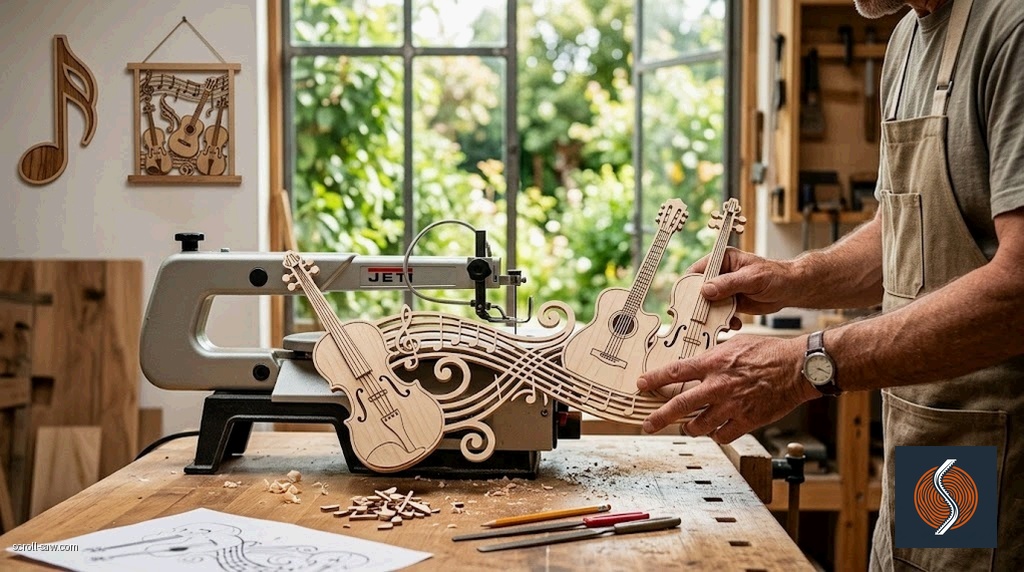
Scroll Saw Music Patterns: Instruments, Notation, and Music-Themed Decor
A music teacher’s classroom wall. A teenager’s bedroom where she practices violin every evening. A jazz musician’s home office. These are rooms where a music-themed scroll saw piece belongs, and where the person who receives it will recognize immediately that whoever made it understood what they were looking at.
Music patterns in scroll saw work cover a specific catalog: instrument silhouettes, musical notation symbols, staff lines, personalized name signs with music elements, and more elaborate fretwork compositions. This article covers the design categories that work, the structural challenges specific to music forms, and the finishes that suit the subject.
Direct answer
Music scroll saw patterns fall into three main categories: instrument silhouettes (guitar, violin, piano, saxophone), notation symbols (treble clef, bass clef, eighth notes, whole notes), and personalized music-themed name signs. Instrument silhouettes and notation symbols work as single-piece exterior profile cuts or as fretwork with interior detail. The treble clef and eighth notes are among the most popular music symbols in scroll saw craft.
Pattern categories
Guitar silhouette. The acoustic guitar body shape is one of the most recognizable instrument silhouettes. The waist, bouts, and headstock read clearly even at small scale. The sound hole can be a cut-through interior circle. Guitar pieces sell at music shops, craft fairs near music venues, and online to a large guitar player audience.
Violin and fiddle. The violin has distinctive f-holes (the narrow S-shaped sound openings on the top) that are excellent scroll saw interior details. The scroll at the top of the neck is a more challenging element to cut accurately. Violin and fiddle pieces sell to a specific but loyal audience.
Piano keys. A keyboard section as a wall piece: the top profile of a piano keyboard, with the black key positions defined by cut-through shapes. Immediately recognizable. Works as a long horizontal wall piece or as a name sign base element.
Saxophone. The saxophone silhouette has a distinctive curved body with a flared bell. Keys and key guards add interior detail opportunities. More complex to cut than a guitar; visually compelling.
Treble clef. One of the most-cut music symbols. The treble clef has a complex, flowing line with several enclosed areas (the loops at the bottom and in the body of the clef). Structurally demands careful bridge planning. Usually cut as a single piece with bridges at the enclosed areas.
Eighth note and quarter note. Simple silhouette cuts. Often used as pairs or groups (eighth note beams). Very fast to cut; work well as ornaments and small decor pieces.
Staff with notes. Five horizontal staff lines with notes placed on them. The staff lines must maintain structural connection throughout (they run through the full width of the piece). A backing panel is typically required.
Music-themed name sign. A child’s or student’s name with treble clef, eighth notes, or an instrument silhouette surrounding the text. Highly giftable.
Structural challenges in music patterns
Treble clef enclosed areas. The treble clef has two distinct enclosed areas: the oval loop at the bottom and the loop in the mid-body of the clef. Both need bridge treatment. The bridges should be placed at visually unobtrusive points where the clef’s curves naturally suggest a narrow connection.
Staff lines. Five horizontal lines running through the full width of a piece must connect to each other or to an outer frame at both ends. A piece that is only five horizontal lines with no outer border would fall apart. Design the staff with an outer frame (border rectangle or musical scene) that provides structural support.
Violin f-holes. The f-holes are narrow, long, and have curves at both ends. They are the scroll saw detail that makes a violin recognizable. Cut with a #3 or #5 blade; enter each f-hole through a carefully placed starter hole.
Saxophone bell and body curves. The saxophone body has long gentle curves; the flared bell has tight-radius entry at the flare. Approach the bell flare curve slowly to avoid overrunning the radius.
Guitar sound hole. A clean circle in the center of the guitar body. Use a circle-cutting jig for consistent results; a freehand circle at this size is challenging to keep round.
Material choices
1/4-inch Baltic birch (most music pieces): Standard. Takes paint well; cuts cleanly.
Walnut (for natural-finish instrument silhouettes): A guitar or violin in dark walnut with a clear oil finish looks like serious wall art, not craft decor.
Cherry or alder (for lighter natural-finish pieces): Warm tones that complement the instrument theme.
1/2-inch to 3/4-inch thick solid wood (for freestanding pieces): A guitar or violin shape as a freestanding studio accessory.
Finish approaches
Natural wood, oil finish. For instrument silhouettes in solid hardwood. The wood’s tone suggests the instrument’s body; clear finish enhances it.
Painted in instrument colors. A guitar painted sunburst (amber-to-black gradient radiating from center), or a violin in amber varnish color. Requires masking and layered painting; impressive when well-executed.
Black painted with silver detail. A contemporary finish for notation symbols: treble clef painted flat black, silver-highlighted curves. Clean, gallery-style.
Stained and clear-coated. A medium walnut stain on birch plywood brings the warmth of wood tones without the cost of solid hardwood.
Market context
Music-themed scroll saw pieces have an audience that is passionate and consistent. Musicians identify strongly with their instrument; a gift that references that identity is well-received.
School and teacher gifts. Music teacher appreciation gifts: a treble clef name sign, a piano keys wall piece with the teacher’s name. High demand at certain times of year.
Musician’s studio decor. Guitar shops, rehearsal spaces, home studios. Wall pieces in natural hardwood fit the aesthetic.
Gift for a student. Beginning students receive instruments as gifts; a matching wall piece is a complementary gift item.
Verdict
Music scroll saw patterns serve a specific and loyal audience. The guitar and treble clef are the highest-recognition pieces; violin f-holes and saxophone curves reward the scroller who executes them well. All music pieces benefit from a design and finish that takes the subject seriously rather than treating it as generic decor.
A guitar in walnut with a clear oil finish is not a craft fair ornament; it is a studio decoration. Frame the work that way and price it accordingly.
FAQ
What scroll saw blade for a guitar silhouette? #5 reverse-tooth for 1/4-inch stock. The gentle curves of the guitar body do not require a fine blade.
How do I cut the f-holes in a scroll saw violin? Drill a starter hole in each f-hole. Thread a #3 blade through. Cut the narrow curves slowly, rotating the workpiece continuously through the s-curves.
What are the enclosed areas in a treble clef that need bridges? The oval loop at the bottom of the clef and the loop in the mid-body of the symbol. Plan bridges at each.
What is the best wood for a guitar scroll saw wall piece? Walnut for a natural-finish piece. Baltic birch if painting in sunburst or other guitar finish effects.
Can I cut a full piano keyboard on a scroll saw? Yes. A keyboard section (an octave or two) as a horizontal wall piece works well. The black key positions are cut-through interior slots.
Are music scroll saw pieces good sellers? Yes, especially personalized versions (a music teacher’s name sign, an instrument silhouette with a specific person’s name) and pieces targeted at musician gift markets.
Where can I find music scroll saw patterns? Steve Good’s Scrollsaw Workshop, Fox Chapel Publishing specialty books, and Etsy sellers specializing in music-themed patterns.


