
Scroll Saw Nativity Scene: Building a Set That Lasts Decades
Scroll Saw Nativity Scene: Building a Set That Lasts Decades
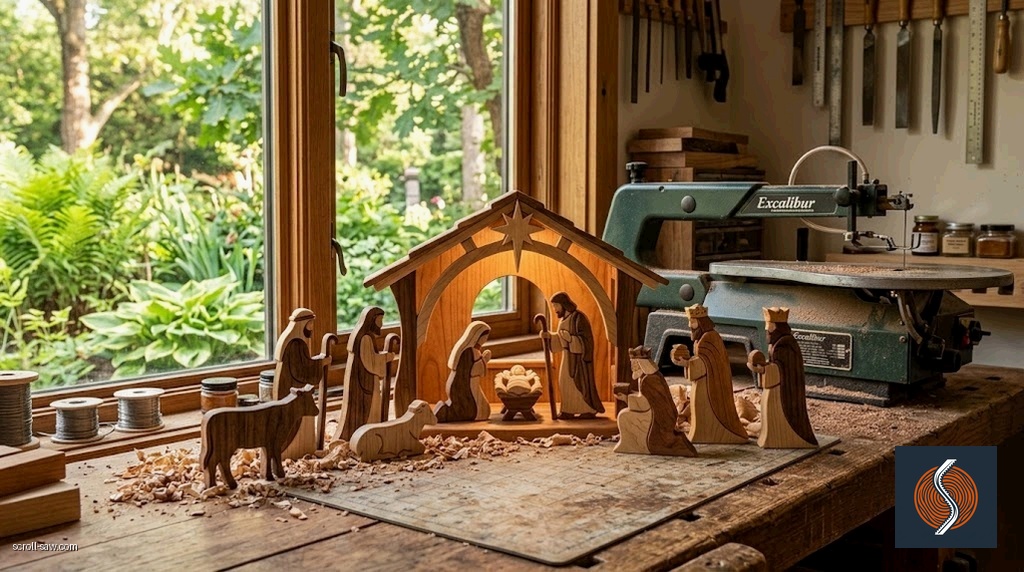
There is a specific category of holiday decoration that comes out of a box every December and matters. Not the inflatable yard deer or the string of lights from the hardware store, but the nativity set that was on your grandmother’s mantel, or the one someone made by hand the year before your first Christmas. A scroll saw nativity scene, built well and finished with care, goes in that category. It comes out every year. It gets set up by children who know which figure goes where. It moves from house to house through generations.
Building one that earns that permanence requires specific choices. This article covers them.
Direct answer
A scroll saw nativity scene is typically a set of individual freestanding figure pieces (Mary, Joseph, infant in manger, shepherds, wise men, angels, animals) cut from 1/2-inch to 3/4-inch stock and finished as a coordinated set. Each figure is cut as a profile silhouette or a more detailed fretwork piece, stands in a routed or cut slot base, and is finished in natural wood or painted in traditional colors. The stable structure is usually a separate architectural piece that frames the scene.
Figure set composition
A complete traditional nativity scene includes:
Holy Family: Mary, Joseph, infant in manger (or in Mary’s arms). The central group. Usually the most detailed and prominent figures.
Angels: One or two angels, often with spread wings. One typically larger, positioned above the stable structure.
Shepherds: Two or three shepherd figures with staffs. Can include a sheep or lamb.
Wise Men (Magi): Three figures, traditionally differentiated by posture (one kneeling, two standing) and the gifts they carry.
Animals: Donkey, ox, and optionally a camel for the Magi arrival.
Stable structure: The architectural frame for the scene. Usually a stable with a roof peak and side walls, sometimes with star detail.
Star: A large star above the stable, sometimes cut separately and mounted on a vertical support.
A simplified set (Mary, Joseph, infant, one angel, one shepherd, one wise man) is appropriate for a first nativity project or a scaled-down gift version.
Design approaches
Simple silhouette figures. Each figure cut as a flat profile silhouette, no interior cuts. Robes defined by the outer profile. Fast to cut; the composition of the full set creates the narrative. Appropriate for a beginner project or for natural-finish hardwood pieces where the wood speaks without elaborate detail.
Detailed profile with robing cuts. Interior cuts suggest the folds and layers of robes, the texture of a shepherd’s cloak, the wing feathers on an angel. More detailed; requires #3 to #5 blade work for the interior robe lines.
Fretwork faces and details. The most detailed category: facial features, robe patterns, and star details executed in fretwork. More demanding; produces impressive results at larger scales (figures 8 inches and taller).
Backlit panel scene. Instead of freestanding figures, a single fretwork panel depicting the full nativity scene, backlit for display. All figures within one composition; shadow-lit effect is striking.
Scale and proportion
Figure height should be consistent within a set. Common approaches:
Large set (figures 6-10 inches tall). Mantel or tabletop centerpiece. Has presence at a distance. More material; more cutting time.
Medium set (figures 4-6 inches tall). The most common gift scale. Fits on a table or shelf without dominating the room.
Small ornament set (figures 2-3 inches tall). Packaged together in a box. Gift scale for a tree mantelpiece or windowsill. Requires simpler figure profiles at this scale.
Within a set, the Holy Family should be the tallest figures. Angels are tall because of the wings. Shepherds and Wise Men slightly shorter. Infant and animals notably smaller.
Material choices
Walnut (3/4-inch solid) for a heirloom natural-finish set. Dark, serious, appropriate for a piece that will be displayed every Christmas for decades. Oil finish.
Poplar or basswood (1/2-inch) for a painted set. Both cut cleanly and take craft acrylic paint very well. Appropriate for the traditional painted nativity look.
Baltic birch plywood (1/2-inch) for a painted or stained set. Consistent and flat. Less formal than solid hardwood.
Cedar for an outdoor or rustic set. Naturally rot-resistant; weathers beautifully to a silver-gray without finish if used outdoors.
Base design
Each figure stands in a base. Options.
Routed slot in a separate base block. Each figure has a tenon or tab at the bottom that inserts into a matching slot routed or cut in a separate base block. Clean and sturdy. The base block can be shaped (landscape base, sand surface, rock base).
Scroll-cut slot base. A base cut from the same stock as the figure, with a wide foot that keeps the figure stable. No separate base needed. Simpler production.
Shared landscape base. All figures share one wide base that represents the stable floor. Positions are fixed; the whole scene assembles as one unit.
Finishing the nativity set
Natural hardwood with oil finish. Sand to 220 grit. Two to three coats of Danish oil. The wood tone and grain are the finish. No painting. The restraint is appropriate for a heirloom piece in walnut or cherry.
Traditional painted finish. Mary: blue robe. Joseph: earth tones. Angels: white or gold. Wise Men: rich colors (burgundy, purple, gold). Shepherd: earth tones with natural staff. Skin tones for faces. Use reference images for accuracy. Clear coat to protect.
Natural wood with painted face and hand detail only. The robes and body in natural wood; faces and hands painted in skin tone; gold on the star and angel halos. A compromise between natural and fully painted.
Storage
A nativity set used annually for decades needs thoughtful storage.
Individual compartments. A divided box or tray with individual spaces prevents figures from knocking against each other and breaking fine details.
Velvet or felt lining. Each figure wrapped in a small piece of felt or stored in a velvet bag.
Labeled. A discreet label on the bottom of each piece (with year made and maker’s name if appropriate) becomes part of the story.
Verdict
A scroll saw nativity scene is one of the most meaningful things a scroll saw hobbyist can build. Simple figure profiles in walnut with an oil finish, a stable structure cut from the same material, figures standing in neat routed-slot bases: this is a set someone keeps for life.
Do not rush the first one. Build it as if it will come out of a box every December for sixty years. Because, if it is built well enough, it will.
FAQ
How many pieces are in a complete scroll saw nativity set? A traditional complete set has 15-20 pieces: Holy Family (3-4), angels (2), shepherds (2-3), Wise Men (3), animals (4-5), stable structure, star. A simplified gift set can be as few as 7-8 pieces.
What is the best wood for a scroll saw nativity scene? Walnut for a natural-finish heirloom set. Basswood or poplar for a traditionally painted set.
How tall should nativity figures be? A medium gift set: 4-6 inches for the primary figures. A mantel centerpiece: 6-10 inches.
What finish is appropriate for a heirloom nativity set? Natural hardwood with Danish oil for an undecorated piece. Traditional craft acrylic colors for a painted set.
How do I make nativity figures stand up? A routed or cut slot base is the most secure option. The figure has a tenon at the bottom; the base has a matching slot.
Where can I find scroll saw nativity patterns? Fox Chapel Publishing has dedicated nativity scroll saw books. Steve Good’s Scrollsaw Workshop has published nativity patterns. Pattern retailers on Etsy also carry nativity sets.
Can a beginner cut a scroll saw nativity set? A simple silhouette set with no interior cuts, in 1/2-inch basswood: yes. More detailed figure sets with interior robe and face cuts: intermediate skill required.


