
Scroll Saw Spider Web Patterns: Halloween Decor That Does Not Look Generic
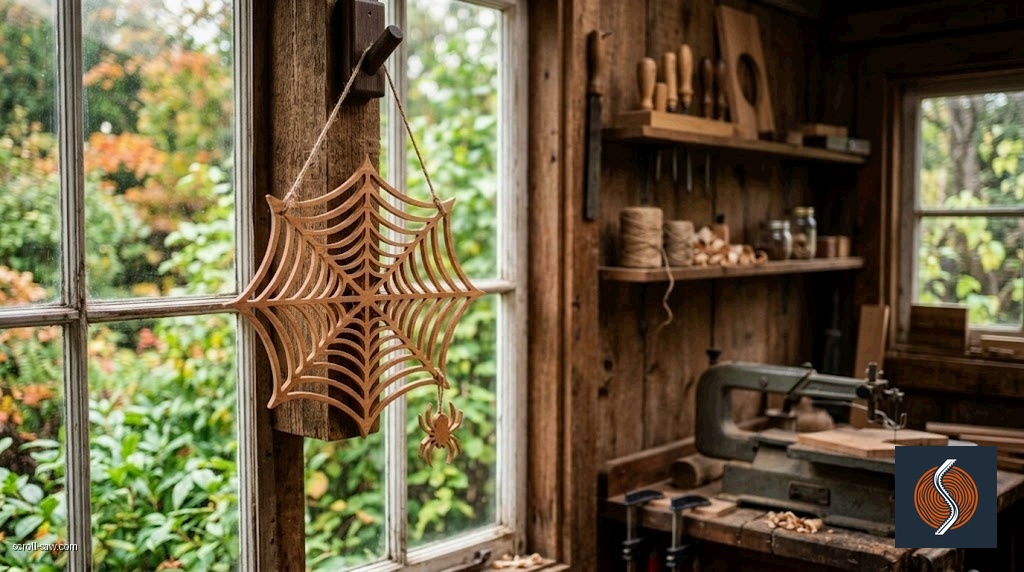
Scroll Saw Spider Web Patterns: Halloween Decor That Does Not Look Generic
A spider web has a specific geometry that makes it recognizable from across the room. The radial strands going out from the center. The spiral strands connecting them, evenly spaced, becoming denser toward the center. A few strands broken for realism. A spider at the anchor point or at the center.
Cut that geometry correctly on a scroll saw and the piece reads immediately as a spider web. Cut it incorrectly and it reads as a generic star or wheel pattern with some connecting lines. The difference is in understanding the actual structure of a web, not just the decorative shorthand.
Direct answer
Scroll saw spider web patterns work best when they reflect actual web geometry: radial strands out from a center, concentric spiral strands connecting them, widening spacing as the web grows outward. The web is a fretwork piece where the cut areas are the spaces between strands. At ornament scale (4-6 inches), minimum strand width is 1/16 inch in 1/4-inch stock; at display scale (10-16 inches), more detail is sustainable. Adding a spider silhouette at the center or at the edge of the web is the finishing detail that completes the piece.
Web geometry
A real orb spider web has two distinct structural elements.
Radial strands. Straight lines from the hub (center) outward to the frame. These are the structural spokes of the web. In a typical orb web, there are 10-30 radial strands.
Spiral strands. The capture spiral runs from near the hub outward, connecting all the radial strands in a continuous spiral. The spiral strands are spaced more closely near the center and more widely near the outer edge.
Frame strands. The outer border of the web, connecting the outermost tips of the radial strands. This is the outer perimeter of the scroll saw web piece.
In scroll saw work, the cut areas are the spaces between the strands; the strands themselves are the remaining wood.
Minimum strand width: 1/16 inch for structural integrity in 1/4-inch stock at ornament to medium display scale.
Design variations
Simple geometric web. Eight radial strands (at 45-degree intervals) with five to seven evenly spaced concentric rings connecting them. Fast to cut; very recognizable. The “default” web design.
Realistic irregular web. A web with 12-20 radial strands at slightly irregular intervals, spiral strands with authentic spiral spacing (tighter near center, wider toward edge), and a few broken or missing strands. More work; more convincing.
Web in a circle or moon shape. The web is contained within a circular outer frame or inside a crescent moon silhouette. The moon-with-web piece is a popular Halloween wall decoration.
Web in a window frame. The web appears in the corner of a scroll-cut window frame, as if built in the corner of a real window. The window frame provides the structural support for the delicate web strands.
Web with spider at center. A spider silhouette (round body, eight legs radiating outward) positioned at the hub of the web. The spider is cut as part of the same piece, connected to the web structure through the radial strands.
Web with spider on the edge. A spider silhouette hanging from a single thread at the outer edge of the web. The spider is cut separately and suspended from a thread or wire, or scroll-cut as one piece with a connecting thread element.
Structural challenges
The strands must be continuous. A strand that is cut through at any point turns the web into multiple unconnected pieces. Plan the cut sequence so no strand is ever cut before its connections at both ends are secured.
Spiral strand width consistency. Variable strand width reads as a mistake, not as web imperfection. Keep strand width consistent through the cut.
Spider leg width at connection to body. If a spider is included, the eight legs must be wide enough to survive cutting and handling. Minimum 1/16 inch at the leg-to-body connection in 1/4-inch stock.
Outer frame connection. The outer frame of the web (the perimeter connecting the radial strand tips) must be the last cut. It is the structural ring holding all the radial strands together until the piece is complete.
Cut sequence for a spider web
-
Mount the pattern and drill any starter holes needed for small enclosed areas (the spider’s body interior, any tight areas at the hub).
-
Cut the hub area (the center of the web) first.
-
Cut the spiral strand segments, working from the center outward. Complete one spiral circuit before moving to the next.
-
Cut any spider detail (if the spider is integral to the web).
-
Cut the outer frame perimeter last.
Material choices
1/4-inch Baltic birch plywood. Standard for most web pieces. Black-painted webs are most recognizable.
1/8-inch birch or basswood. For very delicate ornament-scale webs that need to be lightweight.
Black-painted MDF. For a display-scale web where weight is not a concern and the finished piece will remain painted black.
Finishing
Flat black. The most natural and most dramatic finish for a spider web. Spray flat black over primer. The flat black (not gloss) reduces light reflection and makes the web read as shadow from across the room.
Metallic silver or gold. Contemporary decoration style. A gold web against a dark background reads as decorative rather than Halloween-specific.
White glow-in-the-dark. White glow-in-the-dark spray paint. Charges under normal light; visible in the dark. Strong category at Halloween craft fairs.
Natural birch with dark stain. The web in natural-stained wood without paint. Darker stain makes the piece read clearly in a lit room.
Seasonal and year-round market
Spider web pieces are strongly Halloween-adjacent but can be positioned for year-round sale.
Halloween window decoration. The core seasonal use. Purchased in September and October.
Gothic or nature decor. A black or natural-finish web in a contemporary interior is sold as permanent wall decor rather than seasonal decoration. A somewhat different audience; different price positioning.
Educational. A web piece in a school or nature classroom. Natural finish; labeled as an orb weaver web representation.
Verdict
A scroll saw spider web that reflects actual web geometry is a stronger piece than one that uses a generic wheel-and-rings pattern. The investment in correct radial-and-spiral geometry is modest (it is still a pattern-following exercise) and the result is significantly more convincing.
Flat black spray, a spider at the hub or suspended at the edge, and a clean outer frame. Simple. Effective. The version that sells.
FAQ
How do I cut a scroll saw spider web without the strands breaking? Design minimum 1/16-inch strand width in 1/4-inch stock. Cut the outer frame last. Handle the nearly-completed piece carefully; the web becomes fragile once most interior work is done.
How many radial strands should a scroll saw spider web have? For a realistic orb web: 12-20. For a simple decorative web: 8 (at 45-degree intervals). Six or fewer looks like a star, not a web.
What color should I paint a scroll saw spider web? Flat black for the most convincing and dramatic result. Silver metallic for contemporary decor. White for glow-in-the-dark.
Can I add a spider to a scroll saw web? Yes. Either integral (cut as part of the same piece, connected through the radial strands) or separate (cut independently and hung from the web with thread or wire).
What is the easiest scroll saw spider web design? Eight radial strands at 45-degree intervals with four to five evenly spaced concentric rings. No interior detail; no spider. Simple geometry; fast to cut.
Is a scroll saw spider web appropriate for year-round decor? In natural finish or metallic finishes, yes. In flat black with a Halloween-scale spider, it reads as seasonal.
Where can I find scroll saw spider web patterns? Steve Good’s Scrollsaw Workshop publishes Halloween patterns including webs each September. Fox Chapel Publishing Halloween scroll saw books include web designs.


