
Steve Good Patterns for Scroll Saw Projects
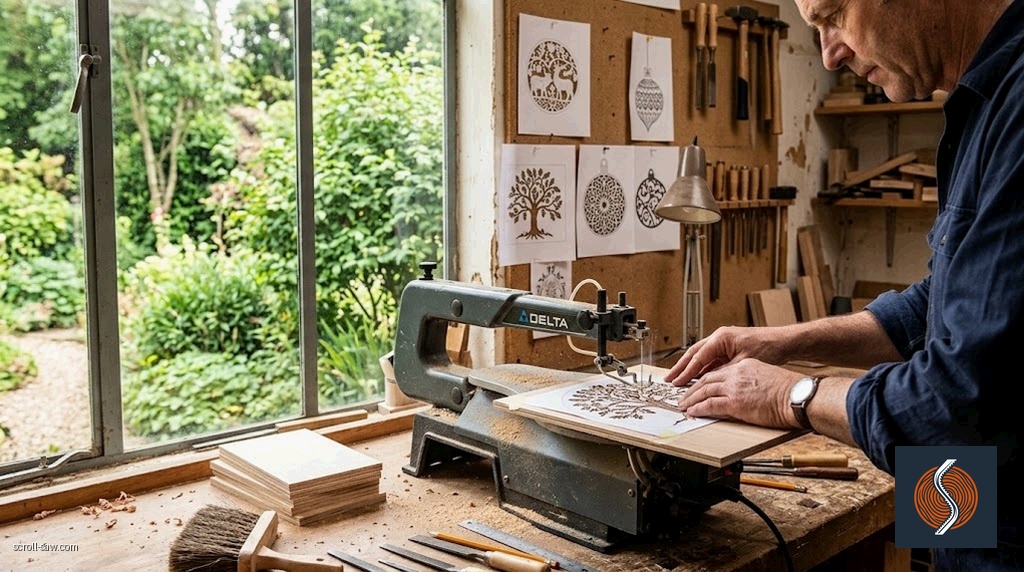
Steve Good Patterns for Scroll Saw Projects
Every scroller I know has printed at least one Steve Good pattern. He has been posting free scroll saw patterns on his blog, Scrollsaw Workshop, since around 2007, and the archive is now enormous: word art, portraits, ornaments, name puzzles, boxes, clocks, and a long back-catalogue of holiday designs. All of it is free to download and print, and most of it is genuinely usable.
The catch is that when a library is that big and that free, quality varies. Some patterns are among the best you’ll find anywhere. Others are quick weekend uploads that need cleanup before they cut well. This is a guide to using the good ones like a pro and knowing which ones to skip.
Steve Good’s patterns are printable PDF files, each containing one project’s artwork at real scale, that you can attach directly to your stock and cut on a scroll saw. The library is hosted on scrollsawworkshop.blogspot.com and is organized loosely by upload date, with a search box that does the heavy lifting.
Where the library actually shines
Name puzzles and word-art plaques are the category Steve Good does better than almost anyone. If you need a child’s name cut in interlocking block letters, or a word like Grace or Faith in a script that will hold together as fretwork, his patterns are ready-to-cut, sized correctly, and generally have bridges thick enough to survive amateur handling.
Holiday ornaments are the other strong category. Every year in September and October he posts a run of Christmas ornaments, and the compound-cut and layered ornaments hold up well against paid books. If you cut gifts every December, bookmark the archive from October onward.
Where the library is weaker: highly detailed portrait patterns (the ones that look photographic in the preview) demand a very specific blade and stock combination, and the instructions on the blog post rarely tell you which. You’ll spend more time on the cut than the design deserves, and the finished piece looks like a photocopy unless your framing does heroic work.
How to pick a pattern that will actually cut cleanly
Before you print, open the PDF and zoom to 200 percent. Look at the thinnest bridge in the pattern — the narrowest strip of wood connecting two areas. If it’s thinner than about 1/16 inch at print scale, it will break the first time you handle the piece, no matter how careful you are. Skip that pattern or scale it up until the bridges are wider.
Next, count the interior cutouts. Each interior cut requires a drilled entry hole and a blade-thread from that hole. Twenty-five cutouts on a pattern the size of a postcard is a genuinely long project, not a Saturday afternoon. Match the pattern’s cutout count to the time you actually have.
Finally, glance at the bottommost line of the PDF. Steve Good frequently notes the recommended stock thickness — usually 1/4 inch or 1/8 inch. Ignore that at your peril. A pattern designed for 1/8-inch stock, cut in 3/4-inch stock, will fight you the whole way and often break bridges from blade drift.
Print settings that actually matter
The single most common way people ruin a Steve Good pattern is by printing it with “fit to page” turned on. Print at 100 percent scale, actual size, no scaling. Every pattern on his blog is drawn to exact scale in the PDF; the printer only has to keep out of the way.
If the pattern is larger than a single sheet, the PDF will usually be split across two or three pages with alignment marks. Trim the margins, overlap the alignment marks, and tape from behind so the tape doesn’t interfere with pattern adhesion.
For the adhesive step, most scrollers spray the back of the pattern with a light-tack adhesive. 3M Super 77 Multipurpose Spray Adhesive is the default choice — lay a piece of scrap cardboard under the pattern, hold the can 8 to 10 inches away, and give it a two-second pass. Any more and the pattern will fight you when it’s time to peel. If you’d rather not spray, ScotchBlue Painter’s Tape 2090 laid on the stock first, then the pattern glued to the tape, is the old-school workaround — the whole pattern-and-tape layer peels off in one strip when you’re done.
Blades that suit the way Steve Good’s patterns are drawn
Most of his patterns are drawn with fretwork-scale detail in mind, which means a #5 or #7 reverse-tooth blade is your daily driver. A pack of Olson FR49202 Reverse Tooth Scroll Saw Blades, 5-inch assortment gives you the range — sizes 5, 7, and 9 in one box, which covers most everything he posts. The reverse teeth on the lower portion of the blade cut on the upstroke, which reduces tear-out on the underside of your workpiece; that matters more on fretwork than most beginners realize because you often never sand the back.
For thicker stock or larger patterns, Olson FR49400 Skip Tooth Assortment gives you a broader range of tooth counts and a full 36-blade selection. Skip-tooth clears sawdust faster in thicker wood, which stops the blade from binding.
Honest note on blades: cheap import blades will cut a Steve Good pattern, but they’ll break faster and burn the wood at speed. If you’re cutting one pattern a week, cheap blades are fine. If you’re cutting three a weekend, the difference in Olsons or Pegas pays for itself in blade changes you don’t have to make.
Pairing his free patterns with a real technique book
Steve Good’s blog posts explain what the pattern is. They rarely explain how to cut it well; that isn’t the format. Pair the free library with a real technique book and your finished pieces will look meaningfully better.
Scroll Saw Workbook, 3rd Edition by John Nelson is the standard companion. Twenty-five exercises, each teaching one skill, cover almost every technique a Steve Good pattern will ask of you: tight inside curves, sharp corners, stack cutting, and clean line-following.
For the Christmas run specifically, Compound Christmas Ornaments for the Scroll Saw, Revised Edition by Diana Thompson walks through the compound-cut technique that many of Steve Good’s ornament patterns assume you already know.
Who should actually rely on this library
If you’re new to the scroll saw and want to build a project shelf without spending money on patterns while you learn, Steve Good’s archive is the best free resource in the hobby. Use it.
If you’re an experienced scroller looking for polished, tested-by-editors patterns with cutting notes and stock recommendations, you’ll find some in the archive but you’ll spend real time searching. In that case a curated book pays for itself in time saved.
And if you’re planning to sell the finished pieces, read Steve’s usage terms on his site. Personal use is unrestricted; commercial use has its own rules and they’re worth respecting.
Frequently asked questions
Are Steve Good patterns actually free? Yes. Every pattern posted on scrollsawworkshop.blogspot.com is free to download and use for personal projects. He publishes commercial-use terms separately.
What software do I need to open the patterns? Any PDF reader. Adobe Reader, Preview on Mac, or any browser’s built-in PDF viewer will all open them at correct scale as long as you print at 100 percent.
Do the patterns tell you what wood to use? Sometimes. Look at the bottom of the PDF or the accompanying blog post. When the stock thickness isn’t specified, 1/4-inch Baltic birch plywood is a safe default for most fretwork designs.
Can I sell projects I make from Steve Good patterns? Check the current terms on his site. Personal use is always allowed. Commercial use has changed over the years and is worth confirming before you build inventory.
What’s the best way to search the archive? Use the blog’s built-in search with a specific noun (“nativity,” “name puzzle,” “clock face”) rather than a category name. The archive is organized by upload date, not by theme, so search is more useful than browsing.
Why do my finished projects look rougher than the preview images? Usually one of three things: the blade is too coarse for the detail, the stock is too thick for the pattern, or the pattern was printed at the wrong scale. Check all three before blaming your cutting.
Can beginners start with Steve Good patterns? Yes, if you start with his simpler word-art or ornament patterns. Skip the highly detailed portrait patterns and dense fretwork until you can follow a line cleanly for several minutes without corrections.
References
-
Steve Good, Scrollsaw Workshop, scrollsawworkshop.blogspot.com.
-
Fox Chapel Publishing, Scroll Saw Workbook by John Nelson.
-
Scroll Saw Association of the World, saw-online.com.


