
Scroll Saw State Patterns: Cutting and Selling Home State Pride
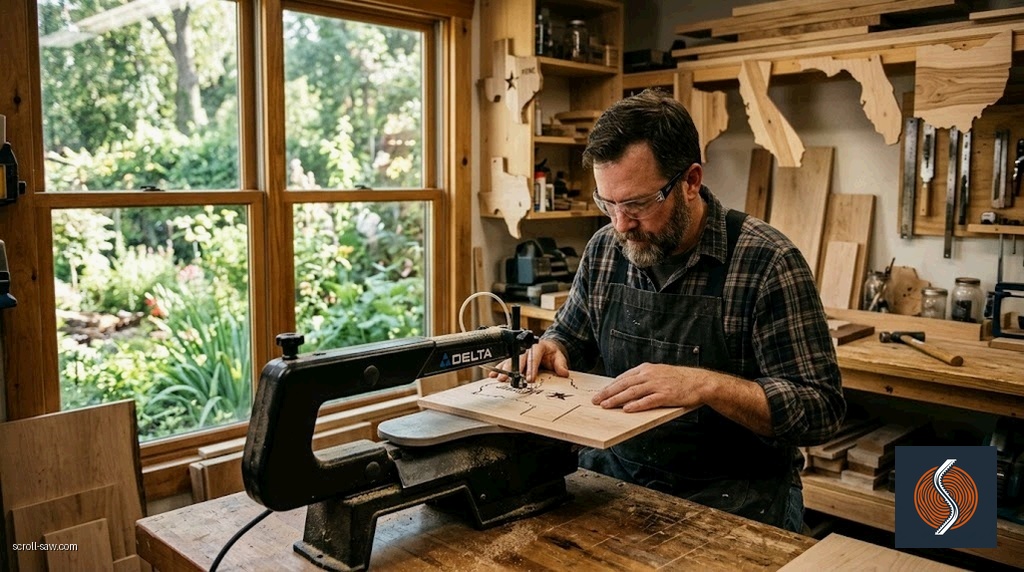
Scroll Saw State Patterns: Cutting and Selling Home State Pride
A person who grew up in Texas, moved to Seattle fifteen years ago, and has a Texas-shaped cutting board in their kitchen will immediately recognize a scroll saw Texas silhouette on a craft fair table. Not because it is artistically impressive, but because it is specific. It is their specific place. That emotional connection is what drives state silhouette sales.
Scroll saw state patterns are one of the most consistent-selling categories in the craft market because the subject matter is immediately personal to a very large audience. Every state has residents, former residents, and loyal sports fans who identify with the shape. This article covers how to cut them well and sell them effectively.
Direct answer
State scroll saw patterns are silhouette cuts of the state outline from 1/4-inch to 3/4-inch stock, finished with painting, natural wood, or personalized elements (a heart or star at a specific city, the state name, a year). Simple rectangular states (Colorado, Wyoming) are the easiest to cut; complex coastline states (Florida, California, Maryland) require more careful pattern following. Most states are best cut with a #5 reverse-tooth blade in 1/4-inch Baltic birch.
Why state silhouettes sell
Immediate personal connection. A person sees their home state shape and stops. The shape is specific to their history.
Gift potential. An out-of-state gift that references someone’s home state is personal and thoughtful. Very giftable.
Widely available market. Every craft fair, every city, every online marketplace has a buyer for their local state shape. This is a category with no regional dead zones.
Personalization multiplier. A state shape with a heart at the city where someone grew up, or the city where they met their spouse, transforms a generic state piece into a specific personal artifact. Personalized states sell at a significant premium over plain state cuts.
Design categories
Plain state silhouette. The state outline, nothing inside. Can stand alone or mount on a contrasting backing. The simplest version; sells as a recognizable gift.
State with city marker. A heart, star, or dot placed at a specific city within the state. Can be drilled as an interior cutout, painted in a contrasting color, or applied as a small inlaid element. “You are here” design language.
State with initials or name. Lettering inside the state boundary. Requires letter work within the state’s interior; letters must maintain bridges at all enclosed areas.
State with significant elements. A state flower, bird, or landmark worked into the design alongside the state shape. More complex; more specific to the state’s identity.
State magnets or ornaments. Small-scale state cuts (2-3 inches) suitable for refrigerator magnets or tree ornaments. Stack-cuttable.
State serving board or tray shape. The state outline as a functional object: a cutting board, a serving tray, or a catchall tray. The state of Texas and the state of California both have market-proven cutting board silhouettes.
Cutting challenges by state category
Simple rectangular states. Colorado, Wyoming, and Utah are nearly rectangular with minor boundary irregularities. Very easy to cut; straight lines with minimal curve work.
Simple boundary states. Iowa, Kansas, Nebraska, South Dakota: mostly straight boundaries with gentle curves. Moderate difficulty; primarily long straight-line cutting with a few curves.
Complex coastline states. Florida (Panhandle and peninsula), California (long with complex coastline bays), Maryland (Chesapeake Bay cutout), and the New England states all have complex, irregular boundaries. These require careful pattern following and cannot be cut quickly. Allow more time per piece.
Island states. Hawaii requires cutting multiple islands. Each island is a separate piece, or the larger islands are cut with channels between them.
Alaska. Complex outer boundary plus the Aleutian Islands. Most practical approaches simplify the Aleutians to the nearest large islands.
Scale matters. At ornament scale (3-4 inches), complex coastline states lose their fine boundary detail because the scale is too small. For Florida and California ornaments, consider a simplified boundary. At 6 inches and above, the full boundary complexity is achievable.
Material and blade guide
1/4-inch Baltic birch (most wall pieces and magnets). Standard.
3/4-inch solid hardwood (for functional serving boards and trays). More demanding to cut; rewarding result.
1/8-inch birch or basswood (ornament-scale states). Lightweight.
Blade:
-
Most 1/4-inch state work: #5 reverse-tooth
-
Fine coastline detail at medium scale: #3
-
3/4-inch hardwood serving board: #9
Finishing approaches
Natural wood, oil finish. A state shape in walnut or cherry with a clear oil finish. The most refined version. Appropriate for a gift that will be displayed in a serious interior.
State colors. Some states have strongly associated colors (Texas: navy and red; Tennessee Volunteers: orange; Michigan Wolverines: maize and blue). Painting in sports-team or state-associated colors sells to that specific audience.
Map-style. A hand-sketched or painted topographic or road map detail within the state boundary. Ambitious; impressive when well-executed.
Natural birch with inked boundary and city markers. The state cut from natural birch, with a city marker burned or inked at the relevant location. Clean, simple, the most popular personalized version.
Heart at specific city. A drilled or painted heart at a specific city, no other detail. The most personal and the easiest to execute.
Selling strategy
Know your most marketable states at each venue. At a craft fair in Austin, Texas cuts outsell every other state combined. At a craft fair in a university town, the home university’s state and any rival states are both relevant.
Have your best-selling states in multiple finishes. Natural wood and painted in state colors. Different buyers respond to different finishes.
Personalization as an on-site service. Some makers offer a wood-burned heart at the customer’s specified city as an on-the-spot personalization. This is a significant upsell and creates immediate purchase momentum.
Online selling. State silhouette ornaments and magnets sell consistently on Etsy year-round. The personalized city-marker version lists well as a custom order.
Verdict
State scroll saw patterns are a category where the subject matter does the selling. The scroll saw hobbyist’s job is to execute the shape cleanly, personalize appropriately, and be at the right venue with the right states in stock.
For a craft fair first-timer, having the home state and the five to eight most popular states in the region ready in two finishes is a viable starting point. The rest of the catalog builds from there.
FAQ
Which US states are easiest to cut on a scroll saw? Colorado, Wyoming, and Utah have nearly rectangular outlines. Iowa, Kansas, and Nebraska have mostly straight boundaries. These are the most approachable state outlines.
Which states are hardest to cut on a scroll saw? Florida (complex coastline and peninsula), Maryland (Chesapeake Bay cutout), Hawaii (multiple islands), and California (long complex coastline).
What scroll saw blade for state silhouette patterns? #5 reverse-tooth for most 1/4-inch state work. #3 for detailed coastlines at medium to large scale.
Can I stack-cut state silhouettes? Yes. Simple boundary states: 4-6 pieces at a time. Complex coastline states: 2-3 pieces at most to maintain cutting accuracy through the fine boundary detail.
How do I personalize a scroll saw state piece? A burned or drilled heart or star at the specific city. The personalization is the highest-value element of the piece.
Are state silhouettes good sellers at craft fairs? Yes, consistently. Home state pieces sell in any market; team-colored state pieces sell strongly to that team’s fanbase. Personalized versions command the highest price.
What size should a state silhouette scroll saw piece be? For a wall piece: 8-12 inches at the longest dimension. For an ornament: 3-4 inches. For a serving board: 12-18 inches, depending on the state’s proportions.


