
Scroll Saw Train: Material Thickness, Blade Size, and Finishing Notes
Scroll Saw Train: Material Thickness, Blade Size, and Finishing Notes
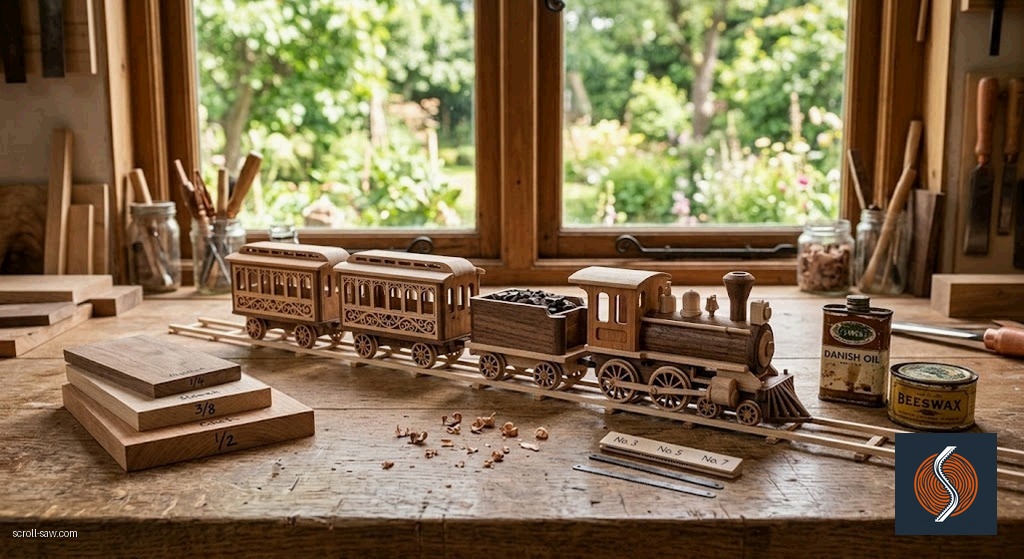
A scroll saw train is almost never one project. It is an engine, a coal car, a boxcar, a flat car, and a caboose that all share wheel geometry, coupler style, and a finishing scheme. The engine is where cutters bail out first, because it has the smokestack, the boiler bands, the cab windows, and the drive wheels all fighting for attention. The rest of the train is easier per car, and the shared decisions (stock thickness, wheel size, blade progression) apply to the whole set.
A scroll saw train is a set of coordinated wooden train car patterns cut on a scroll saw from 3/4-inch or 1-inch stock, often with hardwood wheels and axle pegs, assembled with magnetic or hook couplers, and finished to display on a mantle or roll as a toy.
The short answer to “what do I need to decide before cutting” is three things: stock thickness (the pattern designer usually specifies, honor it), blade progression (reverse-tooth #5 as workhorse, #3 for cab windows and boiler detail), and finish plan (oil for display, toy-safe finishes for children). Everything else is refinement.
Stock thickness sets the whole train
Most multi-car train patterns are drawn for 3/4-inch stock, sometimes 1-inch for larger engines. The thickness decision has consequences that ripple through the whole set:
Axle dowel diameter is chosen based on stock thickness and wheel diameter. A 3/4-inch train usually rides on 1-1/2-inch or 2-inch wheels and 1/4-inch axle dowels. A 1-inch train can carry 2-inch or 2-1/4-inch wheels and 5/16-inch axles.
Coupler size scales with car height. Magnet couplers for 3/4-inch cars are usually 3/8-inch neodymium discs recessed into the car ends; 1-inch cars can carry 1/2-inch magnets.
Boiler diameter on the engine relative to cab and wheel size is fixed by the pattern for the chosen thickness. Scale up and the engine looks stretched next to the coal car; scale down and the smokestack becomes a fragile bridge that snaps in the last cut.
Spend a moment before touching adhesive on a scroll saw train confirming that every car in the set is drawn for the same thickness. Multi-car sets from a single designer usually are; sets you assembled from different sources may not be, and mixing 3/4-inch and 1-inch cars on the same track visually clashes.
Wood: what looks right, what cuts right
Cherry is the classic scroll saw train wood for display sets. It cuts cleanly under a #5, takes wipe-on oil beautifully, and darkens over time so the finished train looks better a year later than it did the day it came off the saw. Walnut works for accent cars (a boxcar or a caboose against cherry engines and flat cars) and gives the visual contrast that photographs well.
Maple is harder on blades and can burn if the feed is inconsistent, but the pale tone under a light oil is honest for a Scandinavian-style train. Birch and Baltic birch plywood work for painted trains (Thomas the Tank-style, or a bright children’s set) and hide the ply pattern under paint.
Skip soft pine, fir, and cedar for any detail engine. Boiler bands and cab windows split along the grain the moment a blade brushes wrong, and the train will lose its detail before it is assembled.
Blade progression through a full set
The honest working blade set for a scroll saw train is two blades. A reverse-tooth #5 handles the outlines, the wheels, the larger interior openings on the coal car and boxcar, and every cut on the flat car and caboose that does not have interior windows. A #3 handles cab windows on the engine, the fine boiler bands if the pattern includes them, and any coupler recess that needs a tight interior curve.
A #7 has almost no place on a train. The only exception is a heavy outline on a very thick stacked-cut engine (2-inch or thicker), and even then the outline heat can wander into the fragile smokestack projection. Start with #5, drop to #3 for the tightest work, and go up only when the outline is genuinely thick.
Blade tension deserves attention. A train pattern with several interior cuts per car is a lot of blade changes. A blade that is under-tensioned will wander and widen every interior opening; an over-tensioned blade will break at the fragile smokestack cut on the third car. Set tension the same way every time and pluck-test before each car.
Cutting order for the engine and its cars
The engine goes first when the shop is warm and the cutter is fresh. It has the most fragile cuts and demands the most attention. The order:
Cab windows first, one after another, with a #3 for the tightest corners. They are the smallest openings with the most support.
Boiler band interiors next if the pattern includes them. Alternate as you would with a grille: cut every other band first, work outward, so remaining bands have wood on both sides.
Wheel arch cutouts and any body cutouts after that.
Smokestack outline and the engine profile last. Approach the smokestack from the supported side and cut it free as one of the last actions on the engine.
The coal car, boxcar, flat car, and caboose are simpler in sequence. Cut interior windows first (caboose has them, boxcar sometimes has door openings), then wheel arches, then outlines. The flat car is almost pure outline and takes fifteen minutes.
Wheels for the whole train can be cut in one session at the drill press. Drill every axle hole in the flat wheel blank first, one dowel diameter plus 1/64 clearance for smooth spin, then cut the wheels out on the scroll saw with a #5. Doing all the wheels together keeps axle geometry consistent across the set.
Assembly: couplers, axles, and how the train stays together
Coupler style is a design choice. The three honest options for a scroll saw train:
Hook-and-eye couplers made from small brass screw eyes and small brass hooks are simple, cheap, and reliable. They visually read as “toy train” and are easy for a child to work.
Magnetic couplers with 3/8-inch or 1/2-inch neodymium discs recessed into the car ends give a clean, sophisticated look and hold well on straight track. They fail on tight curves where the magnets pull past each other.
Ball-and-socket wooden couplers cut into the car end profiles are the most “woodworker” answer and the hardest to make consistent. If every car has slightly different socket geometry, the train binds and derails.
For a first scroll saw train, hook-and-eye is the honest choice. Magnetic couplers reward experienced cutters with tight tolerances.
Axle installation is straightforward. Cut axle dowels to length plus 1/16-inch on each side for the wheel to clear the car body, glue the wheel to the dowel end with Titebond II or III, and let cure with the wheel resting flat on the bench. Do not glue the axle to the car body; the axle must spin freely in the car body hole.
Finishing notes for a scroll saw train
For a display train (a mantle-piece cherry engine and cars), wipe-on oil is the honest finish. Two to three thin coats of tung oil, boiled linseed, or Danish oil, letting each coat cure between applications, and a final coat of paste wax buffed lightly. The finish should sit in the wood, not on it. Any topcoat that reflects like plastic (heavy polyurethane, high-gloss lacquer) hides the cutting detail that made the train worth cutting.
For a painted train (children’s set, Thomas-style, custom color scheme), two thin coats of primer over sanded wood, two thin coats of the color, and one clear topcoat. Thin coats are non-negotiable. A heavy coat of paint fills cab windows, softens boiler band edges, and turns crisp cuts into blobs.
For a toy train that will be handled by young children, mineral oil, beeswax, or a certified toy-safe water-based topcoat. Skip stains and any finish that does not state cured-safety compliance on the label. Published guidance on toy safety and small parts for children under three lives at the U.S. Consumer Product Safety Commission.
Comparison: which train set to cut first
| Style | Difficulty | Best wood | Blades | Finish |
|---|---|---|---|---|
| Simple silhouette train (3 cars, no detail) | Low | 3/4 in Baltic birch | #5 throughout | Paint or oil |
| Cherry display train (engine + 4 cars) | Medium | 3/4 in cherry | #5 outlines, #3 for cab windows | Wipe-on oil |
| Detail engine train with boiler bands | High | 3/4 in cherry or walnut | #5 outline, #3 for bands and windows | Wipe-on oil |
| Painted children’s train | Medium | 3/4 in Baltic birch | #5 outlines, #3 for windows | Paint, sealed topcoat |
Verdict
A scroll saw train is a project set, not a single cut, and the decisions that matter are the shared ones. Stock thickness (3/4-inch for most, 1-inch for larger engines). Blade progression (reverse-tooth #5 with a #3 for cab windows and boiler bands). Wood (cherry or walnut for display, Baltic birch for painted or beginner sets). Finish (wipe-on oil for display, thin paint coats for children’s, toy-safe finishes for young handlers). Get those four right and the difference between engine and caboose is only in the cutting sequence, which the pre-cut plan handles.
Cherry and a reverse-tooth #5 is the honest combination for a first display train. Baltic birch and a #5 with paint is the honest combination for a first children’s train. Neither is harder overall; they end up in different rooms.
FAQ
What thickness of wood is best for a scroll saw train? 3/4-inch is standard for most patterns. 1-inch is used for larger engines and stacked-cut applications. Confirm every car in the set is drawn for the same thickness before starting to keep proportions consistent.
What blade cuts a scroll saw train engine best? A reverse-tooth #5 handles outlines and larger interior openings. Drop to a #3 for cab windows, boiler bands, and any fragile interior detail. Skip #7 on trains; the extra speed is not worth the heat near fragile projections.
Cherry or Baltic birch for a display train? Cherry for oil-finished display sets. It cuts cleanly, takes wipe-on oil beautifully, and darkens gracefully over time. Baltic birch for painted trains and beginner sets; it is more forgiving on fragile cuts and paint hides the ply pattern.
How do I keep wheels rolling straight on a scroll saw train? Drill every axle hole in a flat wheel blank on a drill press before cutting the wheel out. Off-square axle holes cause visible wobble. Use a dowel diameter plus 1/64-inch clearance for smooth spin, and glue the wheel to the axle rather than the axle to the car body.
What is the easiest coupler style for a first scroll saw train? Hook-and-eye brass hardware. Small brass screw eyes on one end of each car and small brass hooks on the other. Simple, inexpensive, easy to work, and forgiving of tolerance variation across the set.
Can I stack-cut multiple identical cars at once? Yes for simple silhouette cars and flat cars where a stacked cut of 1-1/2 or 2 inches is manageable. Not recommended for detail engines with cab windows, where fragile cuts multiply with stack height.
What finish is safe for a toy train that a child will handle? Food-safe mineral oil, beeswax, or a certified toy-safe cured water-based topcoat. Avoid stains and finishes without a clear cured-safety statement, especially for toys aimed at children under three.
How long does a full scroll saw train set take to cut? A five-car silhouette set is a full weekend day including wheels and drilling. A detail engine plus four cars is two weekends. Assembly (axles, couplers, finish) adds a third session.
References
-
U.S. Consumer Product Safety Commission — Toy safety business guidance and small-parts standards (cpsc.gov)
-
ASTM International — F963 Standard Consumer Safety Specification for Toy Safety (astm.org)
-
Scrollsaw Workshop by Steve Good — Free scroll saw patterns and cutting notes (scrollsawworkshop.blogspot.com)


