
Making a Scroll Saw Trivet: From Pattern to Clean Finished Edges
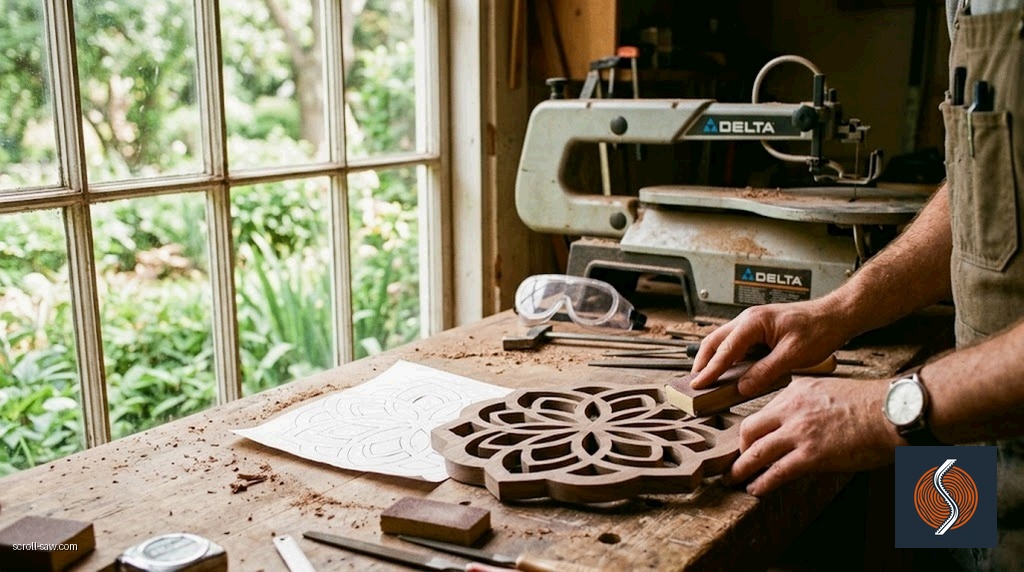
Making a Scroll Saw Trivet: From Pattern to Clean Finished Edges
A trivet is the one scroll saw piece in the house that actually works for a living. It sits under a hot cast iron pan, absorbs a shock of thermal energy, and gets slid across a stone counter with a full stew on top of it. A piece designed for a shelf will warp, cup, or scorch on its first serious use. A trivet designed as a trivet, cut from the right wood in the right thickness with the right finish, spends decades on the table looking better every year.
A scroll saw trivet is a decorative wooden mat cut on a scroll saw from 1/2-inch or 3/4-inch hardwood, sized 6 to 10 inches across, with interior fretwork that lets heat and steam escape and a border thick enough to resist cupping. It sits under hot pots, casserole dishes, or teapots and doubles as a small decorative piece when not in use.
The short answer to “what does a working trivet need” is four decisions. Wood that tolerates thermal shock (maple, cherry, beech, or Baltic birch, never softwood). Thickness thick enough to resist cupping (3/4-inch is the honest default). Pattern with generous heat escape openings (at least 30 percent open by area). Finish rated for heat and food contact, applied thin.
Wood that survives the kitchen
The first decision on a trivet is not the pattern, it is the wood. A trivet cut from the wrong wood cups on the first hot pot, scorches under a cast iron sear pan, or splits along a grain line after a summer of humidity.
Maple, cherry, and beech are the honest hardwoods for trivets. They are dense enough to conduct heat away from the pot base without absorbing damaging thermal shock, tight-grained enough to resist splitting, and take food-safe finishes cleanly. Cherry is the most common because it looks warm and photographs well. Maple is the most durable for daily use. Beech is the classic European trivet wood.
Walnut and oak have their defenders. Walnut looks beautiful and darkens gracefully; oak has open grain that traps water and food residue. Walnut is an honest choice for a display trivet; oak is a poor choice for a daily-use one.
Baltic birch plywood is the safest choice for a beginner. Alternating ply grain resists cupping better than any solid wood, thermal expansion is even in every direction, and there is no grain line to split. The tradeoff is a slightly less refined edge and glue lines that dull blades faster.
Skip pine, fir, cedar, and every softwood without exception. They cup on the first hot pan, scorch on direct contact, and split along the grain within a season. A trivet made from softwood is a decoration, not a tool.
Thickness and the physics of cupping
A trivet cups because one face heats faster than the other. The pot side gets hot; the counter side stays cool. Wood on the hot side expands, wood on the cool side does not, and the piece warps toward the pot. Thin trivets cup fast; thick trivets cup slow or not at all.
3/4-inch is the honest default. It has enough thermal mass that the temperature gradient across the thickness is smaller and cupping stress is manageable. Almost every published trivet pattern is drawn for 3/4-inch stock.
1/2-inch works for smaller trivets (6 to 7 inches across) and for display trivets under teapots or mugs where the thermal load is modest. Below 1/2-inch, expect cupping under a hot cast iron pot within minutes.
1-inch and thicker is honest for a very large trivet (10 to 12 inches) meant for a dutch oven or a heavy stew pot. The extra mass earns its keep under sustained heat. Above 1-inch the piece starts to feel more like a cutting board than a trivet.
Pattern: heat escape openings and border ratio
A trivet pattern is not just a decorative fretwork drawing. It is a thermal management design. Two ratios matter.
Open area to solid area. A trivet with too much solid wood traps heat and steam under the pot; the wood scorches and the finish burns. Aim for at least 30 percent open by area on a working trivet, more if the pot will sit on it for hours (crock pot, dutch oven).
Border width to trivet diameter. The outer border of a trivet is where cupping stress concentrates. A border thinner than roughly 1/8 of the trivet diameter cups fast; a border thicker than 1/4 of the diameter looks heavy and defeats the fretwork. On a 9-inch trivet, a 1 to 1-3/4-inch border is the sweet spot.
Patterns from Steve Good’s scrollsawworkshop archive and from Sue Mey generally honor these ratios. Older book patterns can be tighter on either count and are worth checking before you cut.
Blade and cutting sequence
A reverse-tooth #5 in 3/4-inch hardwood is the honest default. It cuts the outer border and the larger interior fretwork openings comfortably and leaves a clean bottom face. Drop to a #3 for the finest interior detail (tight scrollwork, monogram centers, floral inserts).
Sequence matters more on a trivet than on most fretwork because thermal use punishes any weak spot. Drill every interior entry hole in the flat blank on a drill press before cutting a line. A 1/16-inch brad point clears a #5; a 1/32 clears a #3.
Cut the smallest interior openings first. These usually cluster in the center where the fretwork is densest. Work outward toward the border, and cut the outline last. This keeps the blank stiffest for the longest and reduces the chance of a crack propagating from a fretwork opening to the outer edge under later cutting stress.
On a trivet with symmetric fretwork, cut opposing openings in alternating pairs to keep the blank balanced. Cutting all openings on one side first before starting on the other side sets up stress asymmetry that shows up as a slight warp after finish.
Sanding for a face that meets a hot pot
A trivet needs a flatter, smoother top face than most scroll saw work because a hot pot rocks on any high spot and burns the wood at the contact point. Sand the whole face with a block on 120, then 180, then 220. Do not power-sand with a random orbit and expect flatness; block-sand.
Check flatness with a straight edge in three directions across the face. A trivet that reads flat and true here will support a heavy pot evenly. A trivet with even a 1/64-inch high spot will scorch at that spot on the first serious use.
Ease the top edge of every interior opening with a folded 220 strip so no splinter meets fingers. Break the outer edge with a 1/8-inch round-over or a firm 150 pass and finish with 220.
Finish: what survives heat and food contact
A trivet finish is not a decoration decision, it is a use decision. Three honest options for a working trivet:
Food-safe mineral oil, applied heavily on the first coat, allowed to soak in for an hour, wiped down, and reapplied every few months. This is the traditional cutting-board and trivet finish. It penetrates rather than coating, tolerates heat without softening, and is nontoxic. The finish never fails, it just fades and gets reapplied.
A mineral oil and beeswax blend (board butter). Same behavior as oil with a slight surface film that resists water spots and gives a warmer feel. Reapply every few months. Available commercially or made in the shop.
A hard wax oil like Osmo Polyx or Rubio Monocoat, which cures to a durable surface film that tolerates heat up to a certain point and food contact when cured. This is the modern professional option. Follow the manufacturer’s cure time strictly; a partially cured hard wax oil under a hot pot smells terrible.
Skip polyurethane, lacquer, and any film finish rated only for indoor decorative use. They soften under a hot pot, off-gas smells the first time, and fail visibly within months of real kitchen use. Danish oil and boiled linseed oil are marginal; they cure to a light film that tolerates modest heat but scorches under cast iron.
Comparison of common trivet failures
| Failure | What actually happened | The move that prevents it |
|---|---|---|
| Cupped after first hot pot | Too thin, or one face heated much faster than the other | 3/4-inch stock, minimum 30 percent open by area, hardwood not softwood |
| Scorch mark under a pot | Insufficient open area, or a soft film finish that failed under heat | More fretwork opening, food-safe oil or hard wax oil not polyurethane |
| Split along a grain line | Grain ran across a thin border section, or open-grain oak absorbed moisture | Tight-grain wood (maple, cherry, beech, Baltic birch), border thick enough to resist stress |
| Fine detail broke during use | Interior fretwork bridges too thin for the border to hold under thermal cycling | Increase bridge thickness on center detail, or accept the trivet is decorative only |
Verdict
A scroll saw trivet is a scroll saw project that has to earn its keep every day. The plan is not complicated. 3/4-inch maple, cherry, beech, or Baltic birch. A pattern with 30 percent open by area minimum and a border 1/8 to 1/4 of the trivet diameter. A reverse-tooth #5 for the outline and larger openings, a #3 for center detail. Interior cuts before outline, symmetric openings in alternating pairs. Block-sanded flat, broken edges, finished with food-safe mineral oil, board butter, or a hard wax oil cured per manufacturer.
For a first working trivet, 3/4-inch cherry, a #5 reverse-tooth blade, and mineral oil is the honest combination. For a Baltic birch beginner trivet under a teapot, drop the thickness to 1/2-inch and the finish stays the same. Either one will still look right on the table in a decade.
FAQ
What is the best wood for a scroll saw trivet that will see daily use? Maple, cherry, or beech in 3/4-inch stock. Baltic birch plywood is the safest choice for a beginner because alternating ply grain resists cupping in every direction. Avoid softwoods (pine, fir, cedar) entirely; they cup and scorch on the first hot pot.
How thick should stock be for a working trivet? 3/4-inch is the honest default and what most patterns are drawn for. 1/2-inch works for smaller pieces under teapots or mugs. Below 1/2-inch expect cupping under any real heat load. 1-inch is appropriate for very large trivets meant for dutch ovens or heavy stew pots.
What blade cuts a trivet best? A reverse-tooth #5 for the outline and larger interior openings, dropping to a #3 for the finest interior detail. The reverse-tooth face keeps the bottom clean, which matters because both faces of a trivet are seen in normal use.
What finish survives heat and food contact on a trivet? Food-safe mineral oil, a mineral oil and beeswax blend (board butter), or a hard wax oil like Osmo Polyx or Rubio Monocoat cured per manufacturer. Skip polyurethane, lacquer, and any film finish rated only for decorative indoor use; they soften and fail under kitchen heat.
How much of the trivet should be cut open for heat escape? At least 30 percent open by area for a working trivet, more if the pot will sit on it for hours. Insufficient open area traps heat and steam, scorches the wood, and burns any film finish.
How wide should the outer border be on a scroll saw trivet? Roughly 1/8 to 1/4 of the trivet diameter. On a 9-inch trivet, that is 1 to 1-3/4 inches. Thinner borders cup fast under heat; thicker borders look overweight and defeat the fretwork.
Why did my trivet cup after the first use? Almost always insufficient thickness, softwood, or a pattern with too little open area for heat escape. Move to 3/4-inch maple or Baltic birch with at least 30 percent open by area and the cupping problem generally solves itself.
Can I use polyurethane on a trivet? Not recommended. Polyurethane softens under a hot cast iron pot, off-gasses on first heat exposure, and fails visibly within months. Food-safe mineral oil or hard wax oil is the honest finish for a working trivet.
References
-
FDA — Food contact substances and guidance on materials in contact with food (fda.gov)
-
Fine Woodworking magazine — Cutting board and trivet finish reference (finewoodworking.com)
-
Scrollsaw Workshop by Steve Good — Free scroll saw patterns including trivets (scrollsawworkshop.blogspot.com)


