
Making a Simple Scroll Saw Nativity: From Pattern to Clean Finished Edges
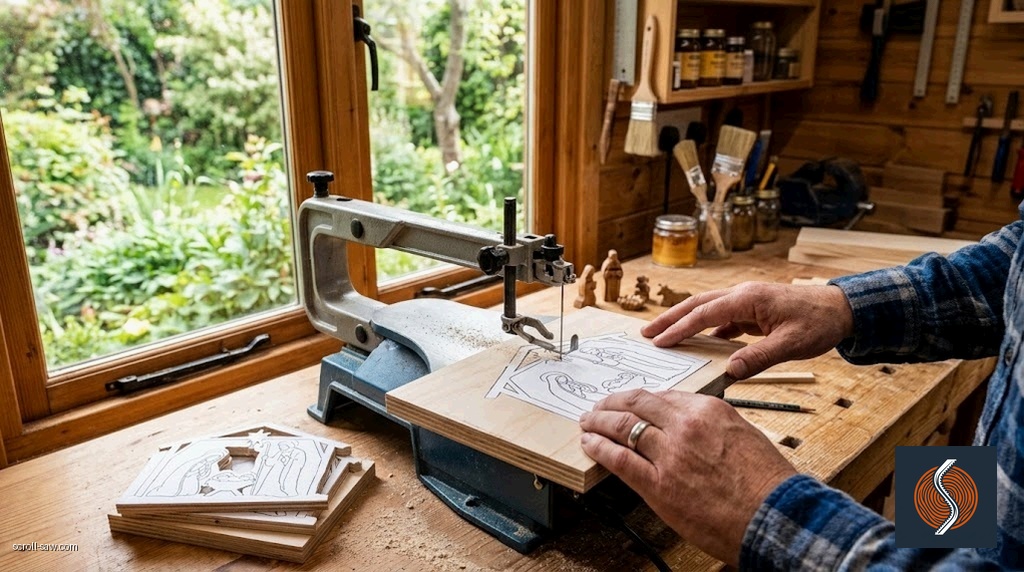
Making a Simple Scroll Saw Nativity: From Pattern to Clean Finished Edges
A simple scroll saw nativity is a family of small silhouette figures that live on a mantle or a side table through Advent and Christmas, and the pieces have to read as one scene rather than as a collection of unrelated cuts. Scale has to match across the figures (a Mary that towers over a shepherd looks wrong). Finish has to match across the set (an oiled Joseph next to a painted wise man looks like two different projects). Stand geometry has to be consistent so pieces stand at the same height on the same surface. This guide is how to plan a simple nativity so the whole set reads unified.
A simple scroll saw nativity is a set of small silhouette figures depicting the nativity scene, cut on a scroll saw from 1/2 to 3/4-inch stock, sized 4 to 8 inches tall, including Mary, Joseph, the baby Jesus in a manger, one or more shepherds, one or more wise men, and often a few animals. Each figure has a stand or base so it stands upright on the display surface.
The short version of the plan: choose one stock thickness for the whole set (3/4-inch is honest), choose one wood species (Baltic birch or cherry), size figures so Mary and Joseph are the tallest and shepherds slightly shorter, cut each figure with a consistent blade progression, and finish the whole set in one batch session.
Figure scale relationships in a nativity set
A nativity set reads as a scene when the figures follow certain scale relationships. These are traditional proportions that produce a scene that looks right.
Mary and Joseph are the tallest figures, typically 6 to 8 inches for a mantle set. They anchor the scene. Shepherds are slightly shorter, roughly 5 to 7 inches, because they are typically shown kneeling or in a bowed pose. Wise men can be similar height to Mary and Joseph or slightly taller if shown with headdresses that add visual height. Baby Jesus in a manger is small, 2 to 3 inches, placed centrally. Animals are proportional to real animals: sheep small (2 to 3 inches at the shoulder), donkey and cow larger.
A typical simple nativity set is 8 to 12 pieces. Choose the composition before selecting a pattern. A tighter set (Mary, Joseph, baby Jesus, two shepherds, three wise men, two sheep) reads better than an overstuffed one.
Stock and wood species
One stock thickness for the whole set. 3/4-inch is the honest default for a mantle set; it gives figures enough visual weight to read at display distance and enough stability to stand upright without a heavy base. 1/2-inch works for smaller sets (figures under 5 inches) or for a lighter, more delicate look. Below 1/2-inch, figures need a wider base to stand stably and start looking flimsy.
Baltic birch plywood at 3/4-inch is the honest first-nativity-set stock. It cuts predictably, resists cross-grain cracking on fragile projections (shepherd staffs, wise men’s raised arms), and takes finish evenly.
Cherry, maple, and walnut work for oil-finished natural-wood sets. Cherry is the most common for the warm tone that pairs with candles and greenery. Walnut gives strong contrast and reads formal. Mixed wood sets are visually striking but demand consistent finish across the set.
Blade choice for silhouette work
Simple nativity figures are silhouette work with occasional light interior detail. Plain silhouette figures with no interior cuts take a reverse-tooth #5 in 3/4-inch stock; it is fast, clean, and forgiving of minor blade drift on gentle outlines. Figures with light interior detail (a suggested robe line, a wise man’s headdress fold) take a reverse-tooth #3 for the interior detail, changing to #5 for the outline.
Special features (shepherd staff, wise man’s crown, angel wing tip) are fragile projections. Approach them with the wood at maximum surrounding support and cut them free late in the sequence.
Layout and cutting sequence for a nativity set
Lay out all figures on a single sheet of 3/4-inch stock with proper spacing (1/4-inch waste between adjacent blank outlines, 1/2-inch edge margin). This lets the whole set be cut in one workshop session with consistent blade tension and blade sharpness.
Orient each figure so any fragile projection runs with the grain. Shepherd staff runs with the grain if possible. Wise man’s raised arm runs with the grain if possible.
Drill every hole in one drill press session. Base slots for the stands go here (a slotted mortise through the base of each figure, typically 1/8 to 1/4-inch wide and 3/8-inch deep, sized to match the stand tenon). Any interior detail entry holes go here too.
Cut order for each figure: first, interior detail (if any); second, silhouette outline, approaching fragile projections from the supported side. Cut all figures in sequence across the sheet. Change blades between passes rather than between figures.
Stand construction
Every nativity figure needs a stand so it stays upright on display. Three approaches:
Mortise-and-tenon stand. Cut a slot through the base of the figure (the mortise) and a matching tenon on a small rectangular base piece. The figure slides into the base and glues in place. Traditional and works well for figures that will not be handled by children.
Glue-on base. A small rectangular base piece glued flat to the bottom edge of the figure. Simpler to make but less stable; the glue joint is the failure point.
Weighted base. A small heavy base with a slot for the figure. Useful for figures with high projecting features that would tip a light stand.
For a first simple nativity set, mortise-and-tenon stands are the honest choice. Cut all bases from the same wood and thickness for visual consistency. Base sizes: 2 to 3 inches long, 3/4 to 1 inch wide, 1/2 to 3/4-inch thick. Glue up with Titebond II or III at a thin bead in the mortise, tenon inserted, and the whole assembly clamped or weighted flat while curing.
Sanding and finish for a unified set
A nativity set that reads as one scene has a consistent finish across every figure. Batch the sanding and finish: sand every figure face flat with 220 in one session; break every edge with 320; ease every interior opening if any.
Finish plan is one plan for the whole set. Wipe-on oil (tung, boiled linseed, Danish) at two to three thin coats is the honest choice for natural-wood sets. Apply to all pieces in one session, wipe after 15 minutes, cure overnight, second coat. For painted sets, work in one paint session across all figures for each color pass.
Skip mixed finishes across the set. An oiled Mary next to a painted wise man looks like two projects. Choose one finish plan and apply it consistently.
Optional additions to the scene
The simple set can be expanded with additional pieces: a stable or manger structure (three-sided rectangular structure that houses the central figures, cut from the same wood), an angel figure (traditional accompaniment, with attention to wing tip projections), a star (large star piece placed above the scene, often on a small standing base), and a base or tray (common wooden tray that all figures stand on, unifying the scene). Add pieces one at a time in future seasons rather than trying to build the whole expanded scene at once.
Verdict
A simple scroll saw nativity is a family of pieces meant to read as one scene, and the plan for the whole set matters more than the plan for any individual figure. One stock thickness (3/4-inch). One wood species (Baltic birch, cherry, or maple). One blade progression across the set (#5 outlines, #3 for any interior detail). One finish plan across the set.
For a first simple nativity set, 8 figures (Mary, Joseph, baby Jesus, two shepherds, three wise men, one sheep) in 3/4-inch cherry with wipe-on oil and mortise-and-tenon stands is the honest starting combination. Cut all figures in one weekend, glue up bases in one session, finish in one batch. The set will read as one scene on the mantle for decades.
FAQ
What thickness of wood is best for a simple scroll saw nativity? 3/4-inch is the honest default for mantle sets. 1/2-inch works for smaller sets with figures under 5 inches. Below 1/2-inch, figures become flimsy.
How tall should nativity figures be? Mary and Joseph 6 to 8 inches for a mantle set. Shepherds 5 to 7 inches (often shown kneeling). Wise men similar to Mary and Joseph or slightly taller. Baby Jesus in the manger 2 to 3 inches. Sheep 2 to 3 inches at the shoulder.
Baltic birch or cherry for a nativity set? Baltic birch for painted sets, beginner projects, and pieces where cost matters across many figures. Cherry, maple, or walnut for oil-finished natural-wood sets meant to be displayed as heirloom pieces.
What blade cuts nativity figures cleanly? A reverse-tooth #5 for silhouette outlines in 3/4-inch stock. A #3 for any interior detail (robe lines, headdress folds).
How do I make nativity figures stand upright? Mortise-and-tenon stands: cut a slot through the base of the figure and a matching tenon on a small rectangular base. Glue the tenon into the slot. Base sizes: 2 to 3 inches long, 3/4 to 1 inch wide, 1/2 to 3/4-inch thick.
How do I keep the finish consistent across the nativity set? Batch the finish. All figures get first coat in one session, cure together, second coat in one session. Wipe-on oil is the simplest for consistent results across many pieces.
Can I mix wood species across a nativity set? Yes for visual variety, but use the same finish across all pieces so the set reads as one scene rather than mixed projects.
How long does a simple nativity set take to cut and finish? A weekend of cutting for 8 figures plus bases. A second weekend of sanding, base glue-up, and first finish coat. Third weekend for finish cure and second coat.
References
-
Fine Woodworking magazine — Scroll saw and figure carving reference (finewoodworking.com)
-
Popular Woodworking — Scroll saw nativity and holiday projects (popularwoodworking.com)
-
Scrollsaw Workshop by Steve Good — Free scroll saw nativity patterns (scrollsawworkshop.blogspot.com)


