
How to Cut Trivet Tree Scroll Saw Patterns Without Losing the Fine Details
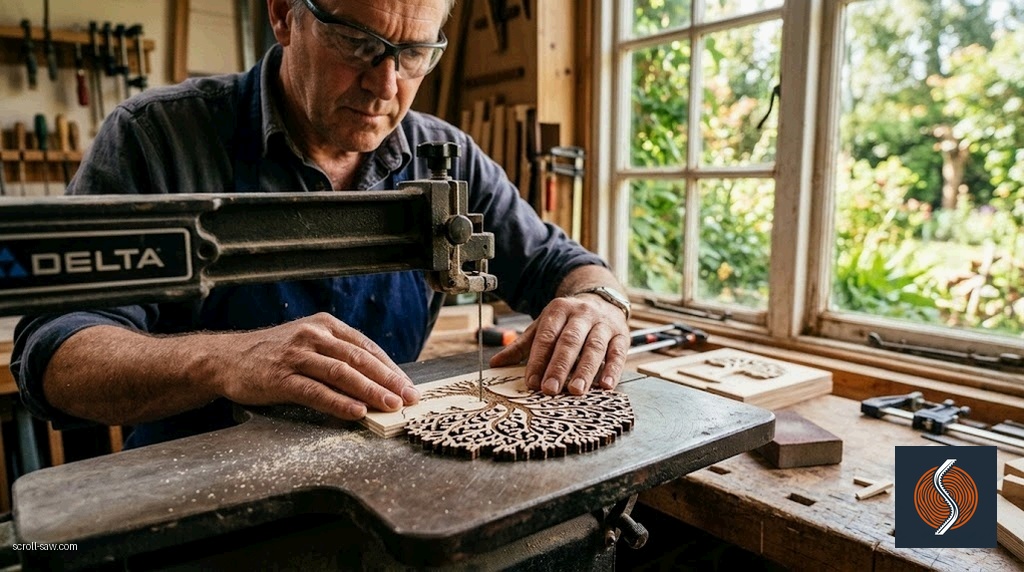
How to Cut Trivet Tree Scroll Saw Patterns Without Losing the Fine Details
A trivet tree is a clever piece of scroll saw work. It is a Christmas tree silhouette with the branches cut as heat-escape openings, meaning the piece can hold a hot pot at the holiday table without cupping or scorching, and it also stores flat as a decorative piece between meals. The design is functional and seasonal at the same time. The catch is that a piece designed to look like a tree has branches that project outward at exactly the angles that make them fragile, and thermal cycling under a hot pot punishes any weakness. This guide is how to cut a trivet tree that works as a trivet.
A trivet tree scroll saw pattern is a Christmas tree silhouette with fretwork branches cut on a scroll saw from 3/4-inch hardwood, sized 8 to 12 inches tall, functioning as both a decorative tree piece and a working trivet that holds hot pots and dishes on the table. It is finished with a food-safe or heat-tolerant finish.
The short version of the plan: 3/4-inch dense hardwood (maple, cherry, or beech) with tight uniform grain; open branch design giving at least 30 percent open area; #5 reverse-tooth blade for outlines and #3 for fine branch detail; cut fragile branch tips last with surrounding waste in place; and food-safe oil finish.
Why a trivet tree needs more than a decorative tree
A decorative Christmas tree silhouette hanging on a wall lives in stable conditions. A trivet tree lives on a Thanksgiving or Christmas table under a hot casserole dish, a heavy roasting pan, or a steaming pot of gravy. The two use cases have different demands.
Heat tolerance. The trivet tree needs to survive a hot pot base without cupping, scorching, or discoloring the wood. This means dense hardwood, adequate thickness, and 30 percent minimum open area for heat escape.
Stability. The piece must sit flat on a table without rocking under a heavy pot. Any warp or twist means the pot rocks and the hot pot base contacts the wood at fewer points, scorching those spots.
Strength at the branches. Branches project outward from the trunk. Every branch is a cantilever loaded by handling stress, and every branch has a fragile tip that can break during use or during storage.
Food-adjacent finish. The trivet is not in direct food contact, but it is in the food-preparation zone where finish smell during heat exposure is unwelcome. Skip polyurethane and lacquer; both off-gas under a hot pot base.
Wood species for a trivet tree
Dense uniform hardwoods with tight grain are the honest choices for a trivet tree.
Maple. The workhorse. Dense, hard, uniform grain, tolerates heat without discoloring, cuts cleanly under a #5 blade in 3/4-inch stock.
Cherry. Warmer tone than maple, slightly less dense but still heat-tolerant. Darkens gracefully over holiday seasons of use and looks warmer against candles and greenery.
Beech. European trivet classic. Very dense, tight grain, tolerates heat well.
Baltic birch plywood. The beginner-friendly option. Ply grain resists cupping better than any solid wood; heat tolerance is adequate for holiday use. The tradeoff is ply lines showing at the branch edges.
Skip open-grain woods (oak, ash) for trivet trees; the open grain absorbs food splatter and moisture. Skip softwoods (pine, fir, cedar) entirely; they cup and scorch on the first hot pot.
Branch geometry and heat escape
A trivet tree pattern is a decorative Christmas tree with branches drawn as fretwork openings. Branch geometry has to do two things: read as a Christmas tree visually, and provide enough open area for heat and steam escape under a hot pot.
Branch spacing. Traditional tree patterns have four to six tiers of branches, each tier slightly wider than the one above. Branches should be closely enough spaced that the tree reads as a tree, and open enough that heat escapes.
Open area to solid area. A working trivet needs at least 30 percent open area. Below that, heat trapped under the pot base scorches the wood. Above 50 percent, the tree starts to look sparse and structural strength suffers.
Border retention. Even a fretwork trivet tree needs a solid outer border around the tree profile so the piece has structural integrity. The border should be at least 1/8 inch wide at the narrowest point.
Trunk width. The trunk at the base of the tree is where the piece is picked up and handled. Keep the trunk at least 1/2 inch wide at the base; thinner trunks crack under handling stress.
Blade choice and cutting sequence
A reverse-tooth #5 is the honest workhorse for a trivet tree in 3/4-inch maple or cherry. It handles the outer tree outline efficiently and cuts the larger branch openings comfortably. Drop to a #3 for the finest branch detail and for tight interior openings at the top of the tree where the geometry gets small.
Cut order:
First, drill every branch interior entry hole in the flat blank at the drill press. A 1/16-inch brad point clears a #5 blade for the branch openings; a 1/32-inch bit clears a #3 for the finest work.
Second, cut the smallest branch openings first, working from the top of the tree downward. The top of the tree has the smallest, tightest branch openings with the most surrounding support.
Third, cut the larger branch openings toward the base of the tree.
Fourth, cut the outer tree outline. Approach any fragile branch tip from the supported inner side and free the tip as the last cut on that tier.
Fifth, cut the trunk profile at the base of the tree.
Fragile branch tips and how to save them
Every branch tier on a Christmas tree ends in a point at the outermost tip. These points are fragile by design; a branch tip that is too thick reads as blocky and defeats the tree aesthetic, and a branch tip that is too thin snaps under handling stress.
Branch tip thickness minimum: 1/8 inch at the very tip in 3/4-inch stock. Thinner branch tips break during finishing or during the first holiday season of use.
Branch tip grain direction: if using solid wood, orient the pattern so the tree trunk runs with the grain. This puts every branch tip crossing the grain at some angle, and there is no way around it. Dense uniform hardwoods handle this cross-grain stress better than open-grain woods; softwoods do not handle it at all.
Cut every branch tip from the supported inner side toward the tip, freeing the tip as the last cut in each tier. Never cut a branch tip early in the sequence; the vibration of subsequent cuts on adjacent branches breaks the freed tip.
Trunk and base handling
The trunk at the base of the tree is the trivet’s structural spine. It bears the weight of the pot above and the handling stress of being lifted between uses.
The bottom of the trivet tree needs to sit flat on the table. Two approaches: cut the bottom edge as a straight horizontal line so the whole trunk width sits on the table; or cut small feet that form a stable tripod. Straight bottom is simpler and safer.
Sand the bottom face flat with a block on 120 then 220. Check flatness with a straight edge in two directions across the face. A trivet tree with even a 1/64-inch high spot rocks under a heavy pot and scorches at the contact point.
Finish for heat and food adjacency
A trivet tree lives near food and under hot pots, and the finish has to survive both. Three honest options:
Food-safe mineral oil applied generously. Traditional trivet finish. Nontoxic, forgiving under heat, and easy to reapply every few months.
Board butter (mineral oil plus beeswax blend). Same behavior as oil with a slight surface film that resists water spots and gives a warmer feel.
Hard wax oil (Osmo Polyx, Rubio Monocoat) cured per manufacturer. Modern professional option. Cures to a durable surface film that tolerates heat and food contact when fully cured.
Skip polyurethane, lacquer, and any film finish rated only for decorative indoor use.
Verdict
A trivet tree scroll saw pattern is a functional piece that has to work as a trivet under real holiday cooking. 3/4-inch dense uniform hardwood (maple, cherry, or beech). Pattern with at least 30 percent open area and 1/8-inch minimum border thickness. Reverse-tooth #5 for outlines and larger branch openings; #3 for the top tiers where geometry gets fine. Cut branches from the top down, tips last within each tier. Sand the bottom face flat. Finish with food-safe mineral oil, board butter, or cured hard wax oil.
For a first trivet tree, a 10-inch tree in 3/4-inch maple with a #5 and #3 blade progression and mineral oil finish is the honest starting combination.
FAQ
What wood is best for a scroll saw trivet tree? Maple, cherry, or beech in 3/4-inch stock. All are dense uniform hardwoods that tolerate heat without cupping or scorching. Baltic birch plywood is the beginner-friendly option.
How thick should stock be for a trivet tree? 3/4-inch is the honest default. Enough thermal mass to resist cupping under a hot pot; enough thickness to support fragile branch tips.
How much open area does a trivet tree need? At least 30 percent open by area for heat escape under a hot pot. Below that, trapped heat scorches the wood. Above 50 percent, the tree looks sparse.
What blade cuts trivet tree branches cleanly? A reverse-tooth #5 for outer tree outline and larger branch openings. A reverse-tooth #3 for the finer branch openings at the top of the tree.
What finish is safe for a scroll saw trivet tree? Food-safe mineral oil, board butter, or cured hard wax oil. All tolerate hot pot contact and food adjacency. Skip polyurethane and lacquer.
Why is my trivet tree cupping after use? Almost always insufficient thickness, wrong wood species, or a pattern with too little open area for heat escape. Move to 3/4-inch maple with at least 30 percent open area.
How thin can I cut trivet tree branch tips? Minimum 1/8-inch at the very tip in 3/4-inch stock. Orient the pattern so the trunk runs with the grain to give branches maximum cross-grain strength.
Can I use a trivet tree as a decorative wall piece too? Yes. Between meal uses, the trivet tree hangs on a wall or stands on a mantle as a decorative Christmas tree. Store flat between seasons.
References
-
FDA — Food contact substances guidance (fda.gov)
-
Fine Woodworking magazine — Trivet and heat-tolerant finish reference (finewoodworking.com)
-
Scrollsaw Workshop by Steve Good — Free scroll saw patterns (scrollsawworkshop.blogspot.com)


