
Cutting Wood Toy Scroll Saw Patterns: Entry Holes, Interior Cuts, and Assembly
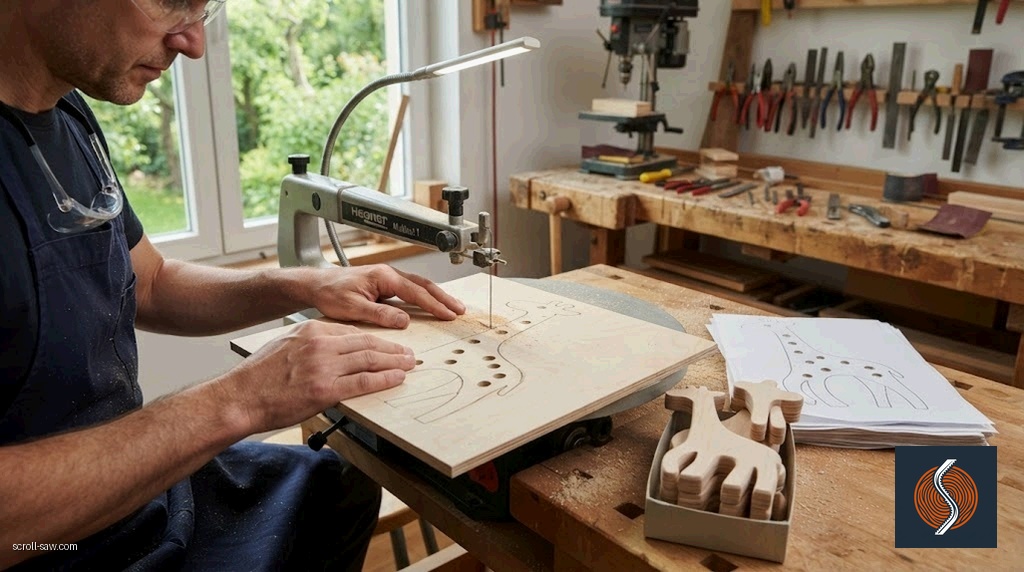
Cutting Wood Toy Scroll Saw Patterns: Entry Holes, Interior Cuts, and Assembly
A wood toy is a gift that lives on a shelf for a decade and gets pulled down every six months to be dragged across a floor, stuffed into a backpack, and sometimes chewed by a younger sibling. The scroll saw builds a lot of that kind of toy: pull-along dogs, wooden trains, chunky cars, animal families, and simple push toys. The trick is that a toy is not a decoration. It has to survive dropping onto a hardwood floor at speed, resist splintering when the paint chips, and hold wheels on axles even after years of rolling on rough concrete. The plan below is how to cut a scroll saw wood toy that actually holds up.
Wood toy scroll saw patterns are patterns for handheld or push-along wooden toys cut from 3/4-inch hardwood (rarely thicker for handling weight), sized 4 to 10 inches long depending on age target, and finished with a nontoxic child-safe finish. Common patterns include pull-toy dogs, wooden trains with detachable cars, cars and trucks, tractors, and animal families.
The short version of the plan: dense hardwood (maple, cherry, or beech) at 3/4-inch for body pieces, hardwood dowel for axles, wheel diameter matched to body proportion, reverse-tooth #5 blade for most cuts, #3 for interior details, and nontoxic finish (mineral oil, food-safe hard wax oil, or ASTM D-4236 certified paint).
Age target sets the safety rules
Toy design starts with the age of the child. Toys for children under three are covered by tighter safety rules than toys for older kids, and the pattern has to reflect that.
Under three years old. No small parts. Every removable piece must pass the small parts cylinder test (roughly, a 1-1/4 inch minimum dimension in any direction). No sharp edges. No exposed metal fasteners on external surfaces. Finish must be nontoxic and rated for children’s toys.
Three to six years old. Small removable parts allowed with parental supervision. Sharper edges still eased. Finish still nontoxic. Weight matters; a heavy hardwood truck at 2 pounds can bruise if dropped on a foot.
Six and up. Nearly any pattern works. Finish still needs to be nontoxic if the toy will be handled frequently or by younger siblings.
For a first toy build, target the six-and-up range unless you are specifically making a toy for a toddler with the tighter constraints in mind. Toddler-safe design is its own craft.
Wood species for scroll saw toys
Dense hardwoods with tight grain are the honest workhorses for wood toys. Reasons: they resist splintering when edges chip, hold axle holes without wallowing, and take finish evenly.
Maple. The traditional wood toy hardwood. Dense, hard, uniform grain, tolerates play well, cuts cleanly under a #5 blade in 3/4-inch stock. Sugar maple (hard maple) rather than red maple; hard maple is dense enough that axle holes stay tight across years of rolling.
Beech. European toy classic. Very dense, tight grain, dimensionally stable. The wood of choice for many high-end European wooden toys.
Cherry. Slightly softer than maple but still dense enough for toy work. Warmer color and darkens gracefully. Excellent for pieces where wood tone is the finish.
Baltic birch plywood at 3/4-inch. The beginner-friendly option. Ply grain resists cross-grain splintering; edges show ply lines that some builders like and some do not.
Skip pine, fir, cedar, and any softwood for toys with narrow projections (dog legs, animal necks, tractor exhaust stacks). Softwood splinters at edges under handling stress and can leave sharp shards that hurt.
Skip open-grain woods (oak, ash) for toys with rounded surfaces that get chewed or mouthed. Open grain harbors saliva residue.
Skip exotic hardwoods with known toxicity concerns (some rosewoods and tropical species) for any toy that a child will handle regularly.
Blade choice for scroll saw toys
A reverse-tooth #5 in 3/4-inch hard maple or cherry is the honest workhorse blade for toy body work. It cuts fast, produces clean edges, and handles the outlines of most toy patterns comfortably.
A reverse-tooth #3 for interior details on toys with fine cutouts (a locomotive with a cab window, an animal with pierced eye detail). Also for smaller wheel patterns when wheels are cut on the scroll saw rather than turned or purchased.
A reverse-tooth #7 for stack cutting two 3/4-inch body pieces at once (a train car with matching left and right sides). Slower cut, but the two sides come off the saw as an identical pair.
Blade tension and sharpness matter more on toys than on decorative pieces because toy patterns have consequential dimensions (wheel diameters, axle spacing). Cut with fresh blades and check tension between pieces.
Wheel work: cutting versus buying
Wheels are the single most consequential toy component. They have to spin freely on the axle, they have to be true (round) so the toy rolls straight, and they have to hold up to real rolling.
Cutting wheels on the scroll saw. Circles from 3/4-inch hardwood, sized to the toy (1 to 2 inches diameter for a small car, 2 to 3 inches for a large truck). Cut with a reverse-tooth #5 in a smooth continuous motion. Any dip in the cut shows as a wobble in the finished wheel and the toy tracks wrong.
Buying wheels. Toy suppliers sell precut hardwood wheels in standard sizes (1 inch, 1-1/2 inch, 2 inch, 2-1/2 inch, 3 inch) with axle holes pre-drilled. Wheels are true, priced reasonably, and available in maple or beech.
For a first scroll saw toy, buying wheels is the honest approach. Bought wheels are truer than most scroll-cut wheels, and the time saved is real. Cut your own wheels once you have several toys under your belt and want the visual integrity of matching wood species throughout.
Wheel diameter to body proportion matters visually. Pull-toy dogs and cars look right with wheels that are roughly one-third the height of the body; trains look right with slightly smaller wheels relative to the body length. Trust the pattern for proportion.
Axle work: dowels, holes, and clearances
Axles are hardwood dowel, sized to match the wheel hole. Standard axle sizes: 1/4 inch dowel with 5/16 inch wheel hole (loose fit for spin); 3/16 inch dowel with 7/32 inch wheel hole for smaller toys.
Axle hole in the body. Drill straight through the body at the drill press, sized to the axle for a snug press fit (axle diameter, no clearance). This holds the axle in the body while the wheels turn on the axle ends.
Axle hole in the wheel. Sized 1/32 inch larger than the axle diameter for smooth spin. Any tighter and the wheel binds; any looser and the wheel wobbles.
Axle length. Cut so each wheel has 1/16 to 1/8 inch clearance between the wheel outer face and the axle end cap or the axle retainer.
Wheel retention on the axle. Two approaches:
Axle cap (wooden or plastic disc glued to the axle end outside the wheel). Traditional, safe, replaceable.
Axle peg with washer. Slightly more involved; classic look on higher-end toys.
Avoid metal nails or screws as axles or wheel retainers on toys for children under six. Wood-on-wood and wood-on-glue joints are safer.
Cutting sequence for a wood toy
Cut order for a typical pull-toy or vehicle body:
First, drill every hole in the flat blank at the drill press. Axle holes, pull-string holes, decorative through-holes. Every hole is drilled square before the outline is cut.
Second, cut interior openings (a train cab window, an animal eye cutout, a truck bed opening). These are cut with the blank at maximum surrounding support.
Third, cut the outer body outline. Approach fragile projections (a pull-toy dog’s tail, an animal’s ear, a locomotive’s exhaust stack) from the supported side and free them as the last cut.
Fourth, cut wheels (if cutting your own) as separate pieces.
Fifth, sand every piece and break every edge. Toy edges must be free of splinters and any hard corners eased.
Sixth, assemble: press axles into body, thread wheels onto axles, cap axle ends.
Edge easing is non-negotiable
Toy edges must be free of splinters and hard corners. Every edge on every toy piece gets attention.
Main body edges: hand-sand or router-round to a 1/8 inch radius on any hard corner. This gives a comfortable hand-feel and eliminates any sharp corner that could cut or splinter.
Interior cutout edges: 220-grit strip, folded, worked around every opening. Any tearout at the cutout entry hole gets sanded smooth.
Bottom edges (the surface that sits on a floor): 220 flat sand to remove any high spot, then 320 to break the perimeter.
Check every edge by rubbing a finger along it. If it catches, sand more.
Finish for wood toys
Toy finish has to be nontoxic. Three honest options:
Food-safe mineral oil. The simplest, safest finish. Nontoxic, reapplyable, and gives a subtle sheen to hardwood. The traditional wooden toy finish for European workshops.
Board butter (mineral oil plus beeswax). Same behavior as oil with a slight surface film that reads warmer.
Certified nontoxic paint. Any paint labeled compliant with ASTM D-4236 (Standard Practice for Labeling of Art Materials) for chronic health hazards. Read the label; the certification is a real chemical test, not a marketing claim. Water-based acrylic craft paints from major brands typically meet ASTM D-4236.
Hard wax oil (Osmo Polyx). Modern professional option. Cures to a durable film that survives play and cleans up with a damp cloth. Follow the manufacturer’s cure time.
Skip conventional polyurethane, alkyd enamel, and any finish not certified for children’s toys. These are formulated for furniture, not for handling by toddlers.
Verdict
Scroll saw wood toy patterns produce heirloom pieces if the plan handles the material and safety demands honestly. Dense hardwood (maple, cherry, or beech) at 3/4-inch for body pieces. Bought hardwood wheels for a first toy; scroll-cut wheels once you have a rhythm. Hardwood dowel axles with proper wheel clearance. Every edge eased to break splinter risk. Nontoxic finish (mineral oil for pure natural, ASTM D-4236 paint for color).
For a first scroll saw wood toy, a simple pull-toy dog in 3/4-inch hard maple with 2-inch bought wheels, 1/4-inch dowel axles, and mineral oil finish is the honest starting combination. It teaches the toy cutting sequence, wheel and axle geometry, and finish choice; every subsequent toy scales up from that base.
FAQ
What wood is best for scroll saw toys? Hard maple, beech, or cherry at 3/4-inch. All are dense hardwoods with tight grain that resist splintering under play. Baltic birch plywood is the beginner-friendly option. Avoid softwoods and open-grain hardwoods for toys with narrow projections.
Should I cut my own wheels or buy them? Bought hardwood wheels for a first toy. They are truer than most scroll-cut wheels and save real time. Cut your own once you want matching wood species throughout the toy.
What axle diameter should I use for wood toys? 1/4-inch hardwood dowel with 5/16-inch wheel hole for most toys. 3/16-inch dowel with 7/32-inch wheel hole for smaller toys. Always drill wheel holes 1/32 inch larger than axle diameter for smooth spin.
What finish is safe for wood toys? Food-safe mineral oil, board butter (oil plus beeswax), or paint certified compliant with ASTM D-4236 for chronic health hazards. Hard wax oil (Osmo Polyx) cures to a durable child-safe surface. Skip conventional polyurethane.
How do I keep wheels from falling off wood toys? Axle caps: small wooden or plastic discs glued to the axle ends outside the wheels. Traditional and safe. Avoid metal nails or screws as axle retainers on toys for children under six.
How do I make wood toys safe for children under three? No small removable parts (1-1/4 inch minimum dimension in any direction), no sharp edges (1/8-inch radius minimum), no exposed metal fasteners, and finish certified for children’s toys. Consult CPSC toy safety guidance for the specifics before building.
How thick should stock be for wood toys? 3/4-inch is the honest default for most vehicle and animal toys. Below 3/4-inch, the toy feels flimsy. Above 3/4-inch, the toy gets heavy enough to bruise if dropped on a foot.
Can beginners tackle scroll saw wood toys? Yes. Start with a simple pull-toy dog or a chunky wooden car with bought wheels. The cuts are forgiving, the assembly is straightforward, and the finished piece is genuinely useful. Complex trains and animal families follow naturally.
References
-
U.S. Consumer Product Safety Commission — Toy safety standards and small parts guidance (cpsc.gov)
-
ASTM International — ASTM D-4236 Standard Practice for Labeling of Art Materials (astm.org)
-
Fine Woodworking magazine — Wood toy design and finish reference (finewoodworking.com)


