
Making 3D Chess Set Scroll Saw Patterns: From Pattern to Clean Finished Edges
Making 3D Chess Set Scroll Saw Patterns: From Pattern to Clean Finished Edges
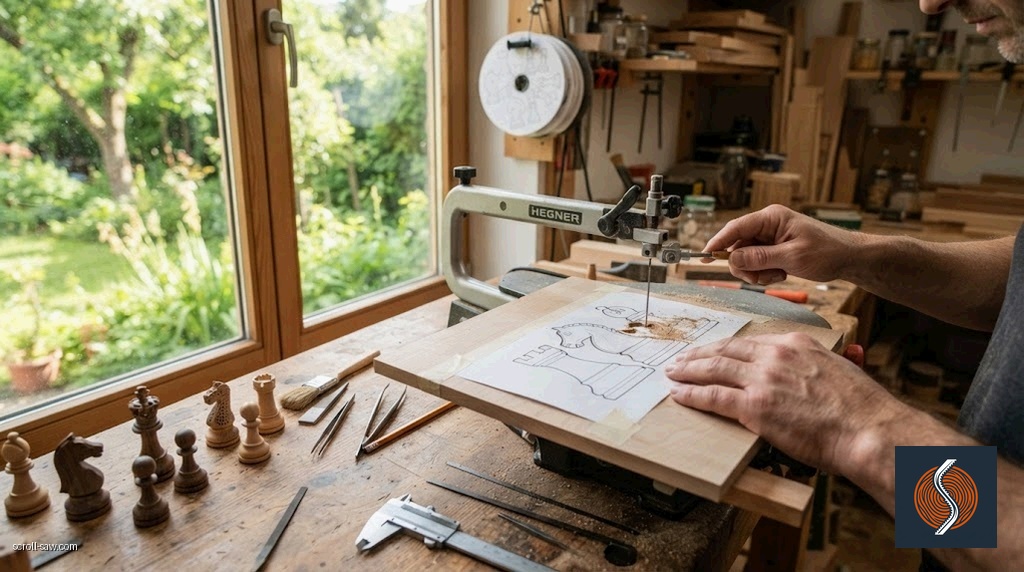
A 3D compound chess set is one of the most ambitious scroll saw projects. It is 32 pieces (16 per side), each cut as a compound blank producing a fully three-dimensional chess piece. The pieces have to scale together (pawns clearly shorter than knights, knights clearly shorter than rooks, and so on to the kings), the two sides have to visually distinguish (usually by wood species, but sometimes by finish alone), and every piece has to feel right in the hand for actual play. This guide is how to plan the whole set so the pieces come off the saw as a coherent set.
A 3D compound chess set scroll saw pattern is a set of six two-view compound patterns (pawn, rook, knight, bishop, queen, king) that produce three-dimensional chess pieces from square-section blanks. Blank sizes scale with piece hierarchy: pawns from 1-inch square, kings from 2 to 2-1/2 inch square. Sixteen pieces per side, 32 total pieces for a complete set.
The short version of the plan: two contrasting hardwoods (light and dark) at matching cross-sections per piece type, established compound chess pattern from an experienced designer, reverse-tooth #7 or #9 blade progression depending on cross-section, careful taping between cuts on every piece, and unified finish across all 32 pieces per side.
Piece hierarchy and blank sizing
Standard chess piece hierarchy from shortest to tallest: pawn, rook, knight, bishop, queen, king. Blank cross-sections and lengths should follow this hierarchy so the pieces scale visually.
A reasonable set of blank sizes for a mid-size scroll saw chess set:
Pawns. 1-inch square blank, 2 to 2-1/2 inches long. Eight per side, 16 total.
Rooks. 1-1/4 inch square blank, 2-1/2 to 3 inches long. Two per side, 4 total.
Knights. 1-1/4 inch square blank, 3 to 3-1/2 inches long. Two per side, 4 total.
Bishops. 1-1/4 inch square blank, 3 to 3-1/2 inches long. Two per side, 4 total.
Queens. 1-1/2 inch square blank, 3-1/2 to 4 inches long. One per side, 2 total.
Kings. 1-1/2 to 2-inch square blank, 4 to 4-1/2 inches long. One per side, 2 total.
Larger sets scale everything up proportionally. Smaller travel sets scale down but pieces below 1-inch square get fussy to cut and handle.
Light and dark side: wood species choice
Chess sets require visually distinct sides. Two approaches:
Contrasting wood species. Maple for the light side, walnut for the dark side. Both are dense enough for chess pieces (holds detail, resists chipping) and the color contrast is clean. Traditional and honest.
Alternative pairings: cherry (medium warm) versus walnut (dark) for a warmer light-dark contrast; maple versus wenge for a stark contrast; or beech versus rosewood for a European classical look.
Single species with two finishes. Both sides cut from the same wood, then one side finished with a dark stain or dye to contrast with the other. Simpler wood sourcing but the finish distinction is less durable and less crisp than natural wood contrast.
For a first scroll saw chess set, maple and walnut in matching cross-sections is the honest choice. Both are available in stable stock, both cut cleanly on the scroll saw, and both take wipe-on oil finish beautifully.
Blade progression for chess pieces
Blade choice follows cross-section as with any compound cutting:
1-inch square blanks (pawns). A reverse-tooth #7 blade. Fast enough cutting for 16 pawns per side without excessive time; clean cut face on the smaller cross-section.
1-1/4 inch square blanks (rooks, knights, bishops). A reverse-tooth #7 or #9 depending on preference. #7 gives finer detail on the knight (which has the most complex compound geometry); #9 cuts faster on the simpler rook and bishop.
1-1/2 to 2-inch square blanks (queens, kings). A reverse-tooth #9 blade. Handles the thicker cross-section with good speed.
Fresh blade for each piece type. A dull blade widens kerf and shifts finished piece dimensions, and a chess set that varies in dimension across pieces looks amateurish.
The knight: the pattern’s hardest cut
The knight is the visually most complex chess piece. Its compound pattern shows a horse’s head with mane, muzzle, and eye detail, and every one of those features is fragile in compound cutting.
The knight’s fragile features:
Ears. Two small projections at the top of the head. Cut from the supported side inward, freeing the ear tips as the last cut in that area.
Muzzle. The forward-projecting nose. Follow the pattern exactly; scaling the muzzle even slightly can put the tip below the minimum stock thickness for the blank.
Mane. A projection at the back of the head/neck. Fragile because it is a large open geometry that becomes an unsupported cantilever during the second cut.
Eye detail. If the pattern includes a small pierced or shallow-cut eye, it demands a #3 or #5 blade for cleanliness. Optional detail; some patterns omit the eye and rely on shading during finish.
Cut the knight after several simpler pieces in the set. Do not attempt the knight first; the compound cutting rhythm is best established on the pawns and rooks before tackling the knight’s complex geometry.
Cutting sequence across the set
Cut order for the full 32-piece set:
First, cut all 16 pawns. Same pattern repeated 16 times gives good cutting rhythm and identifies any pattern or blade issues early on a low-consequence piece.
Second, cut the 4 rooks. Simpler compound geometry than knights, bishops, or royals; a natural next step.
Third, cut the 4 bishops. Slightly more complex geometry than rooks (mitered tip) but not as demanding as knights.
Fourth, cut the 4 knights. Most complex compound geometry in the set. Cut after establishing rhythm on simpler pieces.
Fifth, cut the 2 queens. Complex but generally more forgiving than knights; the queen’s crown detail is less fragile than the knight’s ears and mane.
Sixth, cut the 2 kings. Tallest pieces in the set; compound geometry similar to queens but scaled up.
For each piece, follow the standard compound cutting sequence: front-view pattern applied to front face and side-view pattern applied to adjacent side face, first cut, careful taping, second cut. Change blades to fresh at least between each piece type transition (pawns to rooks to knights, and so on).
Base treatment: flat versus contoured
Every chess piece needs a base that sits flat on the board. Compound patterns produce pieces where the base is the bottom of the blank (an inch or two of square cross-section).
Option 1: leave the base as the compound cut face. The compound cut produces a square-sided base that sits flat on the board. Simple, honest, and pieces do not tip.
Option 2: round or ease the base perimeter with a router or file. Adds visual softness at the base but requires additional work and can compromise stability if overdone.
Option 3: felt or leather pad on the base. Traditional on high-end chess sets. Silent when moved on a hard board and protects the board surface. Cut a felt pad slightly smaller than the base and glue with contact cement.
For a first scroll saw chess set, option 1 (leave the compound base) is the honest choice. Consider felt pads once the set is complete and you want the finished feel of a traditional chess set.
Sanding and finishing across 32 pieces
Batch sanding across the set is where a scroll saw chess set project becomes a real time investment. Every piece has multiple compound faces and edges.
Sand every piece with 120, 220, and 320 in progression. Focus on the compound cut faces; the visible surfaces during play are the piece’s four side profiles and its top.
Batch finish across the set. All 16 light-wood pieces in one finish session; all 16 dark-wood pieces in a separate session (unless using the same finish for both). Wipe-on oil at two thin coats is the honest choice.
Wipe-on tung oil for maple gives a warm honey tone. Wipe-on tung oil or Danish oil for walnut deepens the dark color and highlights the compound geometry. For a starker contrast, leave maple raw or apply a very light mineral oil, and finish walnut with a Danish oil at two coats.
Skip film finishes on chess pieces; they add visual weight to the compound geometry and can transfer to the board during play. Skip paint; the wood contrast is the visual distinction.
Storage: keeping the set organized
A finished scroll saw chess set benefits from proper storage. Two approaches:
Drawstring bag or divided pouch. Simple, portable, protects the pieces from dust and knocks. Suitable for casual play sets.
Wooden storage box with felt-lined dividers. Traditional high-end approach. Cut the box to hold all 32 pieces plus the board (if the board is also scroll saw work); line each divider with felt to prevent scratches.
For a first set, a drawstring bag is honest. Consider building a wooden storage box once the set is complete and appreciated.
Verdict
A 3D compound scroll saw chess set is one of the most ambitious projects on the machine and one of the most rewarding when finished. Two contrasting hardwoods (maple and walnut is the honest first choice). Blank cross-sections scaled from 1-inch for pawns up to 1-1/2 to 2-inch for kings. Reverse-tooth #7 blade for pawns and smaller pieces, #9 for queens and kings. Cut all pawns first, then rooks, bishops, knights, queens, kings. Careful taping between cuts on every piece. Batch sanding and finishing across the set with wipe-on oil.
For a first scroll saw chess set, plan for a month of workshop time. It is not a weekend project. When the set is complete, it is an heirloom piece that gets played and passed down.
FAQ
What wood is best for a 3D scroll saw chess set? Maple for the light side, walnut for the dark side. Both are dense enough for chess pieces, both cut cleanly on the scroll saw, and the color contrast is clean and traditional. Alternative pairings include cherry versus walnut, or beech versus rosewood.
What size blanks do I need for a scroll saw chess set? 1-inch square for pawns, 1-1/4 inch square for rooks/knights/bishops, 1-1/2 inch square for queens, 1-1/2 to 2-inch square for kings. Blank lengths scale with piece hierarchy from 2 inches for pawns to 4-1/2 inches for kings.
What blade cuts scroll saw chess pieces? A reverse-tooth #7 for 1-inch and 1-1/4 inch cross-sections (pawns through bishops). A reverse-tooth #9 for 1-1/2 to 2-inch cross-sections (queens and kings). Fresh blade for each piece type.
Which chess piece is hardest to cut on a scroll saw? The knight. Its compound pattern shows a horse’s head with ears, muzzle, and mane, all fragile in compound cutting. Cut the knight after establishing rhythm on pawns and rooks first.
How long does a full scroll saw chess set take? A month of workshop time is realistic for 32 compound pieces. Cut time alone: 20 to 30 hours for a mid-size set. Add taping, sanding, and finishing: another 15 to 25 hours. Not a weekend project.
Can I mix wood species within one side of the chess set? No. Every piece on the light side should be the same wood (say maple), and every piece on the dark side the same wood (say walnut). Mixing woods within a side breaks the visual coherence of the set.
What finish is best for a scroll saw chess set? Wipe-on oil at two thin coats. Tung oil or Danish oil are honest choices. Batch finish across the set (all light pieces in one session, all dark pieces in another). Skip film finishes.
Do I need to add felt to the bases of scroll saw chess pieces? Not required, but traditional on high-end sets. Felt pads make the pieces silent when moved on a hard board and protect the board surface. Cut felt slightly smaller than the base and glue with contact cement.
References
-
Fine Woodworking magazine — Scroll saw compound and heirloom project reference (finewoodworking.com)
-
Popular Woodworking — Compound scroll saw and chess pieces (popularwoodworking.com)
-
Scrollsaw Workshop by Steve Good — Free 3D compound chess patterns (scrollsawworkshop.blogspot.com)


