
Cutting American Flag Scroll Saw Pattern: Entry Holes, Interior Cuts, and Assembly
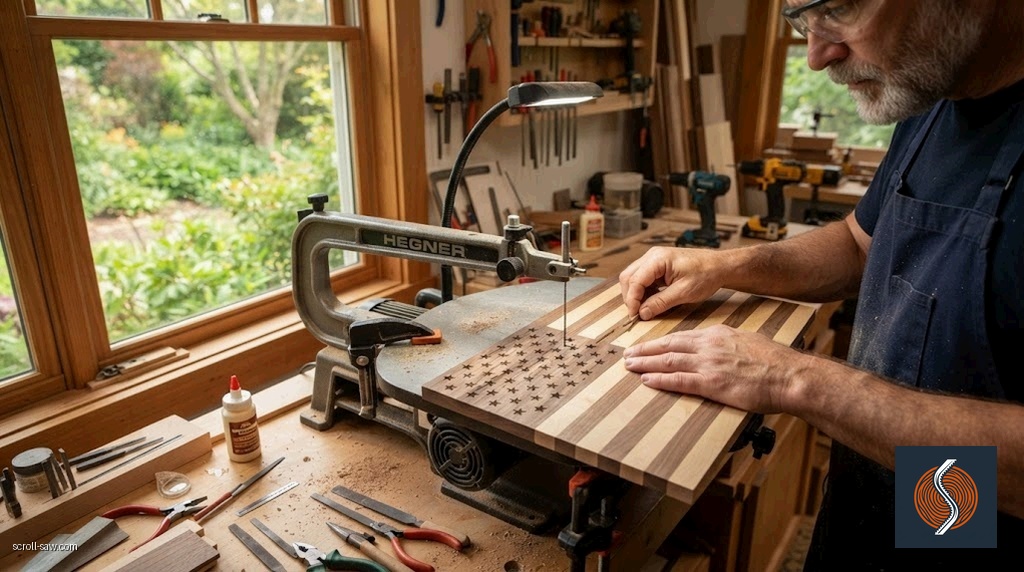
Cutting American Flag Scroll Saw Pattern: Entry Holes, Interior Cuts, and Assembly
An American flag scroll saw pattern is a distinctly American workshop project. It commemorates service, hangs in workshops and homes across the country, and represents something specific about the maker’s connection to the flag. The pattern is not particularly complex geometrically, but it demands attention to proper flag proportions (the ratio of hoist to fly, the position of the union, the sizing of the stars and stripes) so the finished piece reads correctly rather than approximately. This guide is how to cut an American flag that reads as a flag and honors the pattern properly.
An American flag scroll saw pattern is a wooden representation of the flag of the United States cut on a scroll saw from 1/2 to 3/4-inch stock, sized 12 to 30 inches wide, with 13 alternating stripes (7 red and 6 white, but rendered in wood tone), a blue union in the upper-left corner (usually rendered in a contrasting wood or painted), and 50 stars in the union. Applications include wall art, workshop signage, and commemorative pieces.
The short version of the plan: 3/4-inch stock (cherry, walnut, or oak for wood-tone flags; poplar or Baltic birch for painted flags), proper flag proportions (10:19 hoist-to-fly ratio for the official US flag), reverse-tooth #5 for stripe cuts and stripe separations, #3 for star fretwork in the union, and finish that respects the flag rather than covers it.
Flag proportions matter
The United States flag has specific proportions established by executive order. Getting them right is what makes a scroll saw flag read as the American flag rather than a red-white-and-blue rectangle.
Hoist to fly ratio: 10 to 19. If the hoist (vertical dimension, height) is 10 units, the fly (horizontal dimension, width) is 19 units. A 12-inch tall flag is 22.8 inches wide. A 15-inch tall flag is 28.5 inches wide.
Union dimensions: 7 stripes tall (7/13 of the hoist) and 2/5 of the fly wide. On a 10-by-19 flag, the union is 7 by 7.6.
Stripe widths: 13 equal horizontal stripes, each 1/13 of the hoist.
Star arrangement: 50 stars in the union arranged in 9 alternating rows (6 rows of 6 stars and 5 rows of 5 stars, staggered). Star point diameter roughly 4/5 of the row height.
Most scroll saw flag patterns handle these proportions correctly. Verify before cutting; a pattern with wrong proportions produces a flag that looks off to anyone who has served under the flag.
Stock choice
Solid hardwood at 3/4-inch is the honest workhorse for wood-tone flags. Reasons: takes stripes as engraved or shallow-cut divisions rather than through-cuts (giving visual separation without weakening the flag), holds the union as a separate wood species inlaid or applied, and takes finish evenly.
Cherry or oak at 3/4-inch for a warm-tone flag. Cherry darkens with age and reads warmer over years. Oak has strong grain that gives the flag a rustic character.
Walnut at 3/4-inch for a formal or commemorative piece. Dark and dramatic; often paired with maple or ash stripe accents for contrast.
Baltic birch plywood at 3/4-inch for a painted flag. Cuts predictably, holds paint well, and gives a stable base for a flag that will be painted in traditional red-white-and-blue.
Poplar at 3/4-inch for a painted flag on a budget. Cheaper than Baltic birch, cuts well, and takes paint uniformly.
Avoid pine and softwoods for detailed flag work. Star fretwork and stripe separations crack.
Wood-tone versus painted flag
Two primary approaches to a scroll saw flag:
Wood-tone flag. Uses one wood species for the whole flag with stripes rendered as shallow surface cuts or engraved separations. Union is a contrasting wood (walnut on a maple flag, or maple on a walnut flag) either inlaid into a recessed pocket or applied as a raised layer. Stars are fretwork cut through the union. Traditional workshop flag; reads as a wood piece first and a flag second.
Painted flag. Uses one wood species (Baltic birch or poplar) with the entire flag painted in traditional colors after cutting. Stripes are through-cut separations and painted red or white. Union is painted blue. Stars are cut through the union as fretwork and left as the wood tone underneath, or painted white. Traditional patriotic display flag; reads as a flag first.
For a first scroll saw flag, wood-tone in cherry or oak is the honest workshop choice. It looks natural in most rooms and does not require paint application skill. Painted flags require careful masking and multiple color coats.
Blade choice
A reverse-tooth #5 in 3/4-inch cherry or walnut is the honest workhorse for the outer flag outline and any stripe separation through-cuts.
A reverse-tooth #3 for star fretwork in the union. Fine control on 50 small five-point stars.
A #2 for very fine star detail on smaller flags (under 15-inch fly). At smaller flag sizes, star size drops proportionally and #3 blades widen the star gaps too much.
For engraved or shallow-cut stripe separation (not through-cuts), a router with a straight bit or a chisel is more effective than the scroll saw. The scroll saw cuts through the stock; stripe separations that stop at half-depth are surface work.
Cutting sequence for a wood-tone flag with inlaid union
Cut order for a wood-tone flag:
First, cut the flag outline as a rectangle to proper proportions. This is a straight straightforward cut on the scroll saw or table saw.
Second, cut a rectangular pocket in the upper-left corner for the union inlay. This is router work with a straight bit, not scroll saw work.
Third, from a contrasting wood (typically walnut on a cherry flag), cut a rectangle to fit the union pocket. This is the star field.
Fourth, drill entry holes for every star fretwork opening at the drill press. A 1/32-inch bit clears a #3 blade.
Fifth, cut all 50 stars as fretwork openings on the scroll saw with a #3 blade. Each star is a small closed cut from the entry hole back to the entry hole.
Sixth, glue the union inlay into the pocket with Titebond II. Clamp evenly. Wipe squeeze-out immediately.
Seventh, apply stripe separations. For a wood-tone flag, this is usually shallow router-cut grooves (1/16 inch deep) at each stripe boundary, painted or stained darker to read as separations. Alternative: apply a thin dark inlay strip along each stripe boundary.
Cutting sequence for a painted flag
Cut order for a painted flag:
First, cut the flag outline to proper proportions.
Second, cut the union boundary as a straight through-line, dividing the union from the stripes. This is done on the scroll saw or table saw.
Third, drill star entry holes at the drill press. Cut all 50 stars as fretwork with a #3 blade.
Fourth, cut stripe separations as through-cuts or shallow router grooves. Through-cuts give the flag a fretwork look; router grooves give a solid flag with painted stripe boundaries.
Fifth, sand the entire flag with 220 then 320.
Sixth, mask and paint. The 7 red stripes and 6 white stripes require careful masking with painter’s tape; the union requires blue paint; the stars if painted white require another mask coat. Alternative approach: leave the stars as raw wood tone showing through the blue union.
Seventh, remove masks and apply a light clear topcoat.
Sanding and finishing
Wood-tone flags: sand with 220 then 320 across every face. Break every edge with a folded strip. Finish with wipe-on Danish oil or tung oil at two to three thin coats. Oil brings out the natural color contrast between the flag body and the darker union inlay.
Painted flags: sand with 220 before painting. Apply primer coats (two thin coats) before color paints. Apply color paints in traditional order (red stripes and blue union first, then white stripes if masking, or white stripes as raw wood). Clear topcoat at one to two thin coats after color paints cure.
Skip heavy gloss finishes on flags. A flag reads best in a satin or matte finish; high-gloss reads as a plastic replica rather than a wooden flag.
Common flag cutting mistakes
| Mistake | What actually happened | Fix |
|---|---|---|
| Flag proportions look off; not clearly the American flag | Wrong hoist-to-fly ratio in the pattern | Verify 10:19 ratio before cutting; adjust pattern if needed |
| Union is wrong size or position | Pattern used non-standard union proportions | Verify union is 7 stripes tall and 2/5 of fly wide before cutting |
| Stars look off or misaligned | Pattern used 4-row or 5-row star arrangement | Verify 9-row alternating (6-5-6-5-6-5-6-5-6) arrangement |
| Stripe separations look inconsistent | Depth or width varied across the flag | Router with a straight bit and edge guide for consistent stripe grooves |
| Painted flag has paint bleed at stripe boundaries | Painter’s tape lifted between coats | Press tape firmly with a burnishing tool; seal edges with the same color as the underlying paint before applying the contrast color |
Verdict
An American flag scroll saw pattern is a project that rewards attention to proper proportions and cutting sequence. The plan is not complicated. Solid hardwood at 3/4-inch for a wood-tone flag; Baltic birch or poplar at 3/4-inch for a painted flag. Verify 10:19 hoist-to-fly ratio and standard union proportions before cutting. Reverse-tooth #5 for outlines and stripes; #3 for star fretwork. Cut union inlay pocket with a router, star fretwork with the scroll saw. Finish with wipe-on oil or careful painted layers.
For a first scroll saw American flag, a 15-inch fly wood-tone cherry flag with walnut union inlay and Danish oil finish is the honest starting combination. It teaches proper flag proportions and inlay technique; every subsequent flag scales up from that base.
FAQ
What are the correct proportions for an American flag scroll saw pattern? Hoist-to-fly ratio 10:19. Union 7 stripes tall (7/13 of hoist) and 2/5 of the fly wide. 13 equal horizontal stripes. 50 stars arranged in 9 alternating rows (6-5-6-5-6-5-6-5-6). These are established by executive order and produce a flag that reads correctly.
What wood is best for an American flag scroll saw pattern? Cherry, oak, or walnut at 3/4-inch for wood-tone flags with a contrasting wood union inlay. Baltic birch plywood or poplar at 3/4-inch for painted flags. Avoid pine and softwoods.
Should I make a wood-tone or painted American flag? Wood-tone for a workshop flag that reads natural in most rooms and does not require paint skill. Painted for a traditional patriotic display flag with authentic red-white-and-blue colors. Both are honest approaches.
What blade cuts star fretwork on an American flag? A reverse-tooth #3 blade for 50 fretwork stars in the union. A #2 for very fine star detail on flags smaller than 15-inch fly.
How do I inlay a union into a wood-tone flag? Cut a rectangular pocket in the flag body with a router and straight bit sized to fit the union rectangle. Cut the contrasting wood (walnut, or maple on a walnut flag) to fit the pocket exactly. Glue with Titebond II and clamp evenly.
How do I get clean paint lines on a painted American flag? Mask stripe and union boundaries with painter’s tape. Press tape firmly with a burnishing tool to prevent lift. Seal tape edges with the underlying color before applying the contrast color; this prevents paint bleed under the tape edge.
Are there rules for displaying a wooden American flag? The US Flag Code applies to actual fabric flags, not wooden art representations. However, honoring the pattern by getting proportions right, star arrangement correct, and finish respectful is a matter of pride for most makers. Skip novelty variations (flags with skulls, wings, or altered star counts) for a proper flag.
What finish is best for a wooden American flag? Wipe-on Danish oil or tung oil at two to three thin coats for wood-tone flags. Primer and color coats plus one clear topcoat for painted flags. Skip high-gloss finishes; matte or satin reads best.
References
-
Fine Woodworking magazine — Scroll saw and inlay reference (finewoodworking.com)
-
Popular Woodworking — Scroll saw flag and patriotic project techniques (popularwoodworking.com)
-
Scrollsaw Workshop by Steve Good — Free scroll saw American flag patterns (scrollsawworkshop.blogspot.com)


