
Celtic Scroll Saw Patterns: A Project Plan That Anticipates Fragile Cuts
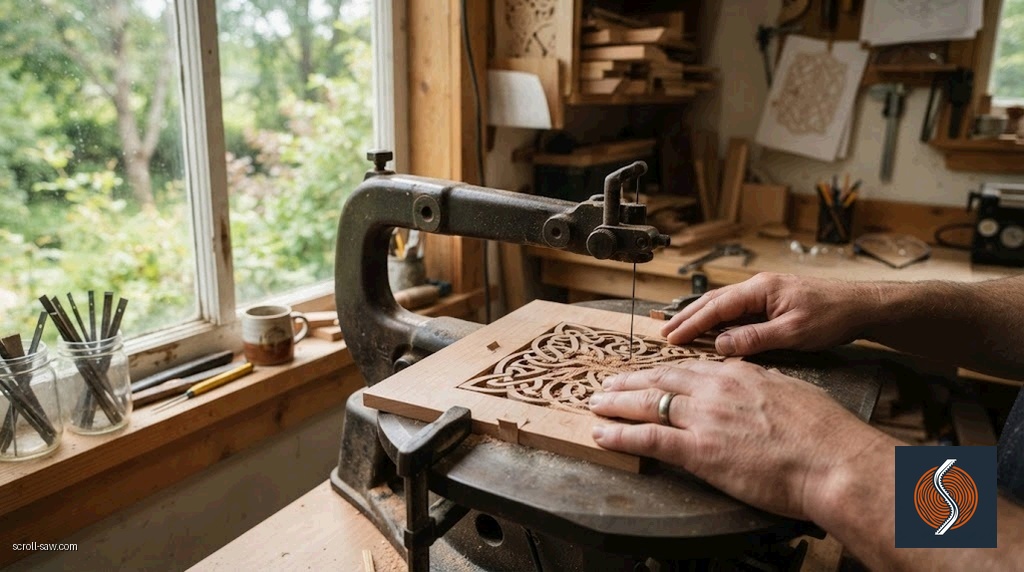
Celtic Scroll Saw Patterns: A Project Plan That Anticipates Fragile Cuts
Celtic scroll saw patterns are a family of related designs that share a visual language: interlaced strands, endless loops, spiral motifs, and symbolic significance rooted in early medieval Celtic art. The family includes knots (Trinity knot, love knot, shield knot, dragon knot), crosses (Celtic cross, high cross variants), interlace panels (Book of Kells inspired panels), spirals, and combinations of all four. This guide is a plan for the whole family so a scroll saw shop can tackle any Celtic pattern with the same core approach.
Celtic scroll saw patterns are fretwork patterns of Celtic art and symbolism cut on a scroll saw from 1/4 to 3/4-inch stock, including Celtic knots, Celtic crosses, interlace panels, spirals, and hybrid designs. Applications include wall art, memorial pieces, gift plaques, ecclesiastical decorative work, and heritage display pieces.
The short version of the plan: Baltic birch plywood at 3/8 to 1/2-inch for most patterns (grain-neutral supports fine strand junctions in every direction), reverse-tooth #3 blade for fine fretwork, cut interior openings from center outward, verify strand junctions before each next cut, and finish with wipe-on oil.
The Celtic family: five categories
Celtic scroll saw patterns fall into five categories, each with its own considerations:
Celtic knots. Interlaced strand designs with over-under crossings. Trinity knot, love knot, endless knots. See the Celtic knot guide for detailed cutting sequence.
Celtic crosses. Christian crosses with Celtic interlace at the crossing and often within the arms. The Celtic cross is the single most requested Celtic scroll saw pattern.
Interlace panels. Rectangular or square panels of interlaced strand work, sometimes with animals (birds, dragons, hounds) worked into the interlace. Complex; Book of Kells inspired.
Spirals. Single spirals, triple spirals (triskele), and connected spiral motifs. Simpler than interlace but demand clean curved cuts.
Hybrid designs. Combinations of two or more categories: a Celtic cross with spiral motifs, an interlace panel with knot centers, a knot with spiral corners. Most elaborate scroll saw Celtic patterns are hybrids.
Each category shares the same core cutting approach; the differences are in specific fragile features and cutting sequence for the particular pattern.
Stock choice for Celtic patterns
Baltic birch plywood at 3/8 to 1/2-inch is the honest first-Celtic stock across all five categories. Reasons: alternating ply grain gives strength at fine strand junctions in every direction; the surface reads clean under a satin finish; and the wood is stable across seasonal humidity so pieces do not shift after cutting.
1/4-inch Baltic birch works for smaller pieces (under 8-inch diameter or panel) or lighter hanging pieces.
3/4-inch Baltic birch works for larger display pieces where visual weight matters (a 15-inch Celtic cross wall piece, for instance).
Solid hardwood (cherry, maple, walnut) at 1/2 to 3/4-inch works for premium display pieces. Grain orientation is where solid wood Celtic patterns get challenging; many strand junctions cross grain regardless of blank orientation. Choose solid wood only after several Baltic birch pieces have established comfort with the pattern family.
Skip open-grain woods (oak, ash) for detailed Celtic patterns. Grain figure distracts from the interlacing pattern and open grain can splinter at fine strand tips.
Skip pine and softwoods entirely. Strand junctions crack.
Blade choice
A reverse-tooth #3 in 3/8 to 1/2-inch Baltic birch is the honest workhorse for Celtic fretwork across all pattern categories.
A reverse-tooth #2 for very fine strand work in interlace panels or elaborate hybrid designs. Not the default because cutting speed drops significantly with finer blades, but essential for the finest Celtic patterns.
A reverse-tooth #5 for the outer boundary of larger pieces (over 12-inch diameter). Faster cut on the outer profile without compromising interior detail.
Blade tension is critical on Celtic fretwork because the interior openings are many and the strand junctions between them are narrow. Under-tensioned blades wander at strand junctions and widen them; over-tensioned blades break mid-cut on a long fretwork session. Set tension carefully; pluck-test.
Reading Celtic patterns before cutting
Celtic patterns share a common reading challenge: identifying every interior opening, every strand junction, and (for knots and interlace) every over-under crossing.
A quick pre-cut ritual for any Celtic pattern:
First, count the interior openings and mark each with a small dot at the intended entry hole location. Every opening needs a drilled entry hole before cutting.
Second, identify every strand junction (the narrow bridges between strands). Mark any junction narrower than 1/4 of the stock thickness as a fragile junction that requires careful sequence.
Third, on knots and interlace, mark the over strand at every crossing. Use a colored highlighter or a pencil dot.
Fourth, on Celtic crosses, verify the arm proportions match the traditional Celtic cross design (three shorter arms and one longer stem, all connected by a central ring).
With the pattern read carefully, cutting proceeds systematically. Skipping this reading step causes cutting sequence errors that break strand junctions or misread crossings.
Cutting sequence for Celtic patterns
Cut order across the Celtic family:
First, drill every interior entry hole in the flat blank at the drill press. Count the openings and drill them all in one session. A 1/32-inch bit clears a #3 blade.
Second, cut every interior fretwork opening. Take each as a closed cut from the entry hole back to the same hole.
Cut order within openings: work from the center of the pattern outward. Center openings are surrounded by the most remaining wood; edge openings have less support. Center first, edge last.
For Celtic crosses, cut the central ring interior openings first (they have the most surrounding support), then the arm interior openings, then any decorative openings within the arms.
For knots, cut the innermost openings first (the loops at the center of the knot), working outward through the strand sequence.
For interlace panels, cut opening by opening in a serpentine or grid pattern to maintain consistent blade rhythm and pattern support.
Third, cut any shallow overlap cuts at over-under crossings (on knots and interlace). Shadow cuts must be very shallow to preserve strand junction integrity.
Fourth, cut the outer boundary as the last cut, freeing the finished piece from the surrounding waste.
Common fragile features across Celtic patterns
Across the Celtic family, certain features are consistently fragile:
Ring junctions on Celtic crosses. The central ring meets each arm at a junction that has strand widths from the ring and from the arm meeting at a narrow bridge. Fragile.
Strand end tips on knots. Some knot designs have strand ends that terminate in points or curls; these tips are fragile.
Interior openings with tight curves. Blade drift at tight interior curves widens the opening and can weaken adjacent strand junctions.
Corner strand junctions on interlace panels. At corners, strand junctions have less surrounding support and are more fragile than junctions in the panel interior.
Spirals with tight inner turns. The center of a spiral turn is where the strand thickness is at its minimum; fragile.
Before cutting each fragile feature, verify surrounding strand support is still intact. If any adjacent strand junction is compromised, delay the fragile feature cut and revisit the sequence.
Sanding and finishing
Sand every face flat with 220 then 320. Ease every interior opening edge with a folded 320 strip. Ease outer boundary with 320.
For Baltic birch Celtic pieces, wipe-on oil at two thin coats brings out ply layering and gives a warm finish. Skip heavy topcoats; they cover the fine fretwork detail.
For solid hardwood Celtic pieces, wipe-on Danish oil or tung oil at two to three thin coats. Wood tone shows through the fretwork geometry.
Optional gilding or accent color. Traditional Celtic decorative work sometimes used gold leaf or dark blue accents at specific pattern elements (letter interiors on interlace panels, ring interiors on crosses). Modern scroll saw Celtic work can adopt this selectively for a museum-quality display piece; use gold leaf sheets and adhesive size following the manufacturer instructions.
Skip heavy gloss finishes. Celtic patterns read best in satin or matte finish.
Verdict
Celtic scroll saw patterns are a rewarding family with a shared core approach. Baltic birch plywood at 3/8 to 1/2-inch for most patterns; solid hardwood at 1/2 to 3/4-inch for premium display pieces. Reverse-tooth #3 blade with fresh sharpness. Read the pattern carefully before cutting. Drill every interior entry hole in one session. Cut interior openings from center outward, shallow overlap cuts at crossings, outer boundary last.
For a first Celtic scroll saw project, a simple Celtic cross or a Trinity knot in 3/8-inch Baltic birch with wipe-on oil finish is the honest starting combination. Interlace panels and elaborate hybrid designs follow naturally once the family’s core approach is comfortable.
FAQ
What are the main categories of Celtic scroll saw patterns? Five categories: Celtic knots (interlaced strands), Celtic crosses (Christian cross with interlace), interlace panels (rectangular or square strand work), spirals (single, triple, or connected), and hybrid designs (combinations of the above).
What wood is best for Celtic scroll saw patterns? Baltic birch plywood at 3/8 to 1/2-inch for most patterns. Grain-neutral so strand junctions have support in every direction. Solid hardwood at 1/2 to 3/4-inch for premium display pieces where visual weight and wood tone matter.
What blade cuts Celtic scroll saw patterns cleanly? A reverse-tooth #3 in Baltic birch is the honest workhorse across the Celtic family. A #2 for very fine strand work. A #5 for the outer boundary of larger pieces.
How do I read a Celtic scroll saw pattern before cutting? Count interior openings and mark each entry hole location. Identify fragile strand junctions (narrower than 1/4 stock thickness). Mark over strands at every crossing on knots and interlace. Verify pattern proportions match traditional Celtic art conventions.
What is the cutting sequence for Celtic patterns? Drill every interior entry hole first. Cut interior fretwork openings from center outward. Cut shallow overlap cuts at crossings on knots and interlace. Cut outer boundary last.
How thick should stock be for Celtic scroll saw patterns? 3/8 to 1/2-inch Baltic birch for most patterns. 1/4-inch for small pieces under 8-inch. 3/4-inch for larger display pieces where visual weight matters.
Can I make Celtic memorial pieces on a scroll saw? Yes. Celtic crosses are widely used as memorial markers, gift plaques, and remembrance pieces. Cherry, walnut, or Baltic birch at 3/4-inch with careful oil finish makes a memorial piece that displays for decades.
What finish is best for Celtic scroll saw pieces? Wipe-on Danish oil or tung oil at two to three thin coats. Optional gilding or accent color on specific pattern elements for museum-quality display pieces. Skip heavy gloss finishes.
References
-
Fine Woodworking magazine — Scroll saw and Celtic fretwork reference (finewoodworking.com)
-
Popular Woodworking — Scroll saw Celtic and decorative techniques (popularwoodworking.com)
-
Scrollsaw Workshop by Steve Good — Free scroll saw Celtic patterns (scrollsawworkshop.blogspot.com)


