
Chess Set Scroll Saw Pattern: A Project Plan That Anticipates 32 Pieces
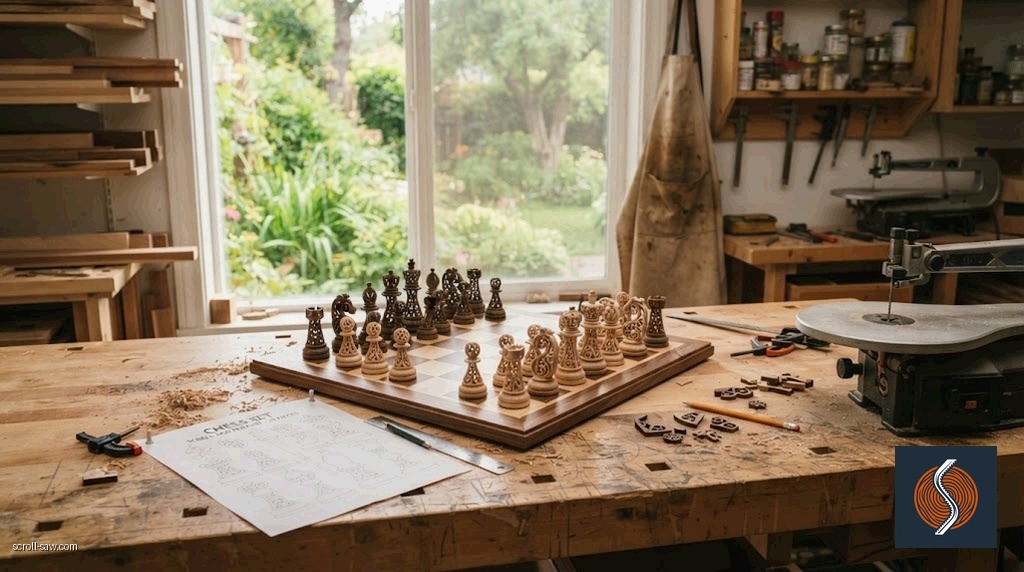
Chess Set Scroll Saw Pattern: A Project Plan That Anticipates 32 Pieces
A chess set is one of the more ambitious scroll saw projects. It is 32 pieces total (16 per side) with six distinct piece types (king, queen, bishop, knight, rook, pawn), each requiring compound cutting or another 3D approach to produce recognizable three-dimensional chess pieces. The catch: within a set, all 8 pawns must match each other, all 4 knights must match, and each piece type on both sides must be identical except for wood color. Consistency across many pieces is the real challenge. This guide is a plan for making a scroll saw chess set that reads as a chess set rather than 32 approximate pieces.
A chess set scroll saw pattern is a set of six chess piece patterns (king, queen, bishop, knight, rook, pawn) cut on a scroll saw using compound cutting from square-section blanks. A complete set is 32 pieces: 8 pawns, 2 rooks, 2 knights, 2 bishops, 1 queen, and 1 king per side, in two contrasting wood species. Applications include display sets, playable sets, and gift chess sets.
The short version of the plan: compound cutting from 1 to 2-inch square blanks in cherry and walnut (or maple and walnut) for wood-tone contrast, reverse-tooth #9 blade for the compound cuts, batch cutting to ensure consistency within a piece type, and finish that lets both wood species show their natural color.
Chess set piece types and their 3D geometry
A chess set has six piece types, each with distinctive geometry:
King. The tallest piece with a cross at the top. Usually 3 to 4 inches tall on a display set. Compound geometry is straightforward: a tall body with a small cross projecting from the top.
Queen. Slightly shorter than the king with a crown at the top (usually stylized as points or a decorative circle). Compound geometry similar to king.
Bishop. Medium height with a distinctive mitre (pointed top) with a slit. Compound geometry includes the mitre point and the mitre slit as a shallow cut.
Knight. The horse-head piece. The most complex compound geometry because the horse head profile is irregular and asymmetric.
Rook. The castle tower piece. Compound geometry is a squat body with a crenellated (battlement) top. The crenellations require careful cutting on all four faces.
Pawn. The simplest piece. Compound geometry is a small body with a rounded top.
Heights typically scale: king 3.5 inches, queen 3.25 inches, bishop 3 inches, knight 2.75 inches, rook 2.5 inches, pawn 2 inches. Verify the pattern shows proper scaling before cutting.
Stock choice for a scroll saw chess set
Square-section blanks in the honest chess-set woods:
Cherry (light side) and walnut (dark side). Traditional chess set contrast. Cherry darkens with age and reads warmer over years; walnut is dark and dramatic. Blanks: 1 to 2 inches square section, cut to length for each piece type.
Maple (light side) and walnut (dark side). More contrast than cherry-walnut; maple is very light and reads formal.
Basswood (light side) and stained walnut (dark side). Basswood is soft and cuts easily but does not have strong grain figure; suitable for a first chess set.
Beech (light side) and walnut (dark side). Beech is dense and takes compound cutting well; slightly less contrast than maple-walnut.
Blank sizing: pawn blanks 1 by 1 by 2 inches. Rook blanks 1 by 1 by 2.5 inches. Bishop 1 by 1 by 3 inches. Knight 1 by 1 by 2.75 inches. Queen 1 by 1 by 3.25 inches. King 1 by 1 by 3.5 inches. Use consistent 1-inch square cross-section across the set for cutting rhythm; adjust length per piece type.
For larger tournament-sized pieces, scale to 1.5 or 2-inch cross-section. Larger blanks take a #9 or #12 blade for compound cutting.
Blade choice for compound cutting
A reverse-tooth #9 in 1-inch cross-section blanks is the honest workhorse for chess set compound cutting.
A reverse-tooth #12 for 2-inch cross-section blanks or larger tournament pieces.
A reverse-tooth #7 for smaller 3/4-inch cross-section pieces (unusual, but some designer patterns specify).
Blade tension is critical on compound cutting because the two cuts (front view and side view) must produce clean edges without blade drift. Under-tensioned blades wander at the deep cut sections; over-tensioned blades break during long compound cutting sessions. Set tension carefully.
Blade sharpness matters. Fresh blade for every 4 to 6 pieces of the same type; a dull blade widens the compound cut and shifts finished dimensions.
Batch cutting for consistency
A chess set has 8 pawns, 4 knights, 4 rooks, 4 bishops, 2 queens (one per side), 2 kings. Within each piece type, pieces must match each other within visible tolerance.
Batch cutting produces consistency:
Cut all 8 pawns as one batch. All 8 blanks cut to identical length, all 8 with the same pattern applied to two faces, all 8 cut with the same blade on the same day.
Cut all 4 knights as one batch.
Cut all 4 bishops as one batch.
Cut all 4 rooks as one batch.
Cut the 2 kings as a pair. Cut the 2 queens as a pair. These are single pieces per side so consistency is between the two identical pieces of that type.
Within a batch, use the same blade throughout. Change blades between batches. This means the pawns are all cut with the same blade wear; the knights with a different blade in the same wear pattern.
Batch cutting is what separates a scroll saw chess set that reads as a set from 32 approximate pieces.
Compound cutting sequence for one piece
Cut order for a single chess piece (repeat for each piece in the set):
First, apply the pattern. The blank has two faces marked: the front view pattern on one face, the side view pattern on the adjacent face. Adhere both patterns with spray adhesive or peel-and-stick.
Second, cut the front view. Start at the top of the pattern and cut around the front view profile back to the starting point. This removes the waste from the front and back of the blank.
Third, tape the waste back in place. Use painter’s tape or clear packing tape around the entire blank, securing the waste that was just cut away. This restores the blank to a square section for the second cut.
Fourth, rotate the blank 90 degrees so the side view pattern is now on top.
Fifth, cut the side view. Cut around the side view profile back to the starting point. This removes the waste from the sides of the blank.
Sixth, remove the tape. The finished piece is the intersection of the front and side view profiles: a fully three-dimensional chess piece.
Sanding and finishing come after all 32 pieces are cut.
Sanding and finishing
Sand every face of every piece with 220 then 320. On chess pieces, the piece is handled during play, so smooth finish matters. Ease every edge with 320 or 400.
For cherry-walnut or maple-walnut sets, wipe-on Danish oil or tung oil at two to three thin coats. Both wood species take oil finish evenly and both develop natural warmth over time.
For basswood pieces (light side), stain first with a natural or medium stain (basswood is very light and often reads too pale next to walnut without a light stain). Then oil finish.
For tournament pieces where dice-like handling is expected, add a wipe-on polyurethane at one thin coat over the oil for handling durability. Skip heavy gloss.
Weight the pieces if desired. Chess sets traditionally have small lead or steel weights inserted in the base for a satisfying feel during play. Drill a 3/8-inch hole in the base of each piece 1 inch deep, insert a metal slug, and glue the slug in place with epoxy. Cover the hole with a felt disk.
Bases: many chess sets include a felt disk on the base of each piece for silent play and protection of the chessboard. Trace and cut felt disks to match each piece’s base diameter; glue with contact cement.
Common chess set cutting mistakes
| Mistake | What actually happened | Fix |
|---|---|---|
| Pieces within a type do not match each other | Batch cutting was inconsistent; blade wore between pieces | Batch cut all pieces of a type on the same day with the same blade |
| Knight head geometry looks off | Compound cutting produced asymmetric result | Verify front and side view patterns are correctly registered on adjacent faces of the blank before cutting |
| Pieces are too light or too heavy | Wood species density differences not accounted for | If using two species with very different densities, weight pieces of the lighter species to match |
| Piece bases scratch the chessboard | Base finish is too rough or piece has no felt disk | Sand base with 320 and 400; apply felt disk to every piece |
| King or queen top decorative feature broke during cutting | Feature was too fragile in the stock chosen | Larger cross-section blank or thicker top feature in pattern |
Verdict
A scroll saw chess set is a rewarding ambitious project that punishes inconsistent execution. The plan is not complicated but every step matters. Cherry and walnut or maple and walnut in 1-inch square-section blanks. Reverse-tooth #9 blade for compound cutting. Batch cut each piece type on the same day with the same blade. Sand every face and every edge. Finish with wipe-on oil. Optional weighting and felt disks for play-quality pieces.
For a first scroll saw chess set, start with the pawns (8 pieces of the simplest geometry). Cutting 8 matching pawns builds the consistency discipline the rest of the set demands. Once the pawns are cut and finished as a set, the other piece types follow naturally.
FAQ
What wood is best for a scroll saw chess set? Cherry and walnut for traditional chess set contrast that develops warmth over years. Maple and walnut for more formal contrast. Basswood and stained walnut for a first-set project on easier-to-cut stock.
What blade cuts chess pieces cleanly? A reverse-tooth #9 in 1-inch cross-section blanks. A #12 for 2-inch tournament-sized pieces. A #7 for smaller 3/4-inch pieces on unusual designer patterns.
How do I make chess pieces match within a set? Batch cutting. Cut all 8 pawns as one batch on the same day with the same blade. Cut all 4 knights as one batch. Cut all 4 bishops and all 4 rooks similarly. The pair of kings and pair of queens as a paired cut. Consistent blade wear across a batch produces consistent piece dimensions.
What is compound cutting on a scroll saw? Cutting a three-dimensional piece from a square-section blank by applying two patterns (front view and side view) to adjacent faces, cutting the first view, taping waste back in place, rotating 90 degrees, and cutting the second view. The finished piece is the intersection of the two profiles: a fully three-dimensional shape.
How tall should scroll saw chess pieces be? Standard display set: king 3.5 inches, queen 3.25 inches, bishop 3 inches, knight 2.75 inches, rook 2.5 inches, pawn 2 inches. Tournament sets scale larger to 4 to 5 inches for the king.
Should I weight scroll saw chess pieces? Optional. Traditional tournament sets have small lead or steel weights in the base for a satisfying feel. Drill a 3/8-inch hole in the base 1 inch deep, insert a metal slug, glue with epoxy, cover with a felt disk. Display sets often skip weighting.
How do I keep pieces from scratching the chessboard? Sand the base with 320 and 400 to smooth. Apply a felt disk to the base of every piece with contact cement. The felt silences play and protects the board.
How long does a scroll saw chess set take to cut? Depends on skill and stock size. Compound cutting a single 1-inch cross-section piece takes 15 to 25 minutes. A full 32-piece set is 8 to 15 hours of cutting spread across several sessions.
References
-
Fine Woodworking magazine — Scroll saw compound cutting reference (finewoodworking.com)
-
Popular Woodworking — Scroll saw chess set and 3D techniques (popularwoodworking.com)
-
Scrollsaw Workshop by Steve Good — Free scroll saw chess patterns (scrollsawworkshop.blogspot.com)


