
How to Cut Disney Scroll Saw Patterns Without Losing the Fine Details
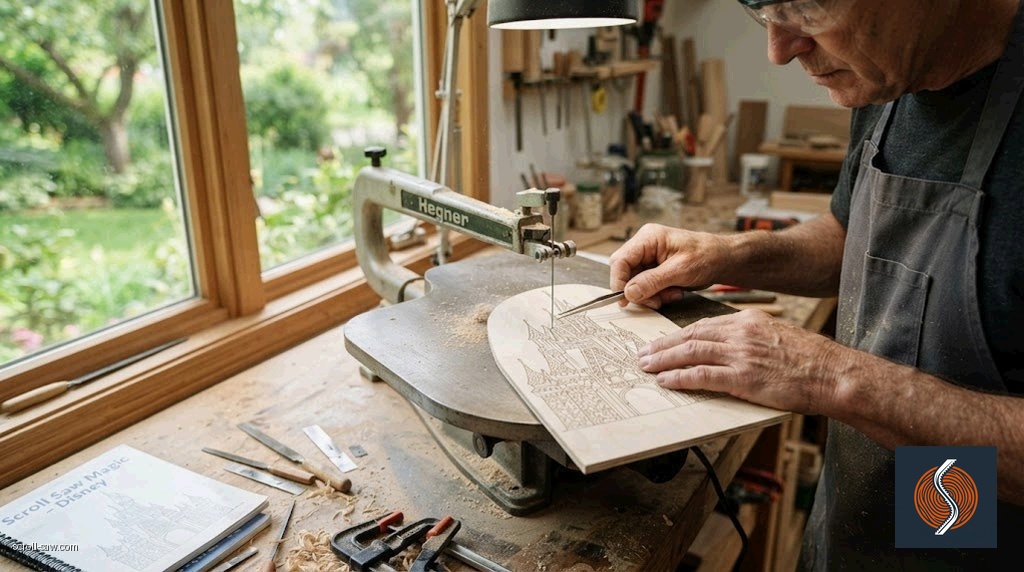
How to Cut Disney Scroll Saw Patterns Without Losing the Fine Details
Disney scroll saw patterns are character portraits with a particular challenge: the finished piece must read as the specific Disney character. A Mickey Mouse silhouette is defined by two round ears at specific angles; get those wrong and the piece reads as a generic mouse. A princess silhouette is defined by hair and gown geometry; simplify too much and it reads generic. This guide is how to cut Disney patterns so the finished piece reads unambiguously as the intended character.
Disney scroll saw patterns are silhouette or fretwork patterns of Disney characters (Mickey, Minnie, Donald, princesses, Winnie the Pooh, and others) cut on a scroll saw from 1/4 to 3/4 inch stock, sized 4 to 15 inches, with attention to the specific features that make each character recognizable. Applications include children’s room decor, Disney fan display pieces, gift plaques, and nursery signage.
The short version of the plan: 3/4 inch Baltic birch or hardwood, reverse-tooth #5 for outline and #3 for fine features, character-specific fragile-feature awareness (Mickey’s ears, princess hair curls, Winnie the Pooh’s rounded body proportions), cutting sequence that preserves character-defining detail, and finish appropriate for children’s room decor.
A note on trademark. Disney characters are trademarked and copyrighted. Scroll saw work using Disney characters is generally acceptable for personal use and personal gifts. Commercial sale of Disney character pieces without licensing is a copyright and trademark violation. For sale pieces, use inspired-by designs that are your own original interpretation rather than direct copies.
The character-specific challenge
Each Disney character has features that define recognizability:
Mickey Mouse. Two round ears at specific angles (roughly 45 degrees from vertical), rounded head, and characteristic body proportion. Ear angle is critical; wrong angle produces a generic round-eared mouse.
Minnie Mouse. Same round ears as Mickey plus a large hair bow. Bow proportions matter.
Donald Duck. Distinctive beak profile, sailor hat, and body proportion. Beak shape is character-defining.
Princess characters (Cinderella, Belle, Ariel). Hair silhouettes and gown geometry vary between princesses. Each has specific hair curl patterns and gown shapes.
Winnie the Pooh. Rounded body, small ears at specific angles, and the belly proportion. Rounded softness is character-defining; sharp corners break the character read.
Goofy and Pluto. Long droopy ears, specific muzzle shapes. Ear length and angle are character-defining.
Olaf (Frozen). Rounded snowman shape with specific stick arms and carrot nose. Arm angle and nose shape define recognition.
Before cutting any Disney pattern, identify the two or three features that make the character recognizable. Protect those features in cutting sequence.
Stock choice for Disney patterns
3/4 inch Baltic birch plywood is the honest workhorse for Disney character pieces. Grain-neutral so character-defining features have support in every direction. Takes paint well for character-color pieces.
1/2 inch Baltic birch for smaller pieces (under 8 inch tall) or hanging ornaments.
3/4 inch solid hardwood (cherry, maple, walnut) for wood-tone display pieces where character reads through silhouette rather than color.
3/4 inch poplar for painted pieces on a budget.
Skip pine and softwoods; fine character detail cracks.
Blade choice
A reverse-tooth #5 in 3/4 inch stock for Disney character outlines. Fast enough cutting, clean edges on gentle curves.
A reverse-tooth #3 for fine character detail: eye definition, mouth features, hair strand rendering, gown detail, and any pierced interior features.
A #2 for very fine detail on realistic princess portraits or Disney character portraits with hair strand fretwork. Not required for silhouette patterns.
Fresh blades matter on Disney patterns because character-defining features (ear angles, hair curls, beak shapes) punish blade wander.
Cutting sequence for Disney character patterns
Cut order:
First, drill every interior entry hole in the flat blank at the drill press: eye openings, mouth interior, character detail entry holes, hanger hole. A 1/32 or 1/16 inch bit clears the blade.
Second, cut interior character detail: eye openings, mouth interior, any pierced detail. Each is a closed cut from the entry hole back to the same hole.
Third, cut the outer character silhouette. Approach character-defining features (ears, princess hair, Donald beak) from the supported inner side. Free character-defining tips as the last cuts.
For Mickey Mouse: cut interior features first (eye, mouth if pierced). Cut the body outline starting from the feet upward, around the body, up to the head. Cut around each ear from the ear base outward, freeing the ear tip as the last cut on that ear. Cut both ears in sequence to maintain symmetry.
For Winnie the Pooh: cut interior features (eyes, nose, mouth). Cut the rounded body outline maintaining soft curves. Ear tips and paw tips as the last cuts.
For princess characters: cut interior features (face, gown detail). Cut hair curl detail with #3 blade before cutting the hair outer boundary. Free hair curl tips carefully; they are often the most fragile features.
Painting Disney character pieces
Many Disney pieces are painted in character-specific colors:
Mickey Mouse. Black body, red shorts with yellow buttons, yellow shoes, white face.
Minnie Mouse. Similar to Mickey plus red-and-white polka dot dress and hair bow.
Donald Duck. Blue sailor suit, yellow beak and feet, white body.
Paint sequence for character pieces:
First, primer at two thin coats.
Second, base coat in the character’s dominant color (typically the character body color).
Third, mask and paint each additional color in sequence from largest area to smallest.
Fourth, fine detail (eye whites, black eye pupils, mouth) with a fine brush.
Fifth, clear satin topcoat.
Skip heavy gloss finishes. Character pieces read best in satin or matte finish.
Common Disney pattern mistakes
| Mistake | What went wrong | Fix |
|---|---|---|
| Character reads generic; not clearly the specific Disney character | Character-defining feature was compromised in cutting or design | Identify the two or three features that make each character recognizable and protect them in cutting sequence |
| Mickey ear broke during cutting | Cut approached ear tip from unsupported side | Cut each ear from ear base outward, freeing tip as last cut |
| Princess hair curl detail lost | Blade too coarse or fresh blade needed | Use #3 blade or finer for hair detail; fresh blade throughout |
| Painted piece has paint bleed at color boundaries | Painter’s tape lifted between coats | Press tape firmly; seal tape edges with underlying color before applying contrast |
| Sold a Disney piece and got a legal notice | Trademark and copyright violation | Do not sell Disney character pieces without licensing; personal use and gifts only |
Verdict
Disney scroll saw patterns are rewarding character pieces that punish cutting shortcuts. The plan is not complicated. 3/4 inch Baltic birch or hardwood. Reverse-tooth #5 for outline, #3 for fine detail. Identify character-defining features before cutting and protect them in the cutting sequence. Interior detail first, character silhouette second, character-defining feature tips freed last. Finish appropriate for the piece (oil for wood tone, character-color paint scheme for classic Disney display).
For a first Disney scroll saw pattern, a simple Mickey Mouse silhouette in 3/4 inch Baltic birch with wipe-on oil or painted Mickey colors is the honest starting piece. Character-specific pieces (princesses, Donald, Pooh) follow naturally once character-defining feature awareness is comfortable.
FAQ
What wood is best for Disney scroll saw patterns? Baltic birch plywood at 3/4 inch for most character pieces (grain-neutral, takes paint well). Poplar for painted pieces on a budget. Solid hardwood for wood-tone display pieces.
What blade cuts Disney character patterns cleanly? A reverse-tooth #5 for character outline in 3/4 inch stock. A #3 for fine character detail (eyes, mouth, hair strands, character-specific features).
How do I make sure a Disney pattern reads as the intended character? Identify the two or three character-defining features (Mickey’s ear angles, Donald’s beak, princess hair curls) and protect them in cutting sequence. Fresh blades; careful approach to fragile features.
Can I sell Disney scroll saw pieces? Disney characters are trademarked and copyrighted. Commercial sale without licensing is illegal. Personal use, personal gifts, and inspired-by original designs are the honest approach.
How do I paint a Disney character piece? Primer at two coats, base coat in the character’s dominant color, mask and paint each additional color from largest area to smallest, fine detail with a fine brush, clear satin topcoat.
What is the cutting sequence for Mickey Mouse? Drill entry holes (eye, mouth if pierced, hanger). Cut interior features. Cut body outline from feet upward. Cut around each ear from ear base outward, freeing ear tip as the last cut on that ear.
How thick should stock be for Disney patterns? 3/4 inch for most patterns. 1/2 inch for smaller pieces under 8 inch tall or hanging ornaments.
What finish suits a nursery Disney piece? Matte or satin finish. Skip heavy gloss. Water-based paints and finishes for children’s rooms; verify low-VOC or zero-VOC finishes for pieces displayed in nurseries.
References
-
Fine Woodworking magazine — Scroll saw and character portrait reference (finewoodworking.com)
-
Popular Woodworking — Scroll saw silhouette and children’s decor techniques (popularwoodworking.com)
-
Scrollsaw Workshop by Steve Good — Free scroll saw silhouette and inspired-by patterns (scrollsawworkshop.blogspot.com)


