
Making Eiffel Tower Scroll Saw Pattern: From Pattern to Clean Finished Edges
Making Eiffel Tower Scroll Saw Pattern: From Pattern to Clean Finished Edges
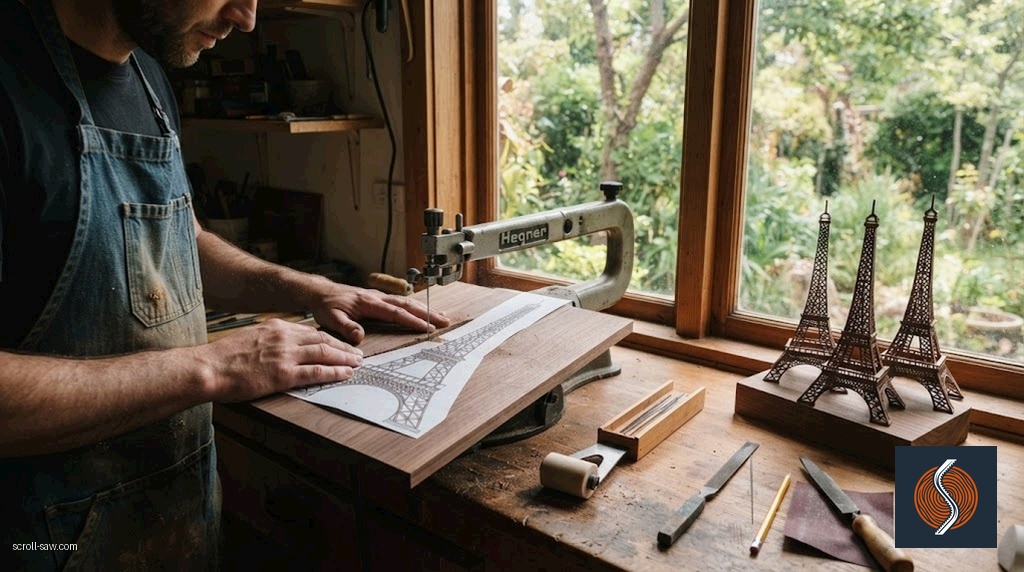
The Eiffel Tower is one of the most recognizable structures in the world, and its distinctive iron lattice geometry translates to scroll saw work as a demanding fretwork pattern. The tower’s silhouette is straightforward: a tall pyramid narrowing upward with four legs and a central platform structure. The challenge is the iron lattice detail: the crossing beams, arches, and structural members that give the tower its characteristic appearance. Rendering that lattice in wood without losing the structural definition takes careful cutting. This guide is how to cut an Eiffel Tower pattern that reads correctly.
Eiffel Tower scroll saw pattern is a fretwork pattern of the Eiffel Tower cut on a scroll saw from 1/4 to 1/2 inch stock, sized 8 to 24 inches tall, featuring the four-legged pyramid silhouette and interior lattice detail. Applications include Paris-themed decor, gift pieces for travel lovers, wedding and anniversary pieces, and decorative wall art.
The short version of the plan: 3/8 to 1/2 inch Baltic birch plywood (grain-neutral supports the crossing lattice), reverse-tooth #3 blade for fine lattice detail, cutting sequence that works from interior lattice outward to the outer silhouette, and finish that shows the fretwork.
Eiffel Tower silhouette and lattice geometry
The Eiffel Tower has distinctive silhouette elements:
Four legs. The tower stands on four legs that splay outward at the base and converge toward the center as they rise. The leg angles are recognizable; verify pattern shows the correct outward splay.
The first platform (about 1/4 of the way up). A horizontal band where the tower narrows and the observation deck sits.
The second platform (about halfway up). Another horizontal band.
The tapering upper section. From the second platform, the tower narrows steadily to the top.
The antenna at the top. A thin vertical extension.
The iron lattice. Diagonal crossing members visible through the tower’s exterior. On a scroll saw pattern, this is the interior fretwork that demands careful cutting.
Proportions matter. The tower’s height-to-base ratio and the leg splay angle are what make the silhouette recognizably Eiffel Tower rather than a generic tower.
Stock choice
3/8 to 1/2 inch Baltic birch plywood is the honest workhorse for Eiffel Tower scroll saw patterns. Grain-neutral so the crossing lattice has support in every direction; cuts predictably; holds a wipe-on oil finish that reads clean.
1/4 inch Baltic birch works for smaller patterns (under 10 inch tall) or lighter hanging pieces.
Solid hardwood at 1/2 inch (cherry, maple, walnut) works for premium display pieces. Grain orientation is complex on the Eiffel Tower because the lattice runs in every direction; Baltic birch is safer.
Skip pine and open-grain woods; lattice detail cracks or reads inconsistently.
Blade choice
A reverse-tooth #3 in 3/8 to 1/2 inch Baltic birch is the honest workhorse for Eiffel Tower fretwork.
A reverse-tooth #2 for very fine lattice detail on premium display pieces where the crossing members are thin and numerous.
A reverse-tooth #5 for the outer silhouette of larger patterns (over 15 inch tall).
Cutting sequence for Eiffel Tower patterns
Cut order:
First, drill every interior entry hole at the drill press. An Eiffel Tower pattern with detailed lattice may have 50 to 200 interior openings. Drill all in one session. A 1/32 inch bit clears a #3 blade.
Second, cut every interior lattice opening. Take each as a closed cut. Work from the center of the pattern outward: cut lattice openings in the upper tapering section first, then the mid-section between the platforms, then the base section between the legs.
Third, cut horizontal band separations at the two platforms. These are the recognizable platform features; cut them cleanly.
Fourth, cut the outer tower silhouette. Start at the base of one leg, cut up the outside of that leg, across the top platform, up the tapering section to the antenna top, and back down the other side. Approach the leg tips and antenna top from the supported inner side; free the leg tips and antenna top as the last cuts.
Sanding and finishing
Sand every face with 220 then 320. Ease every lattice opening edge with a folded 320 strip; this is tedious on a detailed Eiffel Tower pattern.
For Baltic birch pieces, wipe-on oil at two thin coats.
For solid hardwood pieces, wipe-on Danish oil or tung oil at two to three thin coats.
Optional darker finish for the iron-effect. A thin brown or black dye applied to the wood surface before oil coats gives the tower a darker iron-tone appearance suggestive of the actual iron structure. Apply carefully; wipe off excess before it dries.
Skip heavy gloss finishes.
Common Eiffel Tower pattern mistakes
| Mistake | What went wrong | Fix |
|---|---|---|
| Tower proportions look off | Wrong leg splay angle or wrong height-to-base ratio | Verify pattern shows characteristic Eiffel Tower proportions before cutting |
| Lattice detail lost during cutting | Blade wander or dull blade | Fresh #3 or #2 blade; slow feed rate on fine lattice |
| Antenna top broke | Cross-grain in solid wood or too thin | Baltic birch, or thicker stock, or shorter antenna |
| Leg tip snapped | Cut approached leg tip from unsupported side | Cut outer silhouette from leg base upward, freeing leg tip as last cut |
| Tower reads generic; not clearly Eiffel Tower | Simplified pattern lost characteristic lattice detail | Verify pattern includes at least basic lattice detail rather than solid tower |
Verdict
An Eiffel Tower scroll saw pattern is a rewarding display piece that reads instantly as Paris. The plan is not complicated. 3/8 to 1/2 inch Baltic birch plywood. Reverse-tooth #3 blade with fresh sharpness. Verify pattern proportions before cutting. Drill every interior entry hole in one session. Cut interior lattice from center outward. Cut horizontal platform separations. Cut outer silhouette last with leg tips freed at the end.
For a first Eiffel Tower pattern, a 12 inch tall pattern in 3/8 inch Baltic birch with wipe-on oil finish is the honest starting piece. Larger display pieces and premium hardwood versions follow naturally.
FAQ
What wood is best for an Eiffel Tower scroll saw pattern? Baltic birch plywood at 3/8 to 1/2 inch. Grain-neutral so the crossing lattice has support in every direction. Solid hardwood at 1/2 inch for premium display pieces.
What blade cuts Eiffel Tower fretwork cleanly? A reverse-tooth #3 in Baltic birch. A #2 for very fine lattice detail. A #5 for the outer silhouette of larger patterns.
What are the recognizable proportions of the Eiffel Tower? Tall pyramid narrowing upward with four legs splaying outward at the base. Two horizontal platforms (at about 1/4 and 1/2 of the total height). Tapering upper section leading to a thin antenna at the top. Base width about 1/3 of the total height.
What is the cutting sequence for an Eiffel Tower pattern? Drill every interior entry hole in one session. Cut interior lattice openings from center of the pattern outward. Cut horizontal platform separations. Cut outer silhouette last with leg tips freed as the final cuts.
How thick should stock be for an Eiffel Tower pattern? 3/8 to 1/2 inch Baltic birch for most patterns. 1/4 inch for smaller pieces under 10 inch tall or lighter hanging pieces.
Can I give the tower an iron-like finish? Yes with a thin brown or black wood dye applied before oil coats. Wipe off excess before it dries. This gives the wood a darker iron-tone appearance suggestive of the actual iron structure.
How do I keep the lattice from breaking during cutting? Fresh sharp blade; slow feed rate; verify pattern registration before cutting; work from center of pattern outward so surrounding wood supports fragile lattice members throughout.
Can I add Paris scene elements around the Eiffel Tower? Yes with a multi-piece pattern. Cut Eiffel Tower silhouette, Notre Dame cathedral silhouette, and city skyline elements as separate pieces. Assemble on a common backing board for a Paris scene display piece.
References
-
Fine Woodworking magazine — Scroll saw fretwork reference (finewoodworking.com)
-
Popular Woodworking — Scroll saw architectural and landmark techniques (popularwoodworking.com)
-
Scrollsaw Workshop by Steve Good — Free scroll saw architectural patterns (scrollsawworkshop.blogspot.com)


