
How to Cut Elvis Scroll Saw Patterns Without Losing the Fine Details
How to Cut Elvis Scroll Saw Patterns Without Losing the Fine Details
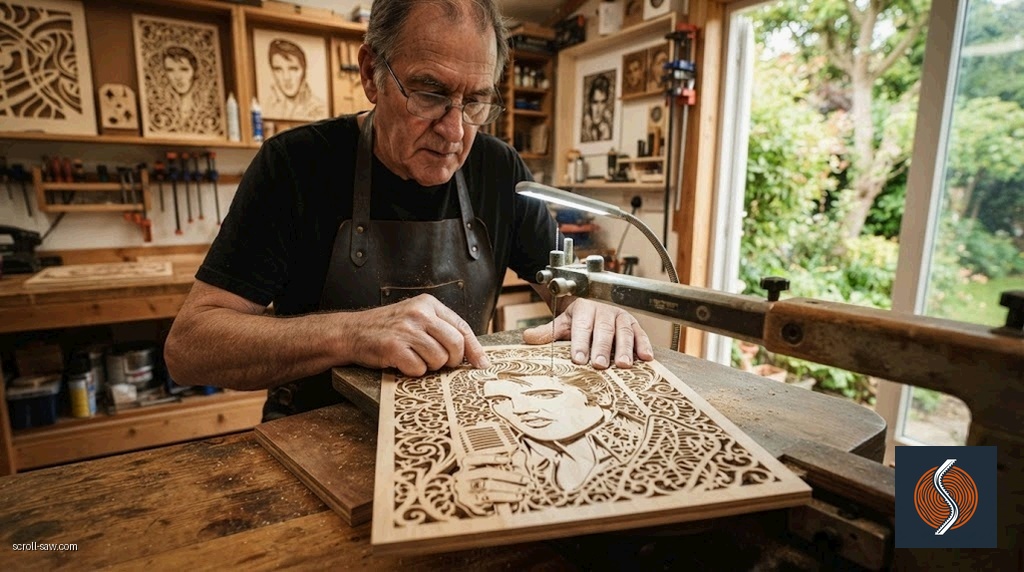
Elvis Presley scroll saw patterns fall in the celebrity portrait category with a particular challenge: the finished piece must read unambiguously as Elvis. His silhouette is defined by the pompadour hair, sideburns, jawline, and often the microphone stance. A pattern that renders those features poorly reads as a generic 1950s man. This guide is how to cut Elvis scroll saw patterns so they read as the specific icon and not as a generic figure.
Elvis scroll saw patterns are silhouette or portrait fretwork patterns of Elvis Presley cut on a scroll saw from 3/8 to 3/4 inch stock, sized 8 to 20 inches, featuring iconic Elvis features (pompadour hair, sideburns, jawline, and often microphone stance or guitar). Applications include Elvis tribute display pieces, gift plaques for Elvis fans, music-themed decor, and memorial pieces.
The short version of the plan: 1/2 to 3/4 inch Baltic birch or dense hardwood, reverse-tooth #3 for portrait detail (hair strand rendering, jaw definition), cutting sequence that protects fragile pompadour and microphone stand detail, and finish suitable for tribute display.
A note on likeness rights. Elvis Presley’s name, likeness, and image are managed by the Elvis Presley Enterprises estate and are protected by right-of-publicity and trademark. Scroll saw work using Elvis likeness is generally acceptable for personal use and personal gifts. Commercial sale of Elvis likeness pieces without licensing is a rights violation.
Recognizable Elvis features
Elvis patterns typically feature:
The pompadour hair. Elvis’s signature hairstyle: swept up and back with distinctive volume at the front. The hair silhouette is one of the most recognizable elements.
The sideburns. Long sideburns extending down the jawline. Length varies by era (shorter in the early period, longer in the Vegas era).
The jawline. Elvis’s distinctive strong jawline is a defining portrait feature.
The microphone stance. Many Elvis silhouettes show him holding a microphone with the microphone stand visible. Fragile projection.
The guitar. Some patterns show Elvis with a guitar. The guitar body and neck geometry are recognizable.
Era-specific features. Early Elvis (young man in casual attire), Army Elvis (uniform), 1968 Comeback (leather outfit), Vegas Elvis (jumpsuit with cape and belt). Each era has recognizable details.
Before cutting, identify which era the pattern represents and verify the era-specific features are rendered.
Stock choice
1/2 to 3/4 inch Baltic birch plywood is the honest workhorse for Elvis scroll saw patterns. Grain-neutral so pompadour hair detail and microphone stand fragile projections have support in every direction.
1/2 to 3/4 inch solid hardwood (walnut, cherry) for premium tribute display pieces. Walnut reads dramatic (suitable for silhouette pieces); cherry reads warm.
1/2 inch stock for hanging pieces or smaller patterns (under 12 inch tall).
Skip pine and softwoods; portrait detail cracks.
Blade choice
A reverse-tooth #3 in 1/2 to 3/4 inch stock for Elvis portrait detail. Fine enough for hair strand rendering, jaw definition, and facial features.
A reverse-tooth #5 for the outer silhouette of larger patterns.
A #2 for premium portrait fretwork with hair strand detail and facial feature rendering.
Cutting sequence for Elvis patterns
Cut order:
First, drill every interior entry hole in the flat blank at the drill press: eye openings, mouth interior, hair strand entry holes, microphone body detail, hanger hole. A 1/32 or 1/16 inch bit clears the blade.
Second, cut interior detail: eye openings, mouth interior, hair strand rendering, jaw shadow lines, microphone body detail. Each is a closed cut.
Third, cut the outer silhouette. Start at a stable point on the body outline and work around. Approach the pompadour hair from the head interior side and free the pompadour hair tips as the last cuts on the hair. Approach the microphone stand from the body side; free the microphone stand base as the last cut.
For Vegas Elvis pieces with cape or jumpsuit belt detail, cut cape edges after body silhouette; free cape tips as last cuts on cape.
Sanding and finishing
Sand every face flat with 220 then 320. Ease every opening edge with a folded 320 strip.
For Baltic birch Elvis pieces, wipe-on oil at two thin coats.
For solid walnut Elvis pieces, wipe-on Danish oil or tung oil at two to three thin coats. Walnut reads dramatic and suits Elvis silhouette work.
Optional gold accent on Vegas Elvis pieces. A small brass or gilded accent at the belt buckle or cape trim adds authentic detail. Skip elaborate paint schemes; the silhouette is the piece.
Optional backing panel. Mount the Elvis silhouette on a solid backing panel of contrasting color (dark stained wood for a Baltic birch piece, light wood for a walnut piece). Backing enhances the silhouette’s read.
Common Elvis pattern mistakes
| Mistake | What went wrong | Fix |
|---|---|---|
| Portrait reads generic; not clearly Elvis | Pompadour hair or sideburns or jawline compromised | Verify pattern shows characteristic Elvis features before cutting; protect them in cutting sequence |
| Pompadour hair broke during cutting | Cross-grain in solid wood or fragile approach | Baltic birch; approach pompadour from head interior side |
| Microphone stand snapped | Cut approached stand base from unsupported side | Cut microphone stand from body outward; free base as last cut |
| Jaw definition lost | Blade too coarse | Use #3 or finer blade for jaw shadow line |
| Sold an Elvis piece commercially | Right-of-publicity violation | Personal use only without Elvis Presley Enterprises licensing |
Verdict
Elvis scroll saw patterns are rewarding tribute pieces that must read as the specific icon. The plan is not complicated. 1/2 to 3/4 inch Baltic birch or walnut. Reverse-tooth #3 for portrait detail. Verify era-specific features before cutting. Interior detail first, silhouette second with pompadour and microphone stand freed as last cuts. Wipe-on oil finish; optional accent for Vegas Elvis pieces.
For a first Elvis scroll saw pattern, a 12 inch Elvis silhouette in 1/2 inch Baltic birch with wipe-on oil finish is the honest starting piece. Premium walnut tribute pieces and elaborate Vegas Elvis fretwork follow naturally.
FAQ
What wood is best for an Elvis scroll saw pattern? Baltic birch plywood at 1/2 to 3/4 inch for grain-neutral fragile-feature support. Walnut at 1/2 to 3/4 inch for premium dramatic tribute display pieces.
What blade cuts Elvis portrait detail cleanly? A reverse-tooth #3 for hair rendering, jaw definition, and facial features. A #5 for outer silhouette of larger patterns. A #2 for premium portrait fretwork.
What features define an Elvis silhouette? Pompadour hair, sideburns, jawline. Optional microphone stance or guitar. Era-specific details (young Elvis, Army, 1968 Comeback, Vegas). Verify pattern captures the intended era’s characteristic features.
How do I cut an Elvis pattern without losing the pompadour? Baltic birch plywood (grain-neutral). Approach pompadour hair from the head interior side. Free pompadour tips as the last cuts on the hair section.
Can I sell Elvis scroll saw pieces? Elvis likeness is protected by right-of-publicity and trademark managed by Elvis Presley Enterprises. Commercial sale without licensing is a rights violation. Personal use and personal gifts are the honest approach.
How thick should stock be for an Elvis pattern? 1/2 to 3/4 inch for most patterns. 1/2 inch for smaller pieces under 12 inch tall or hanging pieces.
Can I make a Vegas Elvis pattern with cape? Yes. Cut interior detail first, then body silhouette, then cape edges. Free cape tips as last cuts. Optional gold accent for belt buckle or cape trim.
What finish suits an Elvis tribute piece? Wipe-on Danish oil or tung oil for wood-tone silhouettes. Walnut with oil finish reads dramatic. Optional contrasting backing panel enhances silhouette read. Skip heavy gloss.
References
-
Fine Woodworking magazine — Scroll saw portrait reference (finewoodworking.com)
-
Popular Woodworking — Scroll saw silhouette and celebrity portrait techniques (popularwoodworking.com)
-
Scrollsaw Workshop by Steve Good — Free scroll saw silhouette patterns (scrollsawworkshop.blogspot.com)


