
Making a Scroll Saw Angel: From Pattern to Clean Finished Edges
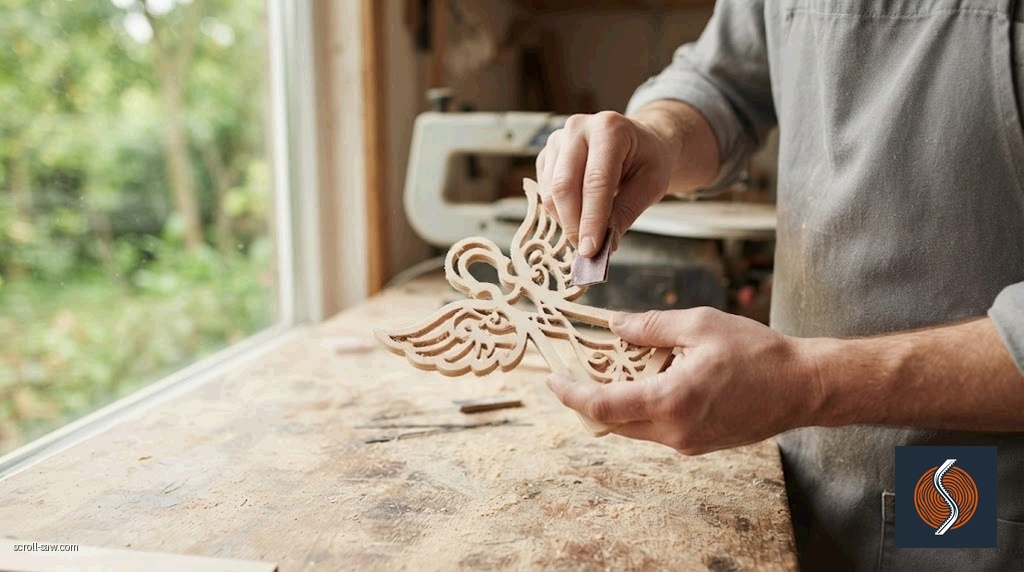
Making a Scroll Saw Angel: From Pattern to Clean Finished Edges
My first scroll saw angel had a broken wing tip, a lost halo, and a dent in the robe hem where I slipped with a chisel trying to clean up a rough cut. It was 4 inches tall in 1/4-inch Baltic birch and taught me every lesson an angel pattern can teach.
Angels concentrate fragile detail in three places: wing tips, halo, and the fine bridges between robe folds. Every one of these details can be redesigned to be more survivable, and doing that redesign before cutting is the difference between an angel that lasts and an angel that breaks.
A scroll saw angel is an angel figure cut from thin hardwood or plywood, ranging from simple silhouette (single flat piece, chunky outline) to complex fretwork (single flat piece with interior detail representing wing feathers, halo, robe folds) to layered angel (multiple pieces stacked for dimension) to compound-cut 3D angel (from a solid block).
The three styles and when to use each
Silhouette angel. Single flat piece, cut perimeter only. Chunky outline of angel with wings, halo, and robe suggested by the silhouette. Beginner-friendly. Reads instantly as an angel.
Fretwork angel. Single flat piece with interior cutouts showing wing feathers, halo, and robe detail. Intermediate to advanced. Requires more design attention to keep detail survivable.
Compound-cut 3D angel. From a solid block, two profiles cut in sequence. Advanced. Produces a small dimensional angel ornament.
Start with a silhouette angel. Move to fretwork after the technique is comfortable.
The three fragile details and how to fix them
Wing tips. Angel wings typically taper to a point at the outer tip. At 1/4-inch stock, a tip drawn thinner than 1/8 inch will break during finishing. Fix: blunt the wing tip by 1/16 inch, leaving a small flat instead of a sharp point.
Halo. A circular halo above the head is often drawn thin, with a bridge to the head that’s fragile. Fix: draw the halo bridge at 3/16 inch minimum. Or omit the physical halo entirely and let the pattern suggest it with an oval curve near the head.
Robe folds. Fretwork angels often show fine bridges between robe folds. At 1/4-inch stock, bridges thinner than 1/16 inch snap. Fix: thicken all robe fold bridges to 1/8 inch minimum.
Books and pattern sources
For a broad pattern library including angels, Big Book of Scroll Saw Woodworking has multiple angel patterns at different skill levels.
For compound-cut 3D angels, Compound Christmas Ornaments for the Scroll Saw by Diana Thompson includes angel patterns.
Steve Good’s blog has extensive free angel patterns. Search scrollsawworkshop.blogspot.com for “angel.”
Stock selection
Baltic birch plywood (real Baltic, void-free) at 1/4 inch for fretwork angels. Cross-plied grain supports the wing tips and halo bridge.
Basswood at 1/4 inch for painted angels. Even grain accepts white or gold acrylics.
Cherry, walnut, or maple at 1/4 inch for clear-finished heirloom angels. All three cut cleanly at this thickness.
Butternut at 1/4 inch for a warm-toned angel with softer visual weight than walnut.
Avoid pine. Pine is too soft for the delicate wing tips and halo details common to angel patterns.
Blade choice
For 1/4-inch stock with fine fretwork detail, a #5 reverse-tooth blade is the daily driver. From Olson FR49202 Reverse Tooth Scroll Saw Blades.
For tight interior corners on wing feather detail, a #3 reverse-tooth turns tighter.
For extended production of angel ornament sets, Pegas Regular Scroll #7 holds its edge across the batch and produces smoother cuts.
Cutting sequence for a fretwork angel
Drill all interior entry holes first. Halo bridge cutouts, wing feather cutouts, robe fold cutouts, any interior detail.
Cut interior fretwork first, smallest features to largest. Halo detail (if present as fretwork) first, then wing feathers, then robe folds.
Cut the perimeter last. Along the wings, cut into each wing tip from one side, back the blade out, enter from the other side. Cutting continuously around a delicate wing tip risks snapping it.
At the head-shoulder junction and halo bridge (if the halo is attached), take slow careful cuts. These are the most vulnerable structural points.
Pattern attachment
Light 3M Super 77 Multipurpose Spray Adhesive. Two seconds from eight inches, ninety-second wait.
For hardwood angels destined for clear finish, use ScotchBlue Painter’s Tape 2090 on the stock first, then adhere the pattern to the tape.
Finishing angel pieces
Clear finish on hardwood for heirloom angels. Wipe-on polyurethane in two thin coats, sanded lightly between with 400-grit.
White painted with gold accents for traditional Christmas angels. Prime with shellac, base coat white acrylic, add gold trim on halo, wings, robe hem with fine brush. Matte spray sealer.
Antique white with brown wash for aged-looking angels. Base coat white, apply diluted burnt umber acrylic wash, wipe most off leaving color in the recesses. Reads as antique.
Stained for a warm heirloom look. Golden oak or cherry stain on basswood produces a warm angel that doesn’t require paint.
Display options
Christmas ornament. Small angel (3-4 inches) with a string loop drilled through the top or halo. Hangs on a tree.
Wall hanging. Larger angel (6-12 inches) with a small sawtooth hanger on the back.
Tabletop display. Angel on a small wooden base for freestanding display.
Nativity component. Angel figure as part of a larger nativity set (paired with shepherds, wise men, and holy family).
Memorial piece. Angel with a name inscription for memorial gifts. This is a common request; approach carefully with appropriate wording.
Frequently asked questions
How do I keep the wing tips from breaking? Blunt the extreme wing tip by 1/16 inch and cut into it from both sides rather than continuously.
Should the halo be attached or separate? Attached is stronger. Draw the halo bridge at 3/16 inch minimum. A separate halo requires drilling and gluing and often looks less convincing.
Can I add glitter or gold leaf to an angel? Gold leaf on wing tips and halo looks elegant if applied carefully. Glitter looks cheap.
How thick should the wood be? 1/4 inch is standard for angel ornaments and wall hangings. Thicker (3/8 or 1/2 inch) for freestanding pieces.
What’s the biggest beginner mistake on angel patterns? Cutting the pattern as drawn without thickening wing tips and halo bridges. Redraw before cutting.
Can I make angel patterns without wings? Yes, though wings are the standard identifier. Robed figures without wings read as saints or nativity figures rather than angels.
How do I make matching pairs of angels? Cut two angels stack cut from 1/8-inch stock, or two separate angels from the same pattern on 1/4-inch stock. Slight size variation across a set often reads better than identical pieces.
References
-
Fox Chapel Publishing, Big Book of Scroll Saw Woodworking.
-
Compound Christmas Ornaments for the Scroll Saw, Diana Thompson, Fox Chapel Publishing.
-
Steve Good, Scrollsaw Workshop, scrollsawworkshop.blogspot.com.


