
Cutting To Print Scroll Saw Patterns: Entry Holes, Interior Cuts, and Assembly
Cutting To Print Scroll Saw Patterns: Entry Holes, Interior Cuts, and Assembly
Free scroll saw patterns to print at home are the most convenient starting point for any scroll saw project. Download, print, cut. The convenience hides two problems: pattern quality varies wildly, and print scaling issues can silently ruin a pattern before cutting starts. This guide is how to find good free print-at-home scroll saw patterns and print them at correct scale for reliable cutting.
Free scroll saw patterns to print are pattern designs distributed as PDF, PNG, or JPG files intended for home printing and cutting. Sources include designer blogs, magazine archives, community sites, and pattern collection archives. Applications include beginner practice, gift piece pattern sourcing, seasonal decor patterns, and building a personal pattern library on a budget.
The short version of the plan: source from reputable designers (Steve Good’s Scrollsaw Workshop is the largest reliable free archive), print at 100 percent Actual Size, verify with a scale measurement, transfer to blank with spray adhesive or peel-and-stick label paper, and cut with standard scroll saw sequence.
Reliable free print pattern sources
Reputable sources for free print-at-home scroll saw patterns:
Steve Good’s Scrollsaw Workshop. Thousands of free patterns across every category. Consistently professional quality; Steve Good tests his patterns before publishing. Available as PDF downloads.
Scroll Saw Woodworking and Crafts magazine sample patterns. The magazine’s website sometimes offers free pattern samples.
Woodworking magazine archives. Some magazines archive select patterns as free downloads.
Designer promotional patterns. Some paid pattern designers offer free samples of their work as promotional downloads.
Woodworking club and community sites. Club sites sometimes host member-contributed free patterns.
Sources to avoid:
Pinterest images. Usually screenshots of paid patterns; low resolution; copyright issues.
Scraper sites that repost patterns without designer attribution. Quality is often degraded from scans; licensing is unclear.
Generic craft aggregator sites with unattributed patterns.
Build a library from reputable sources. A working library of 20 to 30 patterns from Steve Good’s archive covers most beginner and intermediate scroll saw needs.
Printing free patterns at correct size
Print scaling is the silent killer of scroll saw patterns. A pattern printed at 95 percent looks nearly right but is wrong.
Critical settings for PDF pattern printing:
Open the PDF in Adobe Acrobat, Preview (Mac), or another PDF viewer.
In print settings, choose Actual Size or 100 percent or None for scaling. Do NOT choose Fit to Page, Shrink Oversized Pages, or Scale to Fit Paper. These options silently scale the pattern.
Set paper size to match the PDF page size (usually Letter or A4).
Print one page as a test. Measure the scale marker (a labeled line showing 1 inch or 1 cm) or a specified dimension on the printed pattern. It should match exactly.
Any variance is a problem. Common causes: Fit to Page setting active, wrong paper size, printer driver scaling.
For patterns larger than a single sheet, use the tile print option. Print with alignment marks; assemble the tiles carefully.
Transferring printed patterns to the blank
Two standard approaches for transferring a printed pattern to the wood blank:
Spray adhesive approach. Spray a light coat of temporary spray adhesive on the back of the printed pattern. Wait 30 seconds. Press onto the sanded blank. Firm hand pressure to seat the pattern.
Peel-and-stick label paper approach. Print directly on peel-and-stick label paper sized for standard printers. Peel the backing and apply to the sanded blank. No spray, no waiting.
Both work. Peel-and-stick is cleaner and faster; spray adhesive is cheaper and works with any print paper.
After cutting, remove the pattern with mineral spirits (spray adhesive residue) or careful peeling (peel-and-stick residue). Both leave minimal residue when properly removed.
Cutting sequence for printed patterns
Standard scroll saw cutting sequence applies:
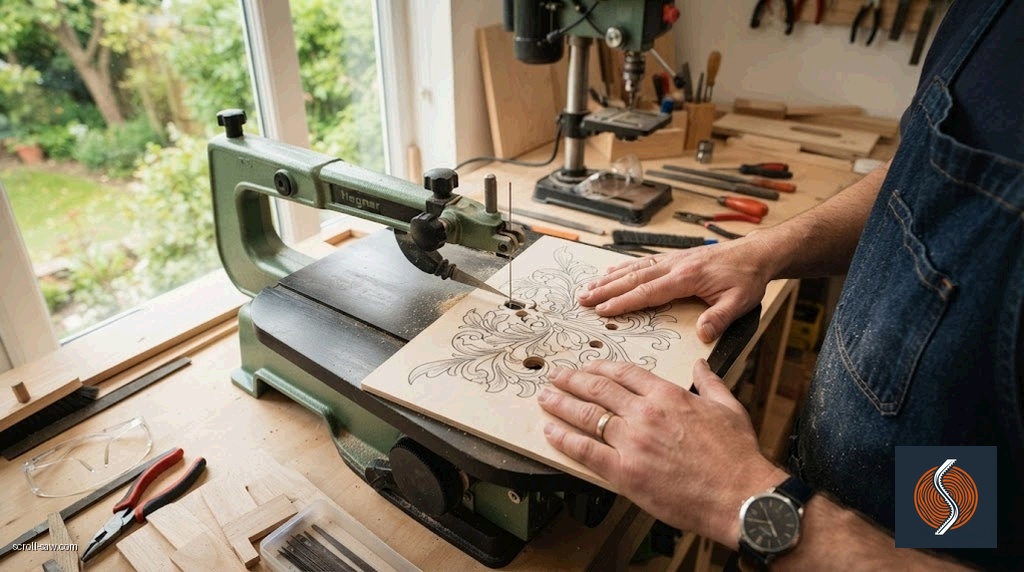
First, drill every interior entry hole at the drill press. Match bit size to blade size (1/32 inch for #3, 1/16 inch for #5).
Second, cut every interior opening. Each is a closed cut from the entry hole back to the same hole.
Work from center of pattern outward. Center openings have the most surrounding support.
Third, cut the outer piece boundary as the last cut.
Approach fragile projections from the supported inner side; free tips as the last cuts.
Building a print pattern library
For cutters who accumulate printed patterns:
Folder structure by category. Silhouettes, fretwork, seasonal, gifts. Subfolders as needed.
Consistent file naming. Pattern name, designer, date. Example: mallard-drake-silhouette-good-2024.pdf.
Optional spreadsheet with pattern names, categories, difficulty, notes from cutting.
Regular backup. Cloud storage or external drive.
Respect licensing. Even free patterns often have licensing terms; read the included license before using.
Common print pattern issues
| Issue | What went wrong | Fix |
|---|---|---|
| Pattern printed at wrong size | Print settings did Fit to Page | Reprint at 100 percent Actual Size; verify by measuring scale marker |
| Pattern from unknown source has broken bridges | Poor design or bad scan | Prefer reputable designer sources with review history |
| Pattern peeled off during cutting | Adhesive not fully seated | Press firmly before cutting; hot cutting may loosen adhesive |
| Detail vanished during cutting | Detail under blade kerf | Verify detail sizing before cutting; use finer blade or enlarge pattern |
| Pattern is a screenshot at low resolution | Downloaded from a scraper site | Find the pattern at the original designer source |
Verdict
Free scroll saw patterns to print are an excellent way to build a pattern library and complete projects on a budget. The plan is not complicated. Source from reputable designers like Steve Good’s Scrollsaw Workshop. Print at 100 percent Actual Size with scale verification. Transfer with spray adhesive or peel-and-stick label paper. Cut with standard scroll saw sequence.
For a first free print pattern, browse Scrollsaw Workshop’s beginner category and pick a simple silhouette or fretwork pattern. Print, verify scale, cut in Baltic birch scrap for practice, then cut in the intended stock for the finished piece.
FAQ
Where do I find free scroll saw patterns to print? Steve Good’s Scrollsaw Workshop is the largest free pattern archive. Woodworking magazine sample patterns, designer promotional downloads, and community sites are additional sources.
How do I print a scroll saw pattern at correct size? Open the PDF, set print settings to Actual Size or 100 percent (not Fit to Page or Scale to Fit). Print a test page. Measure the scale marker or specified dimension on the printed pattern to verify.
What paper should I print scroll saw patterns on? Standard 20 lb paper for spray adhesive transfer. Peel-and-stick label paper for direct application (faster and cleaner but slightly more expensive).
How do I transfer a printed pattern to the wood blank? Spray adhesive approach: light coat on back of pattern, wait 30 seconds, press onto sanded blank. Peel-and-stick approach: print on peel-and-stick label paper, peel backing, apply to blank.
Are free scroll saw patterns as good as paid ones? Steve Good’s free patterns are consistently professional. Some other free sources vary. Paid patterns from established designers are generally reliable. Free plus paid mixed library is the honest approach.
How do I print a large scroll saw pattern that spans multiple pages? Use the tile print option in Adobe Acrobat. Print with alignment marks. Assemble the tiles carefully.
Can I sell pieces cut from free downloaded patterns? Check the pattern’s license. Many free patterns are personal use only; some allow finished piece sales. Steve Good’s patterns generally allow finished piece sales.
How do I remove pattern paper from the finished piece? Mineral spirits for spray adhesive residue; careful peeling for peel-and-stick residue. Both leave minimal residue when properly removed.
References
-
Fine Woodworking magazine — Scroll saw pattern reference (finewoodworking.com)
-
Popular Woodworking — Scroll saw pattern and print techniques (popularwoodworking.com)
-
Scrollsaw Workshop by Steve Good — Free scroll saw patterns (scrollsawworkshop.blogspot.com)


