
German Shepherd Scroll Saw Pattern: A Project Plan That Anticipates Fragile Cuts
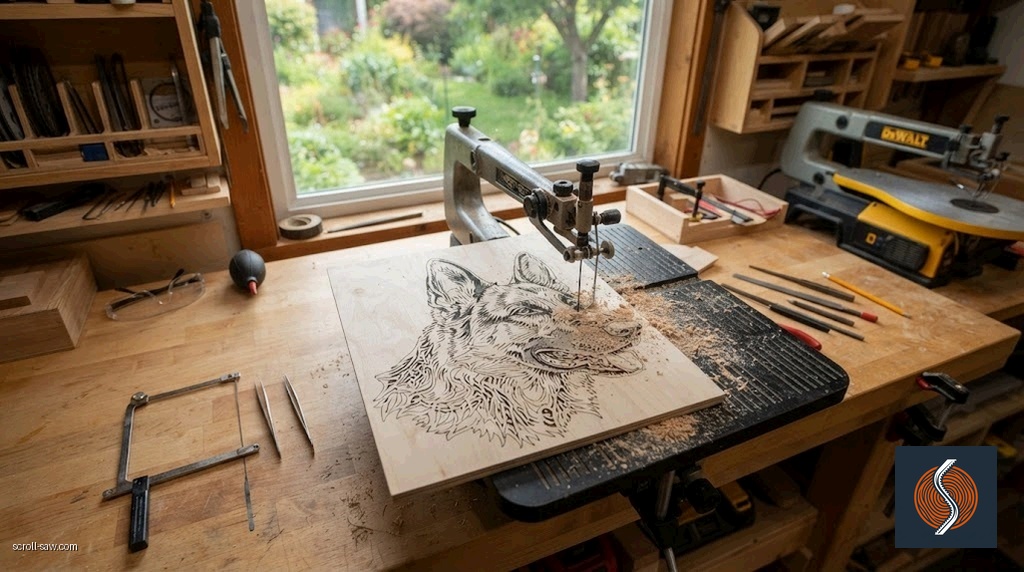
German Shepherd Scroll Saw Pattern: A Project Plan That Anticipates Fragile Cuts
German Shepherd scroll saw patterns are breed-specific dog portrait work. The finished piece must read unambiguously as a German Shepherd rather than a generic dog. Key features: upright pointed ears, long muzzle, alert posture, and characteristic body proportions. This guide is how to cut German Shepherd patterns so the breed is unmistakable.
German Shepherd scroll saw patterns are silhouette or fretwork patterns of German Shepherd dogs cut from 3/4 inch stock, sized 8 to 18 inches, with attention to breed-specific features. Applications include dog owner gift pieces, memorial pieces for beloved pets, K-9 unit tribute pieces, and dog lover decor.
The short version of the plan: 3/4 inch dense hardwood or Baltic birch, reverse-tooth #5 for silhouette outline and #3 for coat and ear detail, cutting sequence that preserves ear tips, and finish suitable for gift or memorial display.
German Shepherd recognition features
A German Shepherd silhouette must have:
Upright pointed ears. The single most identifying feature. Ears stand erect and point upward. Floppy ears read as spaniel or hound.
Long pointed muzzle. Longer than a bulldog, shorter than a Doberman. Straight profile.
Alert posture. Head held high, body composed and attentive.
Sloped back line. The characteristic sloped back from shoulders to hips.
Bushy tail. Full tail carried at approximately hip level.
Proportional body. Longer than tall body proportion. Athletic build.
Stock choice
3/4 inch Baltic birch plywood for grain-neutral fragile-feature support. Ear tips have support in every direction.
3/4 inch dense hardwood (walnut for dramatic pieces, cherry for warm memorial pieces).
1/2 inch stock for smaller pieces.
Blade choice
A reverse-tooth #5 for silhouette outline in 3/4 inch stock.
A reverse-tooth #3 for ear detail, muzzle definition, coat texture fretwork, and eye features.
Cutting sequence
First, drill every interior entry hole: eye opening, coat texture entry holes, hanger hole.
Second, cut interior detail: eye opening, coat texture rendering.
Third, cut outer silhouette. Start at the tail base. Cut along the back line. Continue up to the head. Approach each ear from the head interior side; free ear tip as the last cut on each ear.
Continue cutting around the muzzle. Cut down the front of the body along the chest, under the belly, and back to the starting point.
Sanding and finishing
Sand every face with 220 then 320. Ease ear tips carefully.
For Baltic birch pieces, wipe-on oil at two thin coats.
For walnut or cherry pieces, wipe-on Danish oil or tung oil at two to three thin coats. Walnut reads appropriate for the dark shepherd coloring.
Optional two-tone effect: selective darker stain on shepherd’s back and sides, lighter face and legs.
Common German Shepherd pattern mistakes
| Mistake | What went wrong | Fix |
|---|---|---|
| Ear tip snapped | Cross-grain or approach wrong | Baltic birch; approach ear from head interior side; free tip last |
| Silhouette reads generic dog | Ear shape or back line wrong | Verify upright pointed ears and sloped back line before cutting |
| Muzzle reads too short | Pattern proportion wrong | Verify long muzzle proportion characteristic of the breed |
| Coat reads flat | No texture detail | Add coat texture fretwork; or apply two-tone stain effect |
| Piece feels generic | No personalization | Add dog’s actual name and dates |
Verdict
German Shepherd scroll saw patterns are rewarding dog portrait pieces. 3/4 inch Baltic birch or walnut. Reverse-tooth #5 for outline, #3 for detail. Verify breed-specific features. Standard cutting sequence with ear tips freed last. Wipe-on oil finish.
For a first German Shepherd scroll saw pattern, a 12 inch alert-posture silhouette in 3/4 inch walnut with wipe-on Danish oil is the honest starting piece.
FAQ
What wood is best for a German Shepherd scroll saw pattern? Baltic birch plywood at 3/4 inch for ear tip support. Walnut at 3/4 inch for realistic shepherd coloring. Cherry for warm memorial pieces.
What blade cuts German Shepherd detail cleanly? A reverse-tooth #5 for silhouette outline. A #3 for ear detail, muzzle definition, and coat texture.
How do I make a German Shepherd pattern read as the breed? Verify pattern shows upright pointed ears, long straight muzzle, sloped back line, alert posture.
How do I cut ear tips without breaking? Baltic birch or solid wood with grain along ear length. Approach each ear from head interior side. Free ear tip as the last cut.
How thick should stock be? 3/4 inch for most patterns. 1/2 inch for smaller pieces.
Can I make a K-9 unit tribute piece? Yes. German Shepherd silhouette with K-9 unit designation and officer’s name.
Can I personalize with a specific dog’s name? Yes. Add dog’s name and dates. Popular memorial piece.
What finish suits a German Shepherd piece? Wipe-on Danish oil for wood tone. Optional two-tone stain for realistic coloring.
References
-
Fine Woodworking magazine — Scroll saw dog portrait reference (finewoodworking.com)
-
Popular Woodworking — Scroll saw silhouette techniques (popularwoodworking.com)
-
Scrollsaw Workshop by Steve Good — Free scroll saw dog patterns (scrollsawworkshop.blogspot.com)


