
Cutting Giraffe Scroll Saw Pattern: Entry Holes, Interior Cuts, and Assembly
Cutting Giraffe Scroll Saw Pattern: Entry Holes, Interior Cuts, and Assembly
Giraffe scroll saw patterns are safari and African wildlife display pieces with a distinctive technical challenge: the long neck. A giraffe silhouette is defined by that neck length; if the neck is too short, the animal reads as a generic long-legged mammal. The neck is also fragile if oriented cross-grain in solid wood. This guide is how to cut giraffe patterns so the characteristic geometry survives.
Giraffe scroll saw patterns are silhouette or fretwork patterns of giraffes cut from 1/2 to 3/4 inch stock, sized 8 to 24 inches, featuring long neck proportion, ossicone horns, spot pattern rendering, and characteristic body geometry. Applications include kids’ room safari decor, wildlife wall art, and gift pieces for animal lovers.
The short version of the plan: 3/4 inch Baltic birch, reverse-tooth #5 for silhouette outline and #3 for spot pattern detail, cutting sequence that supports the long neck throughout, and finish suitable for wildlife display.
Giraffe recognition features
A giraffe silhouette needs:
Long neck. The single most identifying feature. Neck length should be approximately 1.5 to 2 times the body length.
Ossicone horns. Two small bony projections on top of the head.
Spot pattern. Optional interior fretwork rendering the characteristic irregular spot pattern.
Long legs. Legs proportional to the long neck; long spindly legs.
Small head. Head is small relative to body.
Sloped back. Characteristic sloping back line from shoulders to hips.
Stock choice
3/4 inch Baltic birch plywood for grain-neutral neck support. Baltic birch is the safer choice because neck orientation is complex.
3/4 inch dense hardwood with grain running along the neck length. Baltic birch avoids the grain orientation problem.
1/2 inch stock for smaller pieces. Neck may be more fragile in thinner stock.
Blade choice
A reverse-tooth #5 for silhouette outline.
A reverse-tooth #3 for spot pattern detail and facial features.
Cutting sequence
First, drill every interior entry hole: eye opening, spot pattern entry holes, hanger hole.
Second, cut interior spot pattern detail. Cut each spot as a closed cut from its entry hole.
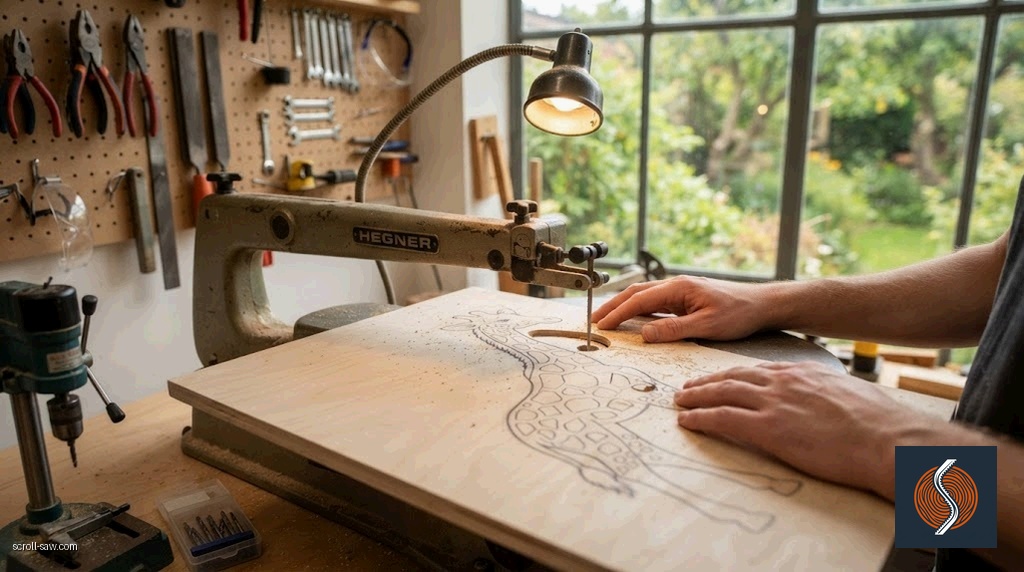
Third, cut outer silhouette. Start at a stable point on the body (typically the belly). Cut around the body, up the front of the neck to the head, around the head (approach ossicone tips from head side; free tips last), and back down the back of the neck. Continue along the back to the tail base, down the hind legs, and back to the starting point.
When cutting the neck, support the neck with hand pressure on the surrounding waste until the outer neck is complete.
Sanding and finishing
Sand every face with 220 then 320. Ease every edge carefully; the long neck has extensive edge work.
For Baltic birch pieces, wipe-on oil at two thin coats.
For solid hardwood pieces, wipe-on Danish oil or tung oil.
Optional two-tone stain for spot pattern coloring. Golden brown base with darker brown spots.
Optional paint for children’s safari decor. Bright colors suit kids’ room application.
Common giraffe pattern mistakes
| Mistake | What went wrong | Fix |
|---|---|---|
| Neck snapped during cutting | Grain orientation wrong | Baltic birch; support waste around neck during cutting |
| Silhouette reads generic | Neck too short | Verify pattern shows characteristic long neck proportion |
| Ossicone horns broke | Approach wrong | Approach ossicones from head interior side; free tips last |
| Spot pattern reads generic | Spots too uniform | Verify pattern shows irregular spot pattern |
| Piece looks flat | No spot detail | Add spot fretwork or two-tone stain |
Verdict
Giraffe scroll saw patterns are rewarding safari display pieces. 3/4 inch Baltic birch. Reverse-tooth #5 for silhouette, #3 for spot detail. Verify long neck proportion. Cut interior spots first, silhouette second with careful neck handling. Wipe-on oil finish; optional two-tone stain for realistic coloring.
For a first giraffe scroll saw pattern, a 14 inch giraffe silhouette in 3/4 inch Baltic birch with wipe-on oil is the honest starting piece.
FAQ
What wood is best for a giraffe scroll saw pattern? Baltic birch plywood at 3/4 inch. Grain-neutral so the long neck has support in every direction. Solid hardwood works if grain can be oriented along neck length.
What blade cuts giraffe patterns cleanly? A reverse-tooth #5 for silhouette outline. A #3 for spot pattern detail and facial features.
How do I cut a giraffe without breaking the neck? Baltic birch. Support waste around the neck with hand pressure until outer neck is complete. Handle finished piece carefully.
What makes a giraffe silhouette read as giraffe? Long neck (1.5 to 2 times body length), ossicone horns, spot pattern, long legs, small head, sloped back.
How thick should stock be? 3/4 inch for most patterns. 1/2 inch for smaller pieces.
How do I render the giraffe spot pattern? Interior fretwork spots or two-tone stain (golden brown base with darker brown masked spots).
What finish suits a giraffe piece? Wipe-on Danish oil for wood tone. Two-tone stain for realistic coloring. Bright paint for kids’ safari decor.
Can I make a giraffe family scene? Yes. Adult giraffe with baby giraffe as a two-piece display.
References
-
Fine Woodworking magazine — Scroll saw wildlife reference (finewoodworking.com)
-
Popular Woodworking — Scroll saw safari techniques (popularwoodworking.com)
-
Scrollsaw Workshop by Steve Good — Free scroll saw wildlife patterns (scrollsawworkshop.blogspot.com)


