
How to Make Scroll Saw Patterns from Pictures: A Workshop Method That Protects the Cut
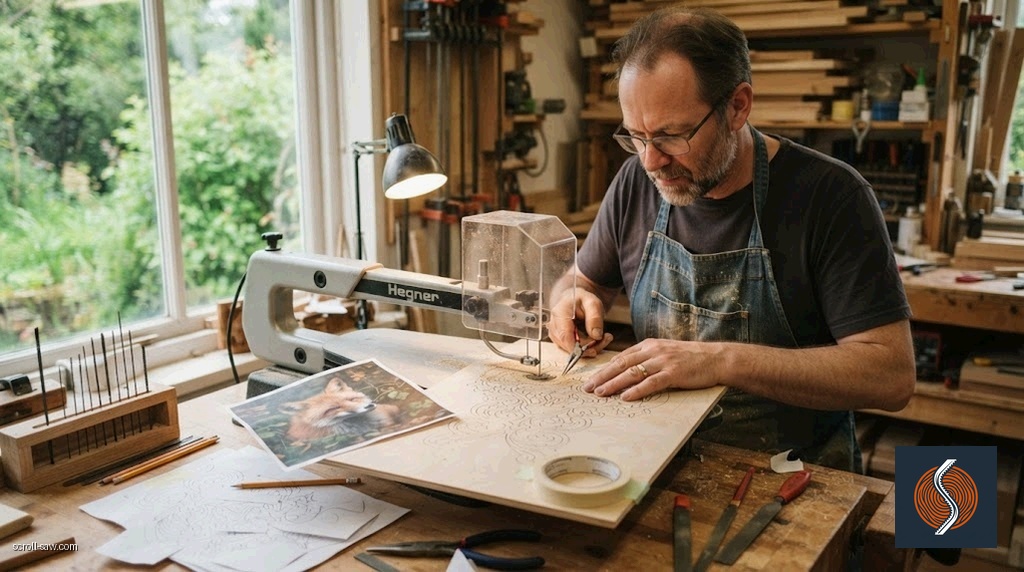
How to Make Scroll Saw Patterns from Pictures: A Workshop Method That Protects the Cut
Making scroll saw patterns from pictures covers a broader source than photo conversion alone: illustrations, hand-drawn artwork, book illustrations, coloring pages, and simplified line drawings. Each source type has different conversion requirements. This guide is how to convert pictures of various types into cut-ready scroll saw patterns.
Making scroll saw patterns from pictures is the process of converting picture sources (photos, illustrations, drawings, coloring pages, book art) into line-art scroll saw patterns suitable for cutting. Applications include custom pattern development from favorite illustrations, converting children’s coloring pages to scroll saw patterns, and general personal pattern development.
The short version: match technique to source type (photos need contrast conversion; illustrations and coloring pages need simpler conversion; hand drawings can be scanned directly); add bridges for structural integrity; test-cut on scrap.
Picture source types
Photographs. Continuous tone images. Require contrast adjustment and threshold conversion. Covered in detail in the photo-to-pattern guide.
Illustrations and clip art. Already stylized line art or two-tone imagery. Often nearly usable as patterns with minimal conversion.
Coloring pages. Line art specifically designed for coloring. Excellent starting point for scroll saw patterns; often nearly cut-ready.
Hand drawings. Original pencil or ink drawings. Scan and convert.
Book illustrations. Vary by style. Some are pattern-ready; others need work.
Simplified drawings. Silhouettes and simple shapes. Nearly cut-ready.
Conversion by source type
Photographs. Contrast adjustment, threshold to two-tone, add bridges. Full workflow required.
Illustrations. Import into vector software, trace to vector paths, verify bridges and structural integrity.
Coloring pages. Scan or import. Trace to vector paths if desired. Add bridges where fretwork areas need support. Coloring pages often have appropriate bridges built into the design.
Hand drawings. Scan at high resolution. Clean up scan (remove noise, refine lines). Trace to vector or use directly. Add bridges.
Book illustrations. Assess complexity. Simple illustrations convert like coloring pages. Complex illustrations may need contrast adjustment like photos.
Workflow for illustration or coloring page conversion
One. Import the illustration into image software (raster) or vector software (Inkscape, Illustrator).
Two. Clean up. Remove noise, refine lines, remove unwanted elements.
Three. Convert to two-tone if not already (illustrations may be two-tone or grayscale; coloring pages are typically two-tone).
Four. Add bridges where fretwork areas need structural support.
Five. Verify entry hole feasibility for each closed interior opening.
Six. Print at intended size for verification.
Seven. Test cut on scrap.
Copyright considerations
When converting pictures to patterns:
Personal use of a picture as pattern source. Generally acceptable for personal use.
Commercial sale of scroll saw pieces cut from converted patterns. Copyright applies to the original picture. Commercial sale of pieces based on copyrighted illustrations without licensing is a rights violation.
Copyright-free sources. Public domain images, Creative Commons images, or original hand drawings are safe conversion sources.
Coloring pages. Coloring pages from commercial coloring books are copyrighted. Free coloring pages designated for personal use may allow personal scroll saw pattern conversion; commercial sale usually not permitted.
When uncertain, use copyright-free image sources or original artwork.
Working with hand drawings
Original hand drawings are the safest picture source for scroll saw pattern conversion:
Draw in pencil or ink on white paper.
Simplify to line art (no shading, no continuous tone).
Add bridges as you draw or in post-processing.
Scan at 300 DPI or higher.
Clean scan in image software: enhance contrast to remove paper texture, adjust brightness/contrast for clean line art.
Trace to vector for clean scaling (optional).
Print at intended size and test cut on scrap.
Original drawings avoid copyright concerns and can be designed with scroll saw considerations from the start.
Common picture-to-pattern mistakes
| Mistake | What went wrong | Fix |
|---|---|---|
| Fretwork too extensive | No bridges added | Manual bridge placement in fretwork areas |
| Detail vanished in kerf | Fine detail below blade width | Enlarge detail or use finer blade |
| Copyright issue | Copyrighted source used commercially | Use public domain, Creative Commons, or original artwork |
| Pattern doesn’t read | Source picture had issues | Choose better source or manual cleanup |
| Scanned drawing had paper texture | Scan resolution too low | 300 DPI or higher; contrast adjustment removes paper texture |
Verdict
Making scroll saw patterns from pictures is a practical workflow across source types. The plan depends on source: photos need contrast conversion; illustrations and coloring pages need simpler conversion; hand drawings can be scanned and used with minimal work. Add bridges, verify structural integrity, test cut on scrap.
For a first picture-to-pattern conversion, use a favorite simple illustration or a hand drawing. Import to Inkscape or GIMP. Convert to line art. Add bridges. Print at 8 inch size and test cut in Baltic birch scrap.
FAQ
What picture sources work for scroll saw pattern conversion? Photographs, illustrations, coloring pages, hand drawings, book illustrations, and simplified drawings.
Which picture source is easiest to convert? Coloring pages and simple illustrations. Already two-tone line art with often adequate bridges built in.
What software converts pictures to patterns? Inkscape (free vector, best for illustrations and line art). GIMP (free raster). Photoshop (professional raster). Adobe Illustrator (professional vector).
Are hand drawings the best source? Safest for copyright. Also allows designing with scroll saw considerations from the start. Simplify to line art, scan at 300 DPI or higher, use directly or trace to vector.
Can I convert coloring pages to patterns? Yes for personal use. Coloring pages are often nearly cut-ready. Verify licensing for commercial sale; commercial coloring pages are copyrighted.
What about copyrighted illustrations? Personal use generally acceptable. Commercial sale without licensing is a rights violation. Use public domain, Creative Commons, or original artwork for commercial pieces.
How do I add bridges to a converted pattern? Identify enclosed dark areas that would be extensive fretwork openings. Add bridges strategically: near features, symmetric, minimum 1/8 inch wide, minimal count.
Should I test-cut a converted pattern? Strongly recommended. Test cutting on Baltic birch scrap reveals issues that visual verification missed.
References
-
Fine Woodworking magazine — Scroll saw pattern conversion reference (finewoodworking.com)
-
Popular Woodworking — Scroll saw picture-to-pattern techniques (popularwoodworking.com)
-
Scrollsaw Workshop by Steve Good — Scroll saw pattern conversion and free patterns (scrollsawworkshop.blogspot.com)


