
How to Transfer Scroll Saw Patterns to Wood: A Practical Scroll-Saw Guide
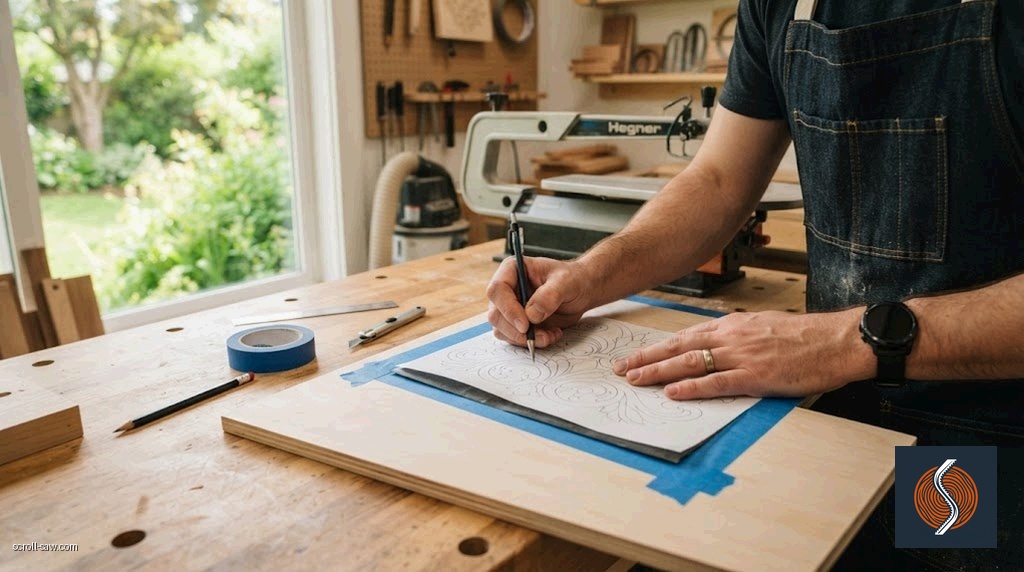
How to Transfer Scroll Saw Patterns to Wood: A Practical Scroll-Saw Guide
Transferring the pattern to the wood blank is a critical scroll saw step. The pattern must adhere securely through cutting, must be visible during cutting, must remove cleanly after cutting, and must not damage the wood surface. Four working methods cover most scroll saw pattern transfer applications. This guide covers all four and when to use each.
Transferring scroll saw patterns to wood is the process of applying a printed or hand-drawn pattern to the wood blank in preparation for scroll saw cutting. Applications include all pattern-based scroll saw cutting work.
The short version: four working methods (spray adhesive, peel-and-stick label paper, blue painter’s tape sandwich, carbon paper transfer); each has distinct advantages; choose based on stock, pattern, and personal preference.
Method one: Spray adhesive
Standard scroll saw pattern transfer method:
Print or copy the pattern on standard printer paper.
Sand the blank surface to 220 grit (removes dust that could interfere with adhesion).
Spray a light coat of temporary spray adhesive on the back of the pattern. Use a designated adhesive for pattern work (3M Spray Mount, Elmer’s Craft Bond, or similar). Regular spray adhesive is too strong.
Wait 30 seconds for the adhesive to become tacky.
Press the pattern onto the blank. Start from one edge and roll across to prevent air bubbles. Firm hand pressure throughout.
Allow 5 to 10 minutes for the pattern to seat before cutting.
After cutting, remove pattern paper. Mineral spirits or naphtha remove any adhesive residue.
Advantages: Cheap. Works with any printer paper. Reusable pattern (peel and reapply to another blank).
Disadvantages: Requires proper adhesive selection. Cleanup with mineral spirits.
Method two: Peel-and-stick label paper
Alternative pattern transfer method:
Buy peel-and-stick label paper sized for standard printers (Avery full-sheet labels or similar).
Print the pattern directly on the label paper.
Sand the blank to 220 grit.
Peel the backing off the label paper. Apply to the sanded blank. Start from one edge and roll across.
Firm hand pressure throughout.
Cut immediately or wait as needed.
After cutting, peel the label paper off. Any residue is minimal; wipe with a damp cloth.
Advantages: No spray, no waiting. Fast application. Clean removal.
Disadvantages: More expensive than standard paper. Not reusable.
Method three: Blue painter’s tape sandwich
Pattern transfer method that also serves as blade lubrication:
Apply blue painter’s tape (2 or 3 inch wide) to the blank in overlapping strips covering the entire cutting area.
Spray adhesive on the back of the printed pattern.
Wait 30 seconds.
Press the pattern onto the tape-covered blank.
Cut through the pattern, tape, and blank.
After cutting, peel the tape (which lifts the pattern with it).
Advantages: Tape provides some blade lubrication (reducing burn on cherry and maple). Very clean removal.
Disadvantages: More material cost. Tape adds thickness.
Method four: Carbon paper transfer
Traditional pattern transfer method:
Sand the blank to 220 grit.
Place carbon paper (or graphite transfer paper) on the blank with carbon side down.
Place the printed pattern on top.
Tape corners to prevent shifting.
Trace the pattern lines with a pencil or ballpoint pen. Firm pressure transfers the pattern outline through the carbon paper to the blank.
Remove carbon paper and pattern.
Cut following the transferred lines.
Advantages: No adhesive needed. Very clean; no paper on the blank. Traditional method.
Disadvantages: Slow. Detail may lose clarity through tracing. Pattern lines can fade or smear during cutting.
Choosing among methods
Use spray adhesive for most standard scroll saw work. Cheap, reliable, works with any printer paper.
Use peel-and-stick label paper for speed and clean removal on premium work.
Use blue painter’s tape sandwich for cherry and maple pieces where blade burn is a concern.
Use carbon paper for traditional or special situations where paper on the blank is undesirable.
Common transfer mistakes
| Mistake | What went wrong | Fix |
|---|---|---|
| Pattern peeled off during cutting | Insufficient adhesion | Firm hand pressure during application; proper wait time |
| Adhesive residue difficult to remove | Wrong adhesive type | Use designated pattern adhesive, not regular spray adhesive |
| Pattern shifted during application | Air bubbles or uneven pressure | Start from one edge and roll across |
| Cutting through tape produced excessive heat | Blade friction against tape | Fresh sharp blade; steady feed rate |
| Carbon paper lines faded during cutting | Light tracing pressure | Firm tracing pressure; pencil not ballpoint sometimes better |
Verdict
Transferring scroll saw patterns to wood is straightforward with four working methods. Spray adhesive is the standard workhorse: cheap, reliable, works with any printer paper. Peel-and-stick label paper is fast and clean. Blue painter’s tape sandwich provides blade lubrication for cherry and maple. Carbon paper is the traditional no-paper-residue method.
For a first scroll saw project, spray adhesive is the honest starting method. Later projects may use peel-and-stick or tape sandwich as preferences develop.
FAQ
What is the most common pattern transfer method? Spray adhesive with standard printer paper. Cheap, reliable, and works with any printer.
What spray adhesive works for scroll saw patterns? Designated temporary spray adhesive for pattern work: 3M Spray Mount, Elmer’s Craft Bond, or similar. Regular spray adhesive is too strong.
How long should adhesive tackify before applying pattern? 30 seconds for most temporary spray adhesives. Follow product instructions.
How do I remove pattern paper after cutting? Spray adhesive: peel pattern; remove residue with mineral spirits or naphtha. Peel-and-stick: peel and wipe with damp cloth. Blue tape sandwich: peel tape which lifts pattern.
Does blue painter’s tape really lubricate the blade? Yes to some extent. Tape reduces blade heat buildup on cherry and maple, reducing burn marks. Standard practice for these species.
What is carbon paper transfer? Place carbon paper on the blank, pattern on top, trace pattern lines with pencil. Carbon transfers pattern outline to blank. Traditional no-adhesive method.
Which method is fastest? Peel-and-stick label paper. Print, peel, apply, cut. No spray, no waiting.
Which method is cleanest? Carbon paper leaves no paper on the blank. Peel-and-stick label paper leaves minimal residue. Spray adhesive requires mineral spirits cleanup.
References
-
Fine Woodworking magazine — Scroll saw pattern transfer reference (finewoodworking.com)
-
Popular Woodworking — Scroll saw pattern transfer techniques (popularwoodworking.com)
-
Scrollsaw Workshop by Steve Good — Scroll saw pattern transfer and free patterns (scrollsawworkshop.blogspot.com)


