
Hunting Scroll Saw Patterns: Material Thickness, Blade Size, and Finishing Notes
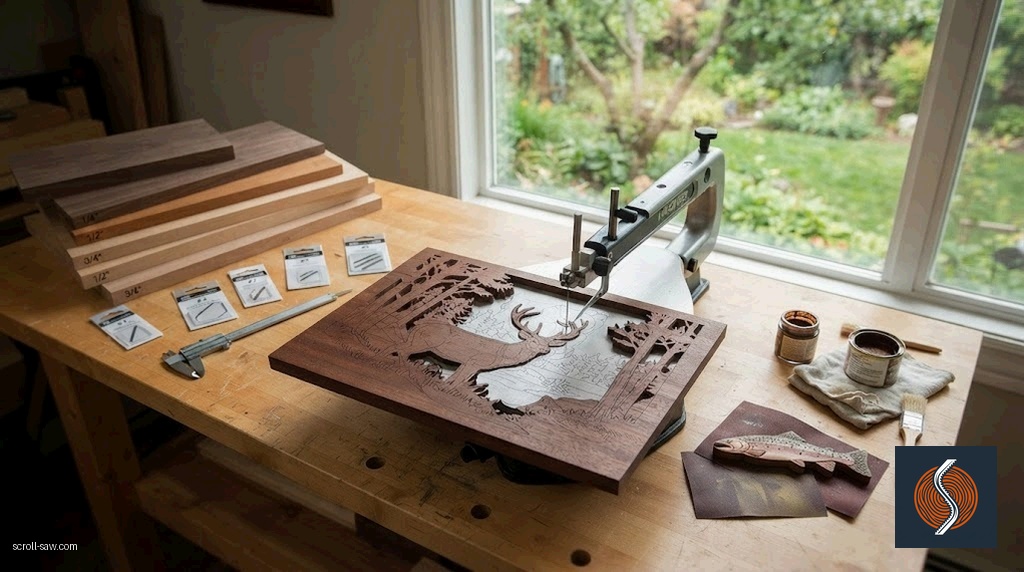
Hunting Scroll Saw Patterns: Material Thickness, Blade Size, and Finishing Notes
Hunting scroll saw patterns are outdoor and lodge decor with specific game subjects: whitetail deer, elk, moose, black bear, ducks and waterfowl, upland game birds, fish, and hunting scenes. Each subject has recognizable geometry. Get the antlers wrong on a deer or the ear proportions wrong on an elk and the pattern reads generic ungulate. This guide is how to cut hunting patterns for outdoorsman gifts and lodge display.
Hunting scroll saw patterns are silhouette or fretwork patterns of game animals and hunting scenes cut on a scroll saw from 3/4 to 1 inch stock, sized 12 to 24 inches, featuring recognizable game species and hunting imagery. Applications include hunter gift pieces, cabin and lodge decor, trophy commemoration pieces, and hunting club decor.
The short version of the plan: 3/4 inch dense hardwood or Baltic birch, reverse-tooth #5 for silhouette and #3 for antler and detail, cutting sequence that preserves fragile antler tines and ear tips, and finish suitable for cabin or trophy display.
Popular hunting pattern subjects
Whitetail deer. Whitetail buck with characteristic antler rack. Antler point count is specific (typical 8-point or 10-point). Ears alert.
Elk. Massive antlers with more mass than deer; body larger than deer. Neck mane in rutting bulls.
Moose. Palmate antlers (broad flat antler surface with points around edges). Very large body. Bell hanging below jaw.
Black bear. Compact body. Distinct short round ears. No antlers.
Waterfowl. Ducks (specific species: mallard, wood duck, canvasback), geese, swans. Landing pose common.
Upland game birds. Pheasant, quail, grouse, turkey. Specific plumage features per species.
Fish. Bass, trout, walleye, salmon. Species-specific body shape and fin proportions.
Hunting scene. Hunter with rifle, dog, and game. More complex multi-element pattern.
Species recognition features
Each hunting subject needs species-specific accuracy:
Whitetail buck. Antler rack with correct point count. Point curvature characteristic. Ears alert.
Elk. Massive antler rack with distinctive tine arrangement. Chest larger than deer. Neck mane on rutting bulls.
Moose. Palmate antlers (broad and flat). Bell under jaw. Massive body.
Black bear. Short round ears. Compact powerful body. No neck mane, no antlers.
Mallard duck. Green head, white neck ring, brown chest, gray body. In silhouette, characteristic head shape.
Wood duck. Elaborate head crest. Characteristic head profile.
Pheasant. Long tail feathers. Male has iridescent head coloring.
Before cutting, verify pattern shows characteristic species features.
Stock choice
3/4 inch dense hardwood (walnut for dramatic pieces, cherry for warm cabin display, oak for rustic lodge display).
3/4 inch Baltic birch plywood for detailed patterns with fragile antler tines. Grain-neutral so antler projections have support in every direction.
1 inch thick stock for premium wall pieces (over 18 inch).
Skip pine and softwoods; antler tines crack.
Blade choice
A reverse-tooth #5 for outer silhouette.
A reverse-tooth #3 for antler detail, ear tip detail, and feature rendering.
Cutting sequence for hunting patterns
First, drill entry holes: eye opening, antler detail entry holes, hanger hole.
Second, cut interior detail: eye opening, coat texture if rendered.
Third, cut outer silhouette. For deer and elk with antlers, cut body outline first with careful transition to the antlers. Approach each antler tine from the antler base side; free tine tips as last cuts. On palmate moose antlers, cut palm edges last with hand support on surrounding waste.
For waterfowl, cut body outline. Free wing tips and tail feathers as last cuts.
For bears and antler-less subjects, standard silhouette cutting.
Sanding and finishing
Sand every face with 220 then 320. Ease every antler tine carefully.
For walnut pieces, wipe-on Danish oil at two to three thin coats. Walnut reads appropriate for game silhouette pieces.
For cherry pieces, wipe-on oil for warm cabin display.
For Baltic birch pieces, wipe-on oil or optional stain for hunter-appropriate coloring (medium walnut or oak stain).
Skip painted finishes for hunting pieces; wood-tone reads authentic.
Trophy commemoration pieces
Special pieces for successful hunts:
Hunter’s name and hunt date. Cut as fretwork lettering on the silhouette or on a backing plate.
Game taken. The specific species silhouette commemorates the hunt.
Hunt location. Optional lettering with hunt location.
Antler point count. For deer/elk pieces, actual point count matches the pattern.
Application: gift for hunter to commemorate the specific hunt.
Common hunting pattern mistakes
| Mistake | What went wrong | Fix |
|---|---|---|
| Antler tine broke | Cross-grain and cutting approach wrong | Baltic birch; approach each tine from base side; free tips last |
| Deer reads generic ungulate | Antler rack wrong or missing | Verify deer has appropriate antler rack; buck has antlers, doe does not |
| Wrong species characteristics | Pattern shows wrong species features | Verify pattern shows characteristic features for intended species |
| Painted finish reads amateur | Chose paint over wood tone | Wood tone with wipe-on oil reads authentic; skip paint |
| Trophy piece has wrong point count | Guessed | Verify actual point count against successful hunt record |
Verdict
Hunting scroll saw patterns are rewarding outdoorsman pieces. 3/4 inch walnut or Baltic birch. Reverse-tooth #5 for silhouette, #3 for antler and detail. Verify species-specific features before cutting. Standard cutting sequence with antler tines and fragile projections freed last. Wipe-on Danish oil finish; wood tone reads authentic.
For a first hunting scroll saw pattern, a whitetail buck silhouette in 3/4 inch walnut with wipe-on Danish oil is the honest starting piece. Trophy commemoration pieces and hunting scene pieces follow naturally.
FAQ
What wood is best for a hunting scroll saw pattern? Walnut at 3/4 inch for dramatic game silhouette pieces. Cherry for warm cabin display. Oak for rustic lodge display. Baltic birch for detailed patterns with fragile antler tines.
What blade cuts hunting patterns cleanly? A reverse-tooth #5 for outer silhouette. A #3 for antler detail and feature rendering.
How do I make a deer pattern read as the specific species? Verify antler rack (buck has antlers with specific point count and curvature; doe does not). Ear proportions and body proportions distinguish deer from elk.
How do I cut antler tines without breaking? Baltic birch (grain-neutral). Approach each tine from the antler base side. Free tine tips as the last cuts on each antler.
How thick should stock be? 3/4 inch for most patterns. 1 inch for premium wall pieces over 18 inch.
Can I make a trophy commemoration piece? Yes. Hunter’s name, hunt date, game species silhouette, and antler point count if applicable. Popular commemoration gift.
Should hunting pieces be painted or wood-tone? Wood tone reads authentic. Wipe-on Danish oil on walnut or cherry. Skip painted finishes for hunting pieces.
Can I make a hunting scene piece? Yes. Hunter, dog, and game as multi-element pattern. More complex than single-subject silhouettes. Rewarding lodge decor.
References
-
Fine Woodworking magazine — Scroll saw wildlife and hunting reference (finewoodworking.com)
-
Popular Woodworking — Scroll saw outdoor and hunting techniques (popularwoodworking.com)
-
Scrollsaw Workshop by Steve Good — Free scroll saw hunting and wildlife patterns (scrollsawworkshop.blogspot.com)


