
Cutting a Scroll Saw Nativity Set: Coordinated Figures and Assembly Notes
Cutting a Scroll Saw Nativity Set: Coordinated Figures and Assembly Notes
My first nativity set had a beautiful Mary and Joseph, an acceptable manger, three passable shepherds, and a Wise Man that looked like he wandered in from a different project entirely. He was cut two months later, from a different piece of the same wood, and finished slightly differently. The set never quite recovered.
A nativity set has to read as one set. Cut every figure in the same session or two sessions. Same wood, same blade, same finish. The scale must be consistent across figures: Mary and Joseph roughly the same height, wise men slightly taller (they’re traditionally standing while Mary and Joseph are kneeling), shepherds various heights, and animals scaled appropriately.
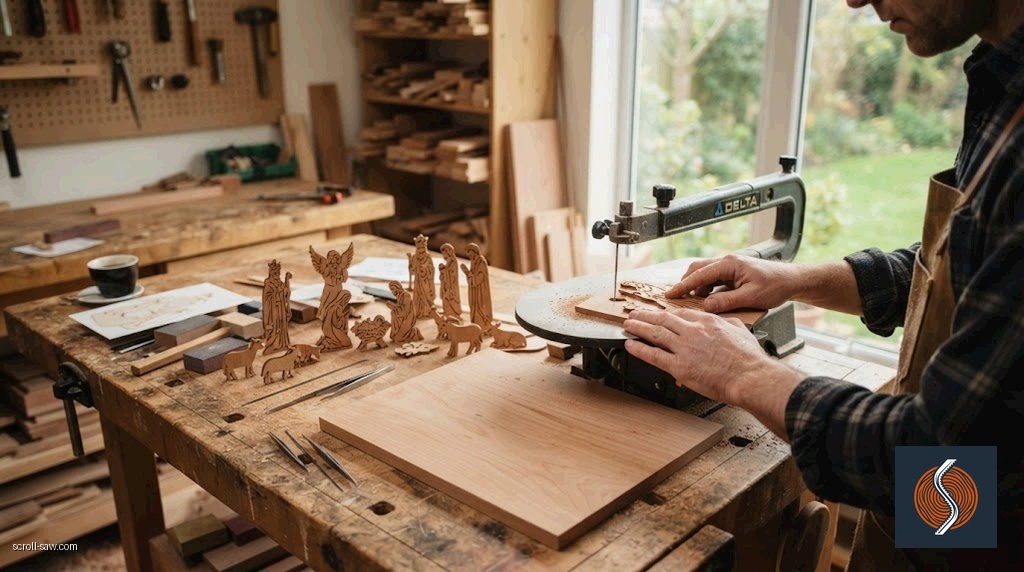
A scroll saw nativity set is a set of wooden nativity figures cut from thin hardwood or plywood, designed to display together as a Christmas nativity scene. Common figures: Mary, Joseph, baby Jesus in manger, three wise men (Magi), two or three shepherds, angel, animals (donkey, sheep, cow, camel), and stable backdrop.
Planning the set as a coordinated project
Pick a scale. Standing figures 5-8 inches tall works well for tabletop display. Kneeling figures (Mary, Joseph) about 4-5 inches when kneeling would stand 6-7 inches. Wise men and shepherds standing 6-8 inches. Animals scaled to the figures: sheep about 3 inches long, donkey about 4-5 inches, camel about 5-6 inches.
Pick a wood. Same wood across all pieces. Cherry, walnut, and butternut all make beautiful heirloom nativities. Baltic birch plywood for painted sets.
Pick a finish. All clear-finished, or all painted with the same palette. Do not mix.
Sequence the cutting. Cut Holy Family (Mary, Joseph, Jesus in manger) first, then wise men, then shepherds, then angels, then animals, then stable. Same wood, same blades, same finish approach.
Include the stable last. A stable backdrop with a roof line, walls, and a floor unifies the set visually. Cut it as one piece or as a foldable multi-panel piece.
Common figures and their features
Mary. Kneeling figure with head bowed, hands folded or on the manger, robe flowing to the ground. Chunky silhouette works better than fine detail.
Joseph. Standing figure with staff, robe, head slightly bowed. Sometimes shown kneeling on the opposite side of the manger from Mary.
Baby Jesus in manger. Manger box with a small figure inside. The manger box is often the anchor of the composition.
Wise men (Magi). Three standing figures, each holding a gift, wearing crown or turban and elaborate robes. Slightly taller than shepherds. Each wise man traditionally has a distinct silhouette.
Shepherds. Standing figures with staffs, simple robes, often one figure kneeling. Two or three shepherds is typical.
Angel. Standing figure with wings above the stable or beside the Holy Family. See the angel article for wing considerations.
Animals. Donkey, sheep, cow, camel. Chunky animal silhouettes without fine detail.
Stable. Simple structure with roof, back wall, floor, and possibly side walls. Often cut as a single piece or as a folded three-panel piece.
Fragile detail warnings
Angel wing tips. Blunt each wing tip by 1/16 inch (see angel article).
Shepherd staffs. The crook at the top of a shepherd’s staff is fragile if drawn thin. Thicken the crook to 3/16 inch minimum.
Wise man crown points. Sharp crown tines break. Blunt each point by 1/32 inch.
Animal legs. Same as any animal pattern: thicken to 3/16 inch minimum.
Camel humps. Chunky, low-risk if drawn substantial.
Books and pattern sources
For a broad pattern library including nativities, Big Book of Scroll Saw Woodworking has a Christmas chapter with nativity patterns.
Steve Good’s blog has extensive free nativity patterns, both silhouette style and layered/compound style. Search scrollsawworkshop.blogspot.com for “nativity.”
Stock selection
Baltic birch plywood (real Baltic, void-free) at 1/4 inch for painted nativity sets. Cross-plied grain supports the delicate details.
Cherry at 1/4 inch for warm-toned heirloom nativities. Ages beautifully.
Walnut at 1/4 inch for dark elegant heirloom sets. Reads formal and traditional.
Butternut at 1/4 inch for a warm-toned nativity with softer visual weight.
Basswood at 1/4 inch for painted sets where you want smooth paintable surfaces.
All figures in the same wood.
Blade choice
For 1/4-inch stock with nativity-scale detail, a #5 reverse-tooth blade is the daily driver. From Olson FR49202 Reverse Tooth Scroll Saw Blades.
For tight interior corners on robe folds, faces, and small details, a #3 reverse-tooth turns tighter.
A nativity set is a batch project, so Pegas Regular Scroll #7 is worth the investment. It holds its edge across the whole set and produces smoother cuts.
Cutting sequence per figure
Drill all interior entry holes first for each figure. Face detail cutouts, hand cutouts, robe fold cutouts, any interior detail.
Cut interior fretwork first, smallest features to largest.
Cut the perimeter last. Take smooth continuous cuts along the robe outline. For staffs held by shepherds, cut into the staff tip from one side, back the blade out, enter from the other side.
For the angel figure, cut wing tips carefully; enter each tip from both sides.
Pattern attachment
Light 3M Super 77 Multipurpose Spray Adhesive. Two seconds from eight inches, ninety-second wait.
For hardwood figures destined for clear finish, use ScotchBlue Painter’s Tape 2090 on the stock first, then adhere the pattern to the tape.
Finishing the nativity set
Clear-finished heirloom. Wipe-on polyurethane in two thin coats across all figures. Sand lightly between with 400-grit. All figures develop patina together over years of display.
Painted traditional. Prime with shellac, base coat each figure with traditional colors (Mary in blue, Joseph in brown, wise men in rich robes, shepherds in earth tones). Add face and hand details with fine brush. Matte spray sealer.
Antique white. Base coat all figures white or ivory, apply diluted burnt umber wash, wipe most off. Reads as antique carved wood.
Stained walnut for basswood or poplar sets. Wipe stain on and off within thirty seconds. Warm even tone across all figures.
Making figures stand freestanding
Each figure needs a base to stand on. Options:
-
Slot base: cut small wooden bases with slots the exact thickness of the figure stock, glue figure into slot.
-
Backer wedge: thin triangular wedge glued to the back of each figure, hidden from the viewing angle.
-
Common platform: a single wooden platform for the whole set, with slots for each figure.
The common platform approach ties the set together visually and eliminates the risk of figures toppling.
Frequently asked questions
How many figures make a nativity set? Minimum: Mary, Joseph, baby Jesus, angel, one wise man, one shepherd, one animal. Better: Holy Family, three wise men, two shepherds, angel, three animals, and stable.
Should figures all be the same height? No. Standing figures (wise men, shepherds, Joseph) roughly the same height. Mary kneeling is shorter. Animals scaled appropriately smaller. Baby Jesus in the manger is the smallest.
How do I keep the set coordinated across years of adding pieces? Cut all figures in the same session with the same wood and finish. Adding pieces years later almost never matches.
Can I paint faces on the figures? Subtle painted faces (small dark eyes, small lip line) are traditional. Elaborate detail is difficult at scroll saw scale and often looks amateur.
What’s the biggest beginner mistake on nativity sets? Cutting figures across different sessions with different wood or finish. Batch the whole project.
Should the stable be tall enough to fit all figures inside? The stable is a backdrop, not a container. Figures stand in front of and beside the stable, not inside it. Stable height about 10-12 inches.
Can I make a nativity set as a gift? Common and meaningful gift. Plan on 15-25 hours of scroll saw work for a full set with stable.
References
-
Fox Chapel Publishing, Big Book of Scroll Saw Woodworking.
-
John Nelson, Scroll Saw Workbook, 3rd Edition, Fox Chapel Publishing.
-
Steve Good, Scrollsaw Workshop, scrollsawworkshop.blogspot.com.


