
Cutting Maple Leaf Scroll Saw Patterns: Entry Holes, Interior Cuts, and Assembly
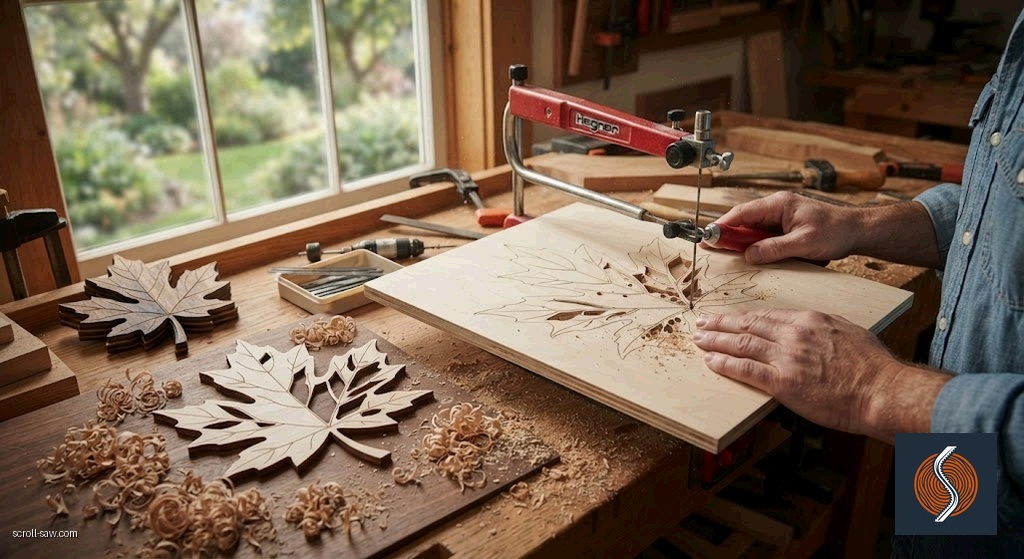
Cutting Maple Leaf Scroll Saw Patterns: Entry Holes, Interior Cuts, and Assembly
Maple leaf scroll saw patterns cover two related categories: the specific Canadian iconic maple leaf (11-point sugar maple leaf from the Canadian flag) and general maple leaf silhouettes for autumn decor. Each has recognizable geometry that must survive cutting. This guide is how to cut maple leaf patterns cleanly.
Maple leaf scroll saw patterns are silhouette or fretwork patterns of maple leaves cut from 1/2 to 3/4 inch stock, sized 6 to 18 inches, including the Canadian 11-point iconic leaf, sugar maple leaf silhouettes, and general maple leaf autumn imagery. Applications include Canadian pride display, autumn decor, gift pieces, and seasonal home decor.
The short version: 1/2 to 3/4 inch Baltic birch or dense hardwood, reverse-tooth #5 for leaf outline and #3 for vein fretwork detail, cutting sequence that preserves leaf point tips, wipe-on oil for wood tone or red paint for Canadian imagery.
Maple leaf types
Canadian iconic leaf. 11-point stylized maple leaf from the Canadian flag. Specific geometry.
Sugar maple leaf. 5-lobed leaf with characteristic sinuses (indentations between lobes).
Red maple leaf. Similar to sugar maple with slightly different lobe proportions.
Stylized autumn leaf. Simplified leaf shape for autumn decor.
Canadian iconic leaf geometry
Exactly 11 points. Verify pattern before cutting.
Stylized (not botanically accurate). Simplified for flag application.
Bilateral symmetry. Left and right halves mirror.
Characteristic proportions. Height greater than width; specific proportions.
Sugar maple leaf geometry
Five lobes. Central lobe, two upper lobes on either side, two lower lobes.
Characteristic sinuses. Deep U-shaped indentations between lobes.
Pointed lobe tips.
Central vein and lateral veins.
Stock choice
1/2 to 3/4 inch Baltic birch plywood for leaf point support. Grain-neutral.
3/4 inch dense hardwood (walnut for dramatic, cherry for warm autumn, oak for rustic).
1/2 inch stock for smaller pieces.
Blade choice
A reverse-tooth #5 for leaf outline.
A reverse-tooth #3 for vein fretwork if present.
Cutting sequence
First, drill entry holes: vein detail entry holes if fretwork included, hanger hole.
Second, cut interior vein fretwork.
Third, cut leaf outline. Approach each lobe point from lobe interior; free lobe tip as last cut on each lobe.
Painting for Canadian leaf
Red paint for iconic Canadian imagery. Match Canadian flag red (specific shade).
Primer, base coat, second coat, clear satin topcoat.
Painting for autumn colors
Red, orange, yellow, and brown paint gradients for autumn display.
Selective staining for muted autumn tones on hardwood.
Common mistakes
| Mistake | What went wrong | Fix |
|---|---|---|
| Canadian leaf has wrong point count | Not verified before cutting | Verify pattern shows exactly 11 points |
| Lobe tip broke | Approach wrong | Free lobe tips as last cuts |
| Sinus curve wrong | Pattern inaccurate | Verify characteristic sinus geometry |
| Autumn colors clash | Paint scheme unbalanced | Use red-orange-yellow gradient |
Verdict
Maple leaf scroll saw patterns are rewarding autumn and Canadian display pieces. 1/2 to 3/4 inch Baltic birch or hardwood. Reverse-tooth #5 for outline, #3 for veins. Free lobe tips last.
For a first pattern, an 8 inch sugar maple leaf silhouette in 1/2 inch Baltic birch with autumn paint is the honest starting piece.
FAQ
What wood is best? Baltic birch for lobe tip support. Cherry, walnut, or oak for wood-tone display.
What blade cuts maple leaf patterns cleanly? A reverse-tooth #5 for outline. A #3 for vein fretwork.
How do I identify Canadian iconic leaf vs sugar maple? Canadian has 11 stylized points; sugar maple has 5 lobes with sinuses.
Can I paint in Canadian flag red? Yes. Primer, red base coat, second coat, clear topcoat.
What autumn color scheme works? Red, orange, yellow, brown gradient. Or selective stain for muted autumn tones.
How thick should stock be? 1/2 to 3/4 inch for most patterns.
How do I cut lobe tips without breaking? Baltic birch. Free lobe tips as last cuts on each lobe.
Can I make a series of leaves in different fall colors? Yes. Multiple leaves in coordinating autumn tones make display.
References
-
Fine Woodworking magazine — Scroll saw leaf reference (finewoodworking.com)
-
Popular Woodworking — Scroll saw autumn decor techniques (popularwoodworking.com)
-
Scrollsaw Workshop by Steve Good — Free scroll saw leaf patterns (scrollsawworkshop.blogspot.com)


