
Number Scroll Saw Patterns: Layout, Blade, and Cutting Sequence
Number Scroll Saw Patterns: Layout, Blade, and Cutting Sequence
Numbers seem like the easy version of monogram work. Ten digits instead of twenty-six letters, mostly rounded shapes, no serif complexity. Then a beginner cuts a house number sign, watches the counter of the 6 fall out of the wood, and learns that number patterns need the same bridge planning as monograms plus the added challenge that most number projects hang outdoors.
Number scroll saw patterns show up in three main project types: address plaques, milestone celebration signs (30th, 50th, 100th birthdays and anniversaries), and calendar or educational pieces. Each project type has different demands on font, thickness, and finish. A house number that lives on a porch behaves differently over three winters than a nursery number that stays indoors.
Short answer: cut number patterns on 3/4-inch weather-resistant wood for outdoor signs and 1/2-inch Baltic birch or hardwood for indoor pieces, use a #5 reverse-tooth blade for outer profiles and #3 for counters, plan bridges on the closed counters of 0, 4, 6, 8, and 9, cut counters first before outer profiles, and finish outdoor pieces with marine-grade exterior sealer.
The rest of this guide covers the setup that makes numbers survive real use.
Which digits have counters
Understanding counter geometry before cutting saves the piece.
Digits with no enclosed counter: 1, 2, 3, 5, 7. These cut like straightforward silhouettes.
Digits with one enclosed counter: 0, 4, 6, 9. Each needs one bridge to hold the counter in place after the outer profile is cut.
Digits with two enclosed counters: 8. This is the one digit that needs two bridges reliably.
Some font styles complicate this. A four with a closed top (as in some geometric fonts) has a counter that other fours do not. A one with a serif base has structural stability that a plain one does not. Read the font before assuming.
Font choice for numbers
House numbers work best in a clean, high-contrast font. Impact, Bebas Neue, and Rockwell are common house-number choices because their thick strokes hold detail from a distance.
Milestone signs (30th birthday, 50th anniversary) benefit from either the same clean fonts or from decorative script for a softer look. Script numbers need bridge planning similar to script letters, because the connecting curves are thin.
Nursery numbers and educational pieces work in playful fonts, but avoid fonts with strokes thinner than 1/8-inch at the final print scale.
Hand-drawn or artisanal fonts translate poorly to scroll saw work if the strokes vary widely in thickness. The thin sections snap. Pick even-weight fonts for scroll saw output.
Material choice by project type
Outdoor house numbers need weather-resistant stock. The two honest options are cedar and marine-grade plywood.
Cedar in 3/4-inch stands up to weather for a decade or more with basic exterior finish. Its natural resistance to rot beats treated pine for this application. The trade-off: cedar splits under fine detail cuts, so number strokes need to stay above 3/8-inch wide at final scale.
Marine-grade plywood in 3/4-inch handles the finest detail and holds up outdoors nearly as well as cedar. Its face veneer is thin, so scratches show, and it needs immediate sealing on the cut edges.
Indoor number pieces cut cleanly in 1/2-inch Baltic birch for wall mounts or 3/4-inch hardwood for standing displays.
Milestone celebration signs work in either 1/2-inch birch (for lighter pieces) or 3/4-inch hardwood (for premium gift pieces).
Avoid oak for detailed number work. Its ring-porous grain tears on the interior curves of 6, 8, and 9.
Blade selection
Outer number profiles cut on a #5 reverse-tooth blade. The reverse teeth keep the down-face clean, which matters because number signs are often visible from both sides.
Counters cut on a #3 reverse-tooth blade. The tighter blade follows the smaller counter curves without straightening them.
On hardwood or cedar, Pégas Modified Geometry blades reduce burn marks on the tight interior curves of 6 and 9. Worth the switch for anything display-quality.
Spiral blades work poorly on numbers because they round the crisp edges that make numbers legible from distance.
Bridge placement for number counters
Bridge planning follows the same logic as letter monograms.
For 0: two bridges opposite each other, at the top and bottom of the counter. Symmetric placement reads as intentional design detail rather than a fix.
For 4: one bridge on the diagonal stroke side of the counter, positioned in the corner where the counter meets the vertical stroke.
For 6: one bridge on the counter’s inner top edge, where it meets the loop’s inner curve.
For 8: two bridges, one at the top of each counter, placed at the pinch point between the two counters where they nearly touch. Both bridges hide in the letterform.
For 9: one bridge on the counter’s inner bottom edge, mirroring the 6 pattern.
Bridges are two to three millimeters wide at final scale. Smaller bridges snap in outdoor conditions. Larger bridges become visible.
Cutting sequence
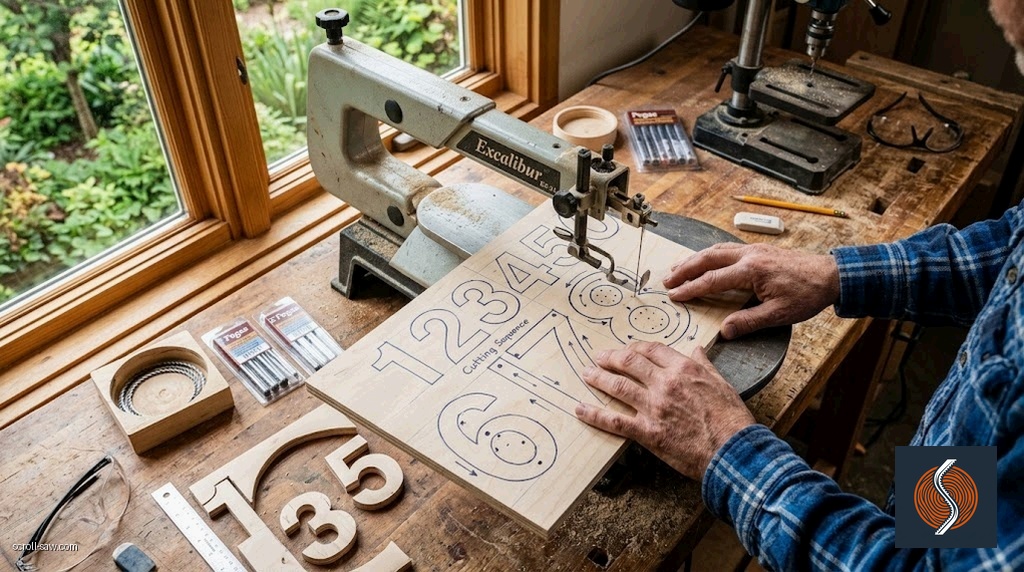
Step one, drill entry holes for every counter before any cutting.
Step two, cut all counters with a #3 blade. Thread the blade, cut the shape, pop free, move to the next.
Step three, cut the outer profile of each digit. For multi-digit signs, work from the least fragile digit to the most fragile. A house number that includes an 8 should have the 8 cut last among the outer profiles.
Step four, cut any decorative border or backing profile if the pattern includes one.
Step five, release the piece from the waste stock in a final cut.
Step six, remove pattern paper only after all cutting is complete.
Outdoor finish for house numbers
A cedar or marine-plywood house number sign lives in weather. Its finish is the difference between a five-year piece and a fifteen-year piece.
Seal every cut surface immediately after cutting. Endgrain absorbs water fast, and cut edges from a scroll saw are essentially all endgrain relative to the face. Use a thin exterior wood sealer or a marine-grade primer.
Apply exterior paint or stain over the sealer. Two coats minimum. Solid-color exterior paint holds up longer than semi-transparent stain in direct sun.
Finish with a UV-resistant clear coat, exterior spar urethane or marine varnish. Two coats. Re-coat every two to three years.
Avoid interior finishes on outdoor pieces, no matter how good the sealer underneath. Interior finishes crack under UV within one season.
Mount the sign with stainless steel or brass hardware. Regular steel screws bleed rust into the wood within one wet season.
Indoor finish for number pieces
Indoor numbers finish like any indoor scroll saw piece.
Sand with 220 grit on flat faces, work with the grain.
Apply wipe-on oil (Danish oil, boiled linseed oil) for hardwood pieces where grain visibility matters.
Apply matte spray lacquer for pieces that will handle regularly or need color under a clear coat.
Color-finished nursery numbers use water-based dye stain applied before lacquer. Test on scrap first.
Sizing for common projects
House numbers on a standard mailbox: 3 to 4 inches tall per digit, readable from the street.
House numbers on a porch plaque: 4 to 6 inches per digit, visible from the sidewalk.
Milestone birthday signs: 6 to 12 inches per digit depending on display context.
Wedding anniversary signs: similar to milestones, 6 to 12 inches.
Nursery numbers (single digit for age or birthdate): 8 to 12 inches for wall display.
At the small end (under 3 inches), counter details become too fine for reliable cutting on stock over 1/4-inch thick.
Common failures and their causes
Counter falls out during cutting. Cause: outer profile cut before the counter, without a bridge. Fix: cut counters first, always add bridges.
Outdoor sign warps within a season. Cause: single-face finish. Water absorbs into the unfinished back face and swells the wood unevenly. Fix: seal and finish both faces plus all cut edges before installation.
Paint bleeds under exterior clear coat. Cause: incompatible finish layers. Fix: use manufacturer-matched sealer, paint, and clear coat, all from the same product line for outdoor work.
Number legibility drops after finishing. Cause: over-application of finish rounds off crisp letterform edges. Fix: two thin coats beat one thick coat.
Bridges are visible from viewing distance. Cause: bridge placement on a face rather than an edge. Fix: place bridges on the counter’s inner edge where they read as part of the letterform.
FAQ
Can I paint numbers before cutting?
Not advisable. Paint on the cut face chips at the blade line. Cut first, then finish.
What is the minimum stroke width for scroll saw numbers?
Roughly 1/4-inch at final scale for reliable indoor cutting, 3/8-inch minimum for outdoor use where weather stress adds fatigue.
How do I center a multi-digit house number on a plaque?
Measure the total width of all digits plus their spacing on the pattern. Center that width on the plaque before applying pattern adhesive.
Should I use offsets for multi-digit house numbers?
Digits at the same visual size have different widths (a 1 is narrower than a 0). Kerning by eye rather than by mathematical centering usually reads better.
What is the durable outdoor wood beyond cedar?
White oak and teak both hold up. White oak cuts well on a scroll saw with care on ring-porous grain. Teak cuts cleanly but is expensive.
Do address plaques need to meet local visibility rules?
Many municipalities require house numbers of at least 3 to 4 inches tall, visible from the street, and contrasting color to the background. Check local code before finalizing size.
Can I combine numbers with a decorative border on one piece?
Yes, and the border adds visual weight that helps small numbers read from distance. Cut the border as a frame with the numbers as inset elements, or cut the whole thing as one piece if the pattern supports it.
References
-
USDA Forest Products Laboratory, wood durability ratings for exterior use
-
Steve Good, Scrollsaw Workshop archive on address plaques
-
Wood Magazine, exterior finishing schedule for sign work
-
Fine Woodworking, wood species for outdoor applications


