
Making Eagle Scroll Saw Patterns: Wing Geometry, Feather Detail, and Finishing
Making Eagle Scroll Saw Patterns: Wing Geometry, Feather Detail, and Finishing
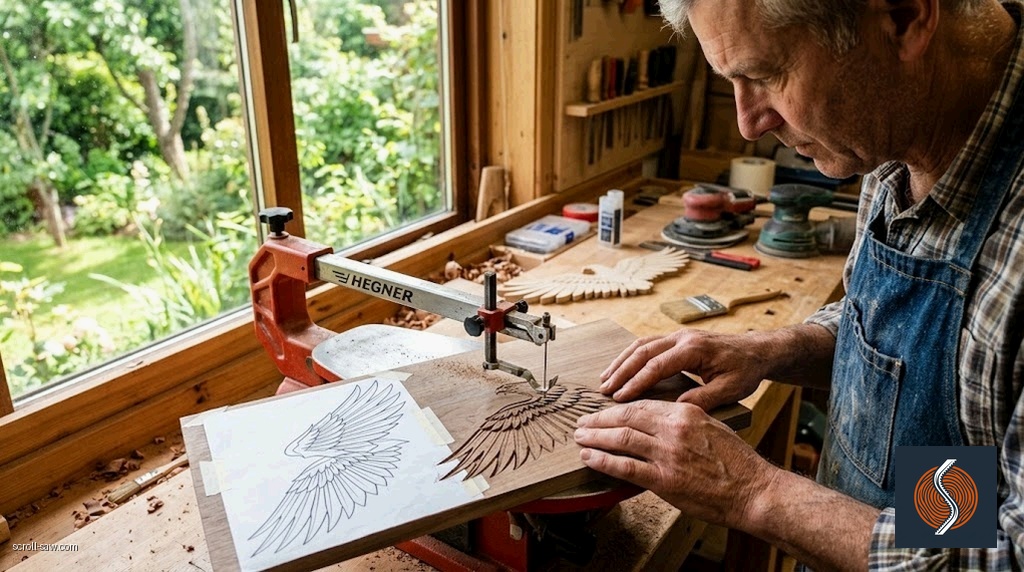
A bald eagle with wings spread, talons extended, is a subject that has to be earned. Not because the cutting is technically harder than other wildlife (it isn’t), but because eagle patterns concentrate a lot of fragile detail into one piece. Every primary feather is a separate bridge. Every talon is a small extended point. The head has a distinctive beak and eye that need to read clearly at scroll saw scale.
The first eagle I attempted lost two feathers and a talon before I finished sanding. The second, planned around the fragility, survived and reads as a proper eagle. Same wood, same blade. Different planning.
An eagle scroll saw pattern is an eagle figure cut from thin hardwood or plywood, ranging from simple silhouette (perimeter only) to complex fretwork (detailed feather and body cutouts) to layered eagle (multiple pieces stacked for dimension). Common subjects: bald eagle in flight, bald eagle perched, golden eagle, eagle with American flag, eagle on branch, eagle head portrait.
The three fragile details and how to fix them
Primary feathers. The individual finger-like feathers at the wing tips are often drawn thin. Each primary feather is a bridge that connects to the wing mass at one end and extends out into space at the other. At 1/4-inch stock, primary feathers thinner than 1/8 inch at the base will snap. Fix: thicken each primary at the base to 3/16 inch. Blunt each tip by 1/32 inch.
Talons. Eagle talons are small curved points on the feet. They’re vulnerable to breaking during finishing or handling. Fix: thicken each talon to 1/8 inch minimum, or simplify the feet to fewer larger talons.
Beak curve. The hooked beak of an eagle can be drawn thin at the tip. Fix: blunt the beak tip by 1/32 inch, and verify the beak base is at least 3/16 inch thick.
Common eagle compositions
Bald eagle in flight. Wings fully extended, head forward, talons trailing or extended. The most dramatic silhouette.
Bald eagle perched. Standing on a branch or rock, wings folded. Fewer fragile details but reads as less dynamic.
Eagle with American flag. Eagle in front of an American flag design cut as a combined pattern. Popular for patriotic decor.
Eagle head portrait. Just the head and shoulders, showing the hooked beak, sharp eye, and characteristic white head against dark body. Simplifies the fragility problem by eliminating wings and talons.
Golden eagle. Similar body shape to bald eagle but with no white head. Distinct as a pattern subject through overall color (or stain choice).
Books and pattern sources
For a broad pattern library including eagles, Big Book of Scroll Saw Woodworking has a wildlife section with eagle patterns at multiple skill levels.
Steve Good’s blog has multiple eagle patterns. Search scrollsawworkshop.blogspot.com for “eagle.”
Fox Chapel Publishing has published patriotic pattern books that feature eagles prominently.
Stock selection
Baltic birch plywood (real Baltic, void-free) at 1/4 inch is the standard for eagle patterns. Cross-plied grain supports the primary feathers and talons. This is the recommended choice for beginners and intermediate cutters.
Cherry at 1/4 inch for warm-toned clear-finished eagles. Beautiful when the piece survives.
Walnut at 1/4 inch for dark elegant eagles. The dark grain suggests the eagle’s body color.
Basswood at 1/4 inch for painted eagles where you want realistic coloring.
Avoid pine. Pine is too soft for the fine feather and talon detail.
Blade choice
For 1/4-inch stock with eagle-scale detail, a #5 reverse-tooth blade is the daily driver. From Olson FR49202 Reverse Tooth Scroll Saw Blades.
For tight interior corners at feather bases and talon detail, a #3 reverse-tooth turns tighter.
For extended production of eagle pieces (patriotic sets, gift series), Pegas Regular Scroll #7 holds its edge across the batch.
Cutting sequence
Drill all interior entry holes first. Eye cutout, negative space between primary feathers, negative space around talons, any interior body detail.
Cut interior fretwork first, smallest features to largest. Eye cutout first, then feather detail cutouts.
Cut the perimeter last. Take smooth continuous cuts along the body outline. At each primary feather tip, cut into the tip from one side, back the blade out, enter from the other side. Cutting continuously around fragile feather tips risks snapping them.
At the beak, cut along the top of the beak from head to tip in one smooth cut, back the blade out, enter from the underside. Do not cut around the beak tip continuously.
At talons, take slow careful cuts. Enter each talon tip from one side, back out, enter from the other side.
Pattern attachment
Light 3M Super 77 Multipurpose Spray Adhesive. Two seconds from eight inches, ninety-second wait.
For hardwood pieces destined for clear finish, use ScotchBlue Painter’s Tape 2090 on the stock first, then adhere the pattern to the tape.
Finishing eagle pieces
Clear finish on hardwood for premium heirloom eagles. Wipe-on polyurethane in two thin coats. Handle carefully during finishing to protect primaries and talons.
Painted realistic bald eagle for wildlife accuracy. Prime with shellac, base coat dark brown for body, white for head and tail, yellow for beak and feet, black detail on eye. Matte spray sealer.
Stained rustic for cabin and lodge decor. Walnut or ebony stain on basswood produces a dark eagle without the specific coloring of a bald eagle.
Painted with metallic accents for special-occasion pieces. Gold or bronze accent on beak and talons reads elegant.
Display options
Wall plaque. Eagle mounted on a rectangular or shaped wooden backer, often with the eagle stained differently from the backer for contrast.
Freestanding shelf piece. Eagle on a small wooden base for tabletop display.
Patriotic wall art. Eagle combined with flag, banner, or state outline.
Silhouette suncatcher. Eagle cut in Baltic birch with fine fretwork, hung in a window where backlight shows the fretwork.
Framed art. Eagle mounted inside a shadow box frame for a formal display.
Frequently asked questions
How do I keep primary feathers from breaking? Thicken each feather to 3/16 inch at the base and blunt each tip by 1/32 inch. Cut into each tip from both sides rather than continuously.
Should I use plywood or hardwood? Baltic birch plywood is more forgiving. Cross-plied grain supports the fragile details. Hardwood produces a more beautiful piece but risks grain-direction breakage on feathers.
Can I cut a bald eagle without a white head if I’m using natural wood? A clear-finished walnut eagle reads as a dark eagle silhouette (visually closer to a golden eagle than a bald eagle). For a bald eagle, either paint the head or use inlay techniques with light wood for the head.
How thick should the wood be? 1/4 inch is standard. Thicker (3/8 inch) for freestanding pieces or where you want more visual weight. Not thinner than 1/4 inch; the primaries need structural depth.
What’s the biggest beginner mistake on eagle patterns? Cutting primary feathers as drawn without thickening. Also cutting around the beak tip continuously and snapping it.
Can I combine an eagle with an American flag? Yes, this is a popular composition. Cut the flag first (stripes and star field), then the eagle overlaid or in front. Requires careful planning.
How do I paint an eye that reads as sharp and alert? Small dark eye with a tiny white highlight offset from the center. The highlight is what makes the eye look alive.
References
-
Fox Chapel Publishing, Big Book of Scroll Saw Woodworking.
-
John Nelson, Scroll Saw Workbook, 3rd Edition, Fox Chapel Publishing.
-
Steve Good, Scrollsaw Workshop, scrollsawworkshop.blogspot.com.


