
Star Trek Scroll Saw Patterns: Cutting Guide for Fandom Pieces
Star Trek Scroll Saw Patterns: Cutting Guide for Fandom Pieces
Star Trek is one of the fandoms that translates well to scroll saw work. The Starfleet insignia has clean geometric lines. The Enterprise silhouettes have sweeping curves and structural details that reward careful cutting. The Klingon and Vulcan emblems have angular fret work that shows off blade control. And Star Trek fans, once they own one scroll saw piece, tend to want a wall’s worth.
Star Trek scroll saw patterns fall into a few categories, and each has its own cutting demands. Insignia and delta shield patterns are geometric and unforgiving of drift. Starship silhouettes have thin sections at the warp nacelles and connecting pylons. Character-based patterns (Spock, Kirk, Picard silhouettes) work like any portrait pattern. Klingon and Romulan emblems have angular interior detail that needs entry holes at every corner.
Short answer: cut Star Trek patterns on 1/2-inch Baltic birch or hardwood for wall pieces and 1/4-inch for ornaments, use a #5 reverse-tooth blade for outer profiles and #3 for interior fret work, treat starship nacelles and pylons as the last cuts in the sequence with waste wood support until release, and finish insignia pieces in high-contrast paint schemes that read from viewing distance.
Before anything else: Star Trek imagery is trademarked. Cutting patterns for personal use, gifts, or hobby display is generally uncontested. Selling patterns or finished pieces commercially can attract enforcement action. If you plan to sell, use original geometric designs inspired by Star Trek rather than direct reproductions of trademarked emblems, or work with licensed pattern packs.
The rest of this guide covers the cutting choices.
Star Trek pattern categories
Delta shield / Starfleet insignia. The arrowhead-style Starfleet emblem. Clean geometry, no interior fret work typically, easy first cut.
Command / Science / Engineering variants. The delta shield with the internal division symbol. Adds interior fret detail. Moderate difficulty.
USS Enterprise silhouettes. Various series’ Enterprise designs. The saucer section, engineering hull, and nacelles all have distinct silhouette challenges. The connection between saucer and engineering hull is the failure point.
Klingon emblem. Trefoil-style angular emblem. Sharp corners, needs entry holes at each internal vertex.
Vulcan IDIC. Circle-and-triangle geometric emblem. Requires precision on the interior circle-triangle intersection.
Klingon Bat’leth silhouette. The curved bladed weapon. Elegant single-piece cut, but the curves need consistent feed rate.
Character silhouettes. Named-character head profiles. Portrait pattern work with all its demands.
Wood choice for Star Trek pieces
1/2-inch Baltic birch works for every Star Trek pattern.
For pieces intended for painted finish (the classic gold delta shield, or the red Klingon emblem), birch plywood accepts paint uniformly.
For natural-wood display pieces, walnut gives the delta shield a modern executive look. Cherry works well for warm-toned display. Maple stays neutral and pairs with contrasting inlay work.
Oak is a poor choice for angular emblems. Its grain fights the geometric precision.
For pieces intended for cosplay or costume props (Bat’leth silhouettes as prop-scale pieces), heavier stock at 3/4-inch gives the weight cosplay props need.
Blade selection
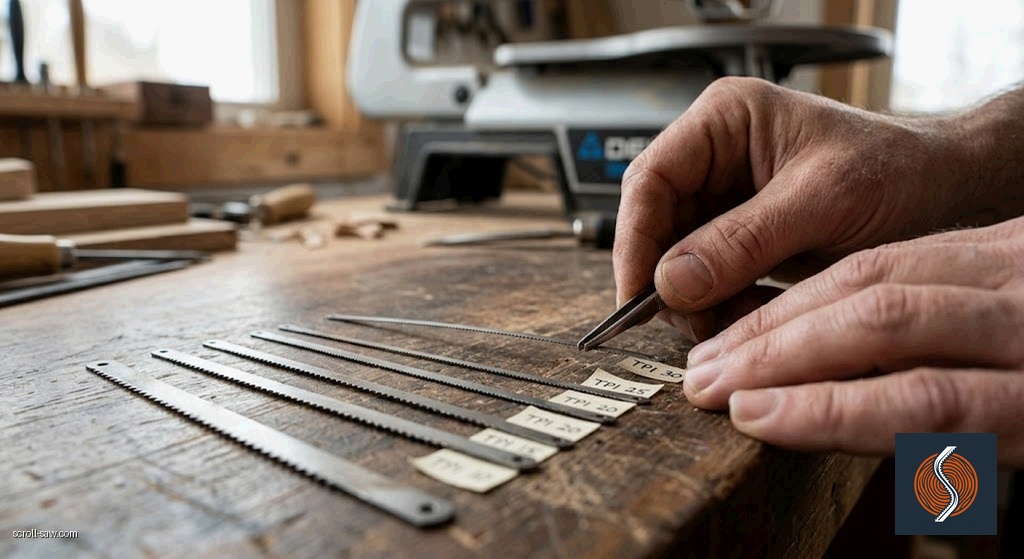
Outer profile of insignia: #5 reverse-tooth blade.
Interior fret work on Starfleet division symbols, Klingon emblem interior, Vulcan IDIC intersection: #3 reverse-tooth blade.
Starship nacelle detail, character silhouette features: #2/0 blade.
On hardwood, Pégas Modified Geometry blades give cleaner corners on angular emblems.
Cutting sequence for a delta shield insignia
The basic delta shield is one of the friendlier first cuts.
Step one, if the pattern includes a division symbol (star, atom, spiral), drill entry holes for the interior detail. A simple delta shield has no interior work.
Step two, cut the interior detail with a #3 blade.
Step three, cut the outer arrowhead profile with a #5 blade. Start at the point of the arrowhead, work around one curve, back to the top, and down the other curve to close the profile.
Step four, the pointed tip of the delta shield is fragile. Approach the tip last if possible, with waste wood supporting it until release.
Cutting sequence for a Starship Enterprise silhouette
Enterprise silhouettes vary by series (TOS, TNG, DS9, etc.) but share structural features.
Step one, drill entry holes for any interior detail (window rows on the saucer section, phaser arrays, engineering hull details).
Step two, cut interior detail with a #3 or #2/0 blade.
Step three, cut the outer profile of the saucer section, working from one side around the front and back to the connection with the engineering hull.
Step four, cut the outer profile of the engineering hull. This is the middle section that connects saucer to nacelles.
Step five, cut the nacelle profiles. Nacelles are the twin cylindrical warp engines and are the most fragile sections of the Enterprise silhouette. Cut with waste wood supporting each nacelle until the final release cut.
Step six, cut the connecting pylons between engineering hull and nacelles last. These thin structural pieces snap easily.
Step seven, remove pattern paper only after all cutting is complete.
Cutting sequence for a Klingon emblem
The Klingon Empire emblem is a trefoil with sharp angular interior.
Step one, drill entry holes at every interior vertex of the emblem. Klingon emblems have multiple sharp interior corners, each needing a threaded blade start.
Step two, cut interior fret work with a #3 blade. Follow the angular pattern lines exactly, pausing at each vertex to change direction cleanly.
Step three, cut the outer trefoil profile with a #5 blade.
Step four, remove pattern paper.
Angular emblems reward slow, deliberate cutting more than fast fluid work. Feed too fast on a sharp interior vertex and the blade drifts past the corner.
Finishing Star Trek pieces
Star Trek pieces display best in painted finishes that match on-screen colors.
Gold delta shield. Metallic gold acrylic or spray paint over base primer. Two thin coats. Clear coat over the gold to prevent chipping.
Silver delta shield. Metallic silver, same process as gold. Silver reads more contemporary than gold.
Red Klingon emblem. Bright red acrylic, two coats. Trim in gold or bronze for accent detail.
Dark Vulcan IDIC. Dark bronze or aged copper finish. Two coats. Semi-gloss clear top coat.
Natural-wood insignia. For pieces meant to display wood grain, wipe-on oil finish only. Skip painted color entirely.
For multi-color pieces (delta shield with contrasting internal symbol), mask carefully between colors. Painter’s tape holds paint boundaries cleanly if pressed down firmly before painting.
Common failures and their causes
Nacelle snaps during cut. Cause: cut nacelle before support wood removed. Fix: nacelles last in cut sequence.
Delta shield tip breaks. Cause: tip cut early in sequence without support. Fix: approach tip last, waste wood supporting.
Klingon vertex rounds off. Cause: blade drift on sharp interior corner. Fix: slow feed at each vertex, use fine blade for interior fret.
Paint bleeds under masking tape. Cause: tape not pressed firmly, or wood surface too textured. Fix: sand smooth, press tape edge firmly with a fingernail before painting.
Insignia looks fuzzy from viewing distance. Cause: pattern too small for detail, or paint too soft in edge definition. Fix: increase piece size or simplify pattern detail, use sharper masking.
FAQ
Can I sell Star Trek scroll saw pieces?
Personal use and gifts to friends are generally uncontested. Commercial sale of pieces reproducing trademarked Star Trek imagery can attract cease-and-desist letters or legal action from the trademark holder. Consider original designs inspired by the franchise rather than direct emblem reproductions if you intend to sell.
What is the easiest Star Trek pattern for a first cut?
A plain delta shield without any interior division symbol. Clean outer profile, no fret work, forgiving on stock and blade choice.
Do character silhouette patterns work well as pieces?
Only if the silhouette is distinctive enough to read as the character. Spock’s pointed ears and eyebrow arch make an identifiable silhouette. Kirk’s profile is harder without color or facial detail.
Can I use Star Trek pieces as costume props?
Delta shields and Bat’leth silhouettes make good costume props. Scale to costume proportion, use lightweight wood or foam-backed stock, add attachment hardware appropriate to the costume.
Should I sign the back of Star Trek pieces?
On gift pieces, yes, in pencil before finishing. Include date if the piece is a memento of a specific event (birthday, convention, milestone).
How should I hang a delta shield insignia?
A sawtooth hanger centered on the back, positioned above the visual center of gravity so the piece hangs with the arrowhead pointing correctly. For heavier pieces in 3/4-inch stock, use two D-ring hangers.
Are Star Trek patterns available in commercial pattern books?
Some pattern books include fandom-inspired geometric designs that resemble but do not directly reproduce trademarked emblems. Direct reproductions typically require licensing. Check specific pattern packs for their licensing status.
References
-
Steve Good, Scrollsaw Workshop archive on geometric and emblem patterns
-
Wood Magazine, tutorials on cosplay and prop-scale scroll saw work
-
Fine Woodworking, wood species for painted display work
-
Pégas Sawblades application guide for angular cutting


