
How to Cut Silhouette Scroll Saw Patterns: Simple Outline Work That Reads Instantly
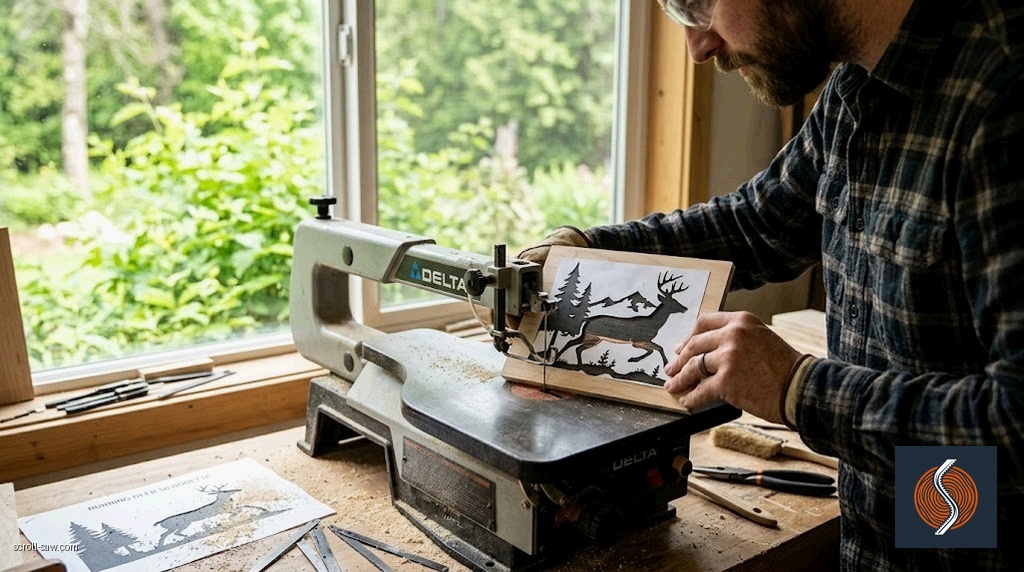
How to Cut Silhouette Scroll Saw Patterns: Simple Outline Work That Reads Instantly
When someone new to scroll sawing asks what to cut first, the answer is silhouettes. Not because they’re a stepping stone to “real” scroll saw work, but because they teach the fundamentals faster than any other subject and produce finished pieces that read as intentional rather than crude.
A silhouette is a shape cut along its perimeter only. No interior fretwork. The final piece reads by the outline alone. Success or failure depends on smooth continuous perimeter cuts and clean finish work, both of which are core skills that transfer to every other scroll saw project.
A printable silhouette scroll saw pattern is a downloadable pattern (usually PDF) showing a subject as an outline shape, formatted for printing at a set size and applying to a wood workpiece. Common subjects: animals in profile, human figures, letters and monograms, holiday shapes, plants and flowers, tools and everyday objects.
Where to find printable silhouette patterns
Steve Good’s Scrollsaw Workshop (scrollsawworkshop.blogspot.com) has thousands of free patterns. Silhouettes are a major category.
Sue Mey’s Scroll Saw Patterns (scrollsawartist.com) has both free and paid silhouette patterns with detailed guidance.
Silhouette clip-art collections in the public domain often work as scroll saw patterns after minor cleanup. Vintage botanical illustrations, animal profiles, and public-domain artwork all work.
Design software output. Silhouette patterns can be generated from photographs using image-tracing software. Trace, simplify to a single outline, print, cut.
Evaluating a silhouette pattern before cutting
Recognizability. Does the outline alone read as the subject? A good horse silhouette looks like a horse without any additional detail. A poor one could be any four-legged animal.
Distinctive features. The silhouette should include the features that identify the subject. A cat silhouette needs the arched back and upright ears. A dog silhouette needs the tail and snout that identify the breed if breed matters.
Structural continuity. Check that no part of the silhouette is unsupported. A running horse where all four legs are off the ground and only the tail connects to the ground is not structurally supported.
Scale. Print the pattern at intended size and hold it at arm’s length. If it doesn’t read clearly, redesign or resize.
Common silhouette subjects
Animals in profile. Horse, dog, cat, deer, bear, wolf, elephant, giraffe. Instantly recognizable when the proportions are right.
Birds in profile. Various songbirds, owls, hawks, ducks, chickens. Distinctive beaks and body shapes identify species.
Human figures in silhouette. Dancers, athletes, workers, silhouette portraits.
Letters and monograms. Single letters or family monograms. Popular for gifts.
Holiday shapes. Christmas trees, pumpkins, hearts, shamrocks. Simple outlines with strong seasonal recognition.
Plants and flowers in silhouette. Trees, flowers, leaves. Works well as home decor.
Tools and objects. Wrenches, hammers, guitars, sports equipment. Reads as personalized based on the recipient.
Books and pattern sources for silhouettes
For a broad silhouette-friendly pattern library, Big Book of Scroll Saw Woodworking includes silhouette patterns across multiple subject categories.
Scroll Saw Workbook, 3rd Edition by John Nelson teaches silhouette cutting as part of its skill progression.
Stock selection
Silhouettes are forgiving on stock choice because there’s no fretwork to fail. Any reasonable scroll saw wood works.
Baltic birch plywood (real Baltic, void-free) at 1/4 inch for painted silhouettes.
Cherry at 1/4 to 1/2 inch for warm-toned clear-finished silhouettes.
Walnut at 1/4 to 1/2 inch for dark elegant silhouettes.
Maple at 1/4 to 1/2 inch for light-toned pieces.
Basswood or poplar at 1/4 to 1/2 inch for painted silhouettes.
Silhouettes can use thicker stock than fretwork pieces because there’s no fine interior detail to worry about. 3/8 or 1/2 inch produces silhouettes with more visual weight.
Blade choice
For 1/4-inch stock, a #5 reverse-tooth blade produces clean perimeter cuts. From Olson FR49202 Reverse Tooth Scroll Saw Blades.
For 3/8 to 1/2 inch stock, a #7 skip-tooth clears sawdust more efficiently. From Olson FR49400 Skip Tooth Assortment.
For extended silhouette production with smooth continuous curves, Pegas Regular Scroll #7 produces cleaner curves and holds its edge across the batch.
Cutting sequence
Silhouettes have only a perimeter cut. Take the outline as a continuous smooth cut wherever possible; stop-and-restart points show as visible steps on the finished piece.
Start the cut on a low-visibility edge (typically the bottom or back of the subject). Return to that entry point to complete the perimeter.
At tight interior curves (the underside of a horse’s neck, the concave curve of a cat’s back), feed slowly and let the blade cut on its own.
At sharp exterior points (ear tips, tail tips), cut into the point from one side, back the blade out, enter from the other side. Do not cut continuously around sharp points.
Pattern attachment
Light 3M Super 77 Multipurpose Spray Adhesive. Two seconds from eight inches, ninety-second wait.
For hardwood pieces destined for clear finish, use ScotchBlue Painter’s Tape 2090 on the stock first, then adhere the pattern to the tape.
Finishing silhouettes
Silhouettes are all about clean edges. Finish work matters more than for busy fretwork pieces where imperfect edges hide in the detail.
Sand thoroughly. Start at 220-grit on the edge, work up to 320 or 400. Silhouette edges are highly visible.
Clear finish on hardwood shows the wood grain along the edge. Wipe-on polyurethane in two thin coats.
Painted solid color for maximum silhouette impact. Prime, base coat, matte spray sealer. Black paint on any silhouette reads as classic profile art.
Stained for a warm natural look. Consistent stain across the whole piece.
Display options
Wall art. Silhouette mounted on a rectangular backer of contrasting color. Black silhouette on white backer is the traditional profile-art format.
Freestanding. Silhouette on a small wooden base for tabletop display.
Ornament. Small silhouette (2-3 inches) with a string loop, hung as ornaments or from mirrors.
Framed art. Silhouette mounted inside a picture frame for formal display.
Grouped set. Multiple silhouettes of related subjects (family pets, sports icons, monograms of family members) displayed together.
Frequently asked questions
Are silhouette patterns only for beginners? No. A well-cut silhouette in premium wood, cleanly finished, reads as elegant. Complexity doesn’t equal quality.
What’s the difference between silhouette and fretwork? Silhouette is perimeter cut only. Fretwork adds interior cutouts. Silhouettes are faster; fretwork adds detail and visual complexity.
Where can I find free printable silhouette patterns? Steve Good’s Scrollsaw Workshop is the largest source. Public-domain clip-art collections also work with minor cleanup.
Can I make a silhouette from a photograph? Yes. Image-tracing software converts photographs to outline files. Trace, simplify to a single closed outline, print, cut.
How thick should silhouette stock be? At least 1/4 inch. Thicker (3/8 to 1/2 inch) produces more visually substantial pieces.
What’s the biggest beginner mistake on silhouettes? Rushing the perimeter cut and producing wavy edges. Silhouettes stand or fall on edge smoothness.
How do I sand silhouette edges without rounding them over? Use a sanding block or flat file, single-direction strokes parallel to the piece face. Do not use random-orbit sanders on silhouette edges.
References
-
Fox Chapel Publishing, Big Book of Scroll Saw Woodworking.
-
John Nelson, Scroll Saw Workbook, 3rd Edition, Fox Chapel Publishing.
-
Steve Good, Scrollsaw Workshop, scrollsawworkshop.blogspot.com.


