
Advanced Scroll Saw Clocks: Fretwork Patterns Beyond Beginner Level
Advanced Scroll Saw Clocks: Fretwork Patterns Beyond Beginner Level
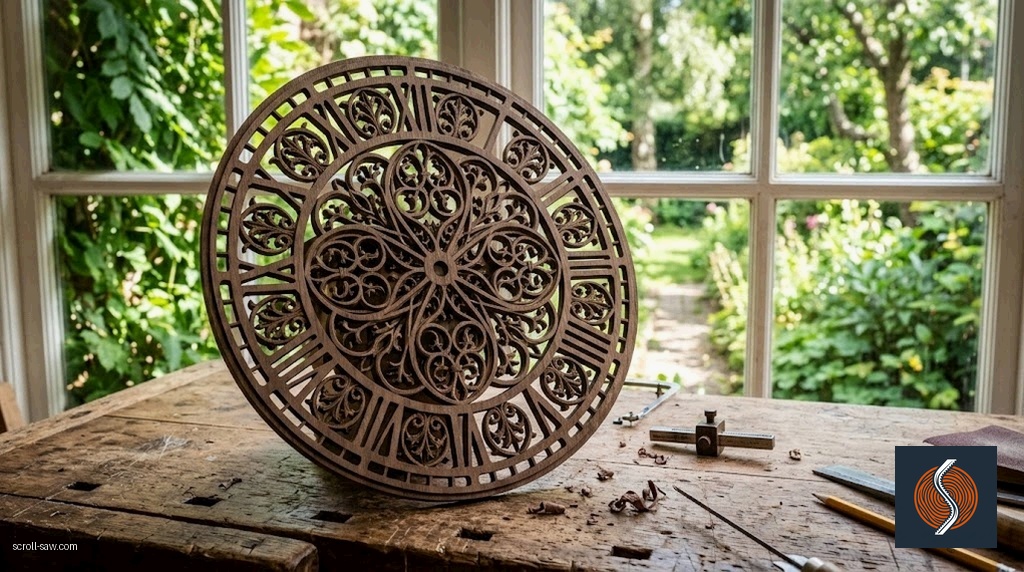
Advanced fretwork clocks are the summit of scroll saw work for many sawyers. A finished clock combines hundreds of interior fret cuts, precise movement fitting, decorative wood choice, and often a wooden numeral face. The best pieces read as gallery-quality craft rather than as hobby work. And the difference between the two comes down to sustained attention across a multi-week project.
Advanced clock patterns can have 400 to 800 individual fret cuts across the clock case, face, and decorative elements. Cutting time runs 20 to 60 hours across multiple sessions. Any single mistake during cutting can wreck the piece or require significant rework. This is not weekend craft; this is committed work.
Advanced scroll saw clocks show up in gallery exhibitions, professional craft shows, high-end gift markets, and personal legacy pieces meant to become family heirlooms.
Short answer: cut advanced clock patterns on 1/4-inch or 3/8-inch premium plywood or hardwood using a #2/0 blade for most fret work and a #3 for the outer profile, plan the movement fitting before cutting begins, work in 2 to 3 hour sessions across multiple weeks, and finish with matte lacquer or wipe-on oil that preserves the fret detail.
The rest of this guide covers advanced clock work.
Advanced clock pattern categories
Fretwork case clocks. Wall or desk clocks with elaborately fret-cut cases. The case is the featured element; movement and hands are secondary.
Grandfather-style pendulum clocks. Full-height pendulum clocks with fret-cut cases. Very advanced, often bench-scale rather than full-scale.
Fretwork wall clocks. Round or shaped wall clocks with fret pattern around the perimeter and behind the face.
Musical clocks. Clocks with music-box movements. Movement fitting complicated by additional space requirements.
Anniversary clocks. Traditional clock forms translated to scroll saw fretwork. Often gift pieces.
Themed clocks. Clocks combining fretwork with specific themes (nature scenes, cathedrals, geometric patterns).
Multi-level clocks. Clocks with multiple depth levels created by stacked fret layers.
Each category has its own difficulty. Even within advanced work, some patterns are more forgiving than others.
Movement selection and fitting
Movement selection affects pattern choice.
Quartz battery movements. Most common. Compact, reliable, no winding. Standard shaft length of 5/16-inch or 3/8-inch fits most patterns.
Mechanical movements. More traditional. Requires more space for weights or springs. Occasional winding required. Advanced skill for fitting.
Radio-controlled movements. Auto-adjusting battery movements. Same fitting as standard quartz but with additional receiver placement consideration.
Music-box combo movements. Battery-powered with music option. Larger footprint than plain quartz.
Select the movement before finalizing pattern choice. Movement shaft length must match total clock face thickness (fretwork case face plus any backing).
Movement diameter must fit through the shaft hole cut in the face.
Movement thickness must fit within the case interior depth.
Hands must fit within the case’s inside face area without touching the fretwork.
Wood choice
Advanced clocks demand high-quality wood.
1/4-inch premium Baltic birch is the standard fretwork stock. Consistent thickness, alternating plies protect fret work.
3/8-inch hardwood (cherry, walnut, maple) for pieces where wood grain contributes to the aesthetic.
Avoid softwoods entirely. Pine and cedar tear out on advanced fret work.
Avoid open-grain species (oak, ash) unless the pattern accommodates the grain characteristic. Ring-porous species cause problems on very fine fret detail.
For pieces intended as heirlooms, wood species matters more than for casual work. Cherry ages beautifully. Walnut darkens attractively. Maple stays consistent. Baltic birch is neutral and unassuming.
Blade selection
Fret work interior: #2/0 blade. Fine enough for tight interior corners and thin fret sections.
Outer profile of case: #3 blade.
Any larger structural work: #5 blade.
On hardwood, Pégas Modified Geometry blades reduce burn marks and give cleaner corners.
Pégas Regular Scroll 25 TPI blades work well for very fine detail on hardwood clock patterns.
Stock replacement blades. Advanced clock work breaks blades. Expect to change blades every 20 to 40 hours of cutting.
Entry hole drilling
Every enclosed interior region in the clock pattern needs a drilled entry hole. Advanced patterns can have 300 to 600 entry holes.
Use a small drill bit, 1/32-inch or 1/16-inch depending on the smallest fret feature.
Drill through the stock cleanly. Back with scrap wood to prevent tear-out on the exit side.
Dedicate a full session to drilling. Trying to drill entry holes as you cut interrupts rhythm and increases misalignment risk.
For patterns with multiple stack layers, drill each layer separately.
Cutting sequence
Step one, complete all entry hole drilling in one session.
Step two, install the finest blade (#2/0) and begin cutting interior fret work. Work systematically. Common approach: start at one corner or edge and work across the pattern in a consistent direction. Avoid random cutting that leaves fragile sections stressed.
Step three, keep the outer profile intact through all interior cutting. The profile provides the structural support that keeps fret work aligned during the cut.
Step four, cut the movement shaft hole. This is a specific-sized hole that must match the movement shaft diameter. Drill or scroll saw to size, test with the actual movement.
Step five, cut any hour or minute marker cutouts on the clock face.
Step six, cut the outer profile last with a #3 blade.
Step seven, remove pattern paper only after all cutting is complete.
For multi-layer clocks (fretwork with additional backing or decorative layers), repeat this sequence for each layer.
Managing extended cutting sessions
Advanced clocks require sustained work across many sessions.
Work in 2 to 3 hour sessions. Beyond 3 hours, fatigue causes blade drift and rushed cuts.
Take breaks every 30 to 45 minutes within each session. Stretch, hydrate, rest your eyes.
Use task lighting focused on the pattern. Good lighting reduces eye strain across long sessions.
Mark your stopping point on the pattern with a pencil. Resume exactly where you left off next session.
Store the in-progress piece flat. Keep pattern paper attached until all cutting is complete.
Expect 4 to 12 weeks for a complete advanced clock, working evenings and weekends. Trying to compress this into fewer sessions leads to mistakes.
Sanding advanced clock pieces
Sanding advanced fret work requires patience.
Sand each fret opening carefully. Small sanding sticks and detail sanders reach into openings that standard sandpaper cannot.
Start with 220 grit. Fine fret work does not need coarser starting grits.
Progress to 320 or 400 grit for pieces that will be finished with clear coat.
Remove sanding dust between grits with a tack cloth or compressed air.
Be careful not to break fret sections during sanding. Support the piece from behind while sanding the front.
Fitting the movement
Movement fitting comes after cutting and sanding are complete.
Dry-fit the movement first. Check that:
-
Movement body fits through the shaft hole from the back.
-
Shaft protrudes correctly on the face side, extending far enough for hands.
-
Movement body sits flush against the inside back of the clock face.
-
Hands do not touch fretwork when rotated through 12 hours.
Adjust hole size if needed. Better to slightly enlarge the hole than to force a movement that binds.
Secure the movement with the retaining nut provided. Do not overtighten; snug is enough.
Attach hands per movement manufacturer’s instructions.
Finishing advanced clocks
Advanced clocks work under finishes that preserve fret detail.
Wipe-on oil. Danish oil or boiled linseed oil. Two coats. Preserves grain visibility. Good for hardwood clocks.
Matte lacquer. Two thin sprayed coats. Protects wood without adding shine that washes out fret detail.
Satin polyurethane. More durable than lacquer but slightly more finish thickness. Suitable for pieces that will be handled or displayed in high-humidity environments.
Avoid heavy glossy finishes on fretwork. High gloss washes out fret visibility.
Avoid pooling finish in fret openings. Wipe off excess during finishing to prevent finish accumulation in interior corners.
Common failures on advanced clocks
Fret section snaps during extended cutting. Cause: cumulative stress from repeated handling. Fix: cut all fret work before removing pattern paper; minimize handling during cutting.
Movement will not fit through shaft hole. Cause: hole too small or wrong position. Fix: enlarge carefully with drill or scroll saw; verify hole position against pattern before enlarging.
Hands do not clear fretwork. Cause: hand length exceeds clock face inside area. Fix: use shorter hands, or plan pattern to give hands clearance.
Clock face warps after cutting. Cause: internal wood stress released by extensive fret cutting. Fix: use quality stock with balanced grain; store flat during cutting.
Finish accumulates in fret openings. Cause: excess finish not wiped away. Fix: apply thin coats and wipe excess.
Clock keeps poor time. Cause: movement issue, not scroll saw issue. Fix: check battery, replace movement if needed. The scroll saw work does not affect time-keeping.
FAQ
How long does an advanced clock project take?
20 to 60 hours across 4 to 12 weeks of evening and weekend work. Faster completion produces rushed cuts and mistakes.
Do I need special tools beyond a scroll saw?
Standard scroll saw with fine-blade capacity. Drill press or hand drill for entry holes. Sanding tools including small detail sanders. Clock movement kit for final assembly.
Where do I buy clock movements?
Clock parts retailers online and in some craft stores. Choose movements matched to your clock face thickness and diameter.
Can advanced clock patterns be simplified for beginners?
No. Advanced patterns are advanced because of their fret density. Simplifying them defeats the purpose. Start with beginner or intermediate clock patterns.
Do advanced clocks sell well at craft shows?
Yes, at premium prices. Well-executed advanced clocks command $200 to $1000 or more at craft shows. The visible labor and skill justify the price.
Should I sign and date an advanced clock?
Yes. Signature and date on the back, in pencil or wood-burned, adds provenance and value.
Can advanced clocks work as heirloom pieces?
Yes, and this is a common motivation for making them. Quality construction with hardwood and matte finish produces pieces that outlast their maker.
References
-
Steve Good, Scrollsaw Workshop archive on advanced clock patterns
-
Wood Magazine, tutorials on multi-week scroll saw projects
-
Fine Woodworking, extended session and fret work management
-
Clock movement manufacturer specifications for shaft length and diameter


