
Horse Scroll Saw Patterns: Anatomy, Proportion, and Fragile Leg Detail
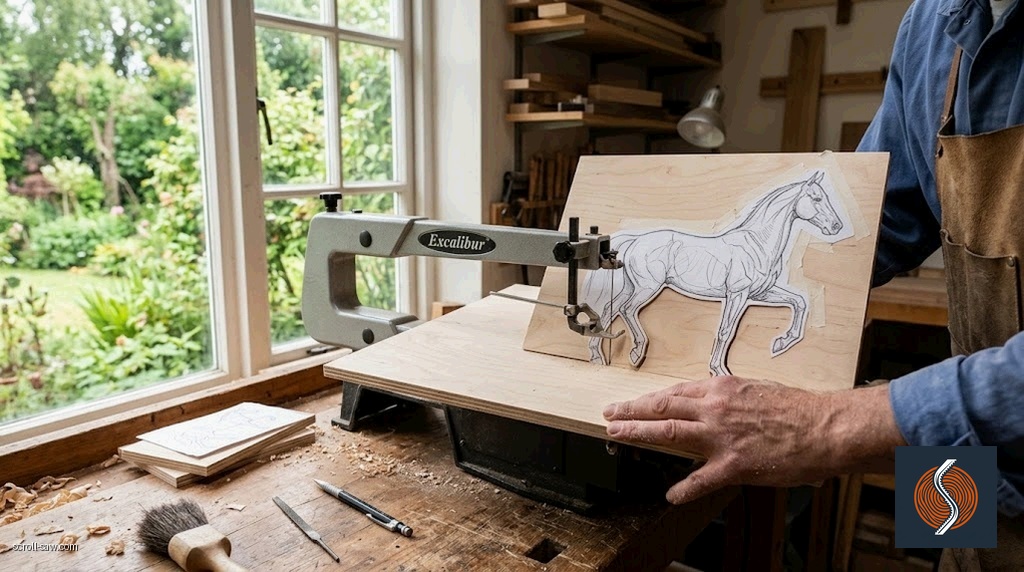
Horse Scroll Saw Patterns: Anatomy, Proportion, and Fragile Leg Detail
My first scroll saw horse had the proportions of a large dog. Long back, short legs, small head. It read as “animal” rather than “horse.” The pattern was drawn poorly, and I didn’t have the eye yet to recognize the problem before I cut it.
Horses are the second-most-recognizable animal after dogs, and viewers spot proportion mistakes immediately. A horse pattern that gets the proportions right reads instantly as a horse; a pattern that misses the proportions reads as some other four-legged creature.
A horse scroll saw pattern is a horse figure cut from thin hardwood or plywood. Common formats: horse silhouette (perimeter only), horse fretwork (with mane, tail, and detail cutouts), horse with rider, horse pair, horse head portrait, and Western scenes with horses.
Horse proportions to check before cutting
Body length to shoulder height. A well-proportioned horse is slightly longer than tall (roughly 1.1:1 or 1.2:1). Longer than that reads as pony or dachshund. Taller than that reads as stretched or unnatural.
Head length to body length. The head is roughly one-third the body length from chest to rump. Larger head reads as pony; smaller reads as stretched.
Leg length. Front legs from ground to elbow should be roughly half the horse’s shoulder height. Shorter legs read as pony or short-legged breed.
Neck length. The neck from shoulder to head base is roughly the same length as the head. Longer or shorter reads as awkward.
Tail placement. The tail attaches at the top of the rump, not the middle. A tail that appears to come out of the horse’s belly is a common pattern error.
If your pattern violates these proportions, redraw before cutting. A good horse pattern reads as a horse instantly.
The two fragile details
Legs. Horse legs in profile are thin. On a 6-inch-long horse silhouette, legs might be drawn at 3/16 inch or less. Fix: thicken legs to 1/4 inch minimum at the thinnest point. Verify each leg has consistent thickness top to bottom.
Tail. A flowing horse tail with fine hair detail is fragile. Fix: draw the tail as a chunky flowing shape rather than fine individual hair strands. Blunt the tail tip.
Breed-specific features
Quarter horse. Muscular, compact body. Moderate proportions.
Thoroughbred. Slender athletic build with long legs and elegant neck.
Draft horse (Belgian, Clydesdale). Massive body, thick legs (easier to cut than lighter breeds), feathered feet.
Arabian. Distinctive dish face, short back, high-set tail.
Mustang. Rugged compact build, often shown running with mane and tail flowing.
Most horse patterns aren’t breed-specific. If breed matters (a gift for someone who owns a specific breed), pick a pattern that captures the breed’s proportions.
Books and pattern sources
For a broad pattern library including horses, Big Book of Scroll Saw Woodworking has multiple horse patterns.
Steve Good’s blog has extensive free horse patterns. Search scrollsawworkshop.blogspot.com for “horse.”
Stock selection
Baltic birch plywood (real Baltic, void-free) at 1/4 inch for detailed horse patterns. Cross-plied grain protects the thin legs.
Cherry at 1/4 inch for warm-toned clear-finished horses. Beautiful for heirloom pieces.
Walnut at 1/4 inch for dark elegant horses.
Maple at 1/4 inch for light-toned pieces.
Basswood at 1/4 inch for painted horses (palomino, pinto, and paint color patterns).
Avoid pine for horse patterns. The thin legs are especially vulnerable to grain-direction breakage in pine.
Blade choice
For 1/4-inch stock with horse-scale detail, a #5 reverse-tooth blade is the daily driver. From Olson FR49202 Reverse Tooth Scroll Saw Blades.
For tight interior corners on mane and tail fretwork, a #3 reverse-tooth turns tighter.
For extended production of horse pieces, Pegas Regular Scroll #7 holds its edge across the batch.
Cutting sequence
Drill all interior entry holes first. Eye cutout, mane detail cutouts, tail detail cutouts, negative space between legs.
Cut interior fretwork first, smallest features to largest.
Cut the perimeter last. Start at the belly (low-stress area), work up over the back and tail, over the head and mane, down under the chest, along the legs.
At each leg bottom, cut into the hoof from one side, back the blade out, enter from the other side. Cutting continuously around each hoof risks a rough cut.
For patterns with multiple legs showing (running horse, jumping horse), verify each leg’s thickness at bends before cutting.
Pattern attachment
Light 3M Super 77 Multipurpose Spray Adhesive. Two seconds from eight inches, ninety-second wait.
For hardwood pieces destined for clear finish, use ScotchBlue Painter’s Tape 2090 on the stock first, then adhere the pattern to the tape.
Finishing horse pieces
Clear finish on hardwood for premium pieces. Cherry and walnut both finish beautifully. Wipe-on polyurethane in two thin coats.
Painted realistic for coat accuracy. Bay (brown with black mane and tail), chestnut (reddish-brown), palomino (golden with white mane and tail), black, pinto (patches of white and color).
Stained warm for a natural look. Golden oak or cherry stain on basswood produces a warm horse without needing full paint.
Weathered rustic for Western-themed decor. Base coat brown, dry-brush gray for a weathered look.
Display options
Wall plaque. Horse mounted on a rectangular or shaped wooden backer.
Freestanding shelf piece. Horse on a small wooden base for tabletop display.
Western sign. Horse integrated with lettering (“Ranch,” specific name, or brand) on a larger horizontal plaque.
Silhouette scene. Horse in a landscape with fences, mountains, or barn. Requires more complex fretwork.
Ornament. Small horse (2-3 inches) with a string loop, hung as ornaments.
Frequently asked questions
How do I keep horse legs from breaking? Thicken legs to 1/4 inch minimum before cutting. Redraw the pattern if the drawn legs are thinner.
Should I include the mane and tail as fretwork or solid silhouette? Solid silhouette is safer and reads well. Fretwork mane and tail adds detail but adds fragility.
Can I cut a rearing or jumping horse? Yes, but action poses have vulnerable leg positions. Verify each leg’s thickness at bends.
How thick should the wood be? 1/4 inch for small-to-medium plaques, 3/8 inch for larger freestanding pieces.
What’s the biggest beginner mistake on horse patterns? Cutting legs as drawn without thickening. Also using patterns with wrong proportions that read as “generic four-legged animal.”
Can I add hair texture to the mane and tail with a wood burner? Yes. Pyrography (wood burning) after cutting adds convincing hair texture without requiring fretwork.
Should I paint or clear-finish for a Western-themed gift? Depends on style. Rustic Western favors weathered stain or painted-then-distressed. Formal Western (ranch office, home decor) favors clear-finished hardwood.
References
-
Fox Chapel Publishing, Big Book of Scroll Saw Woodworking.
-
John Nelson, Scroll Saw Workbook, 3rd Edition, Fox Chapel Publishing.
-
Steve Good, Scrollsaw Workshop, scrollsawworkshop.blogspot.com.


