
Scroll Saw State Patterns: Cutting US State Silhouettes
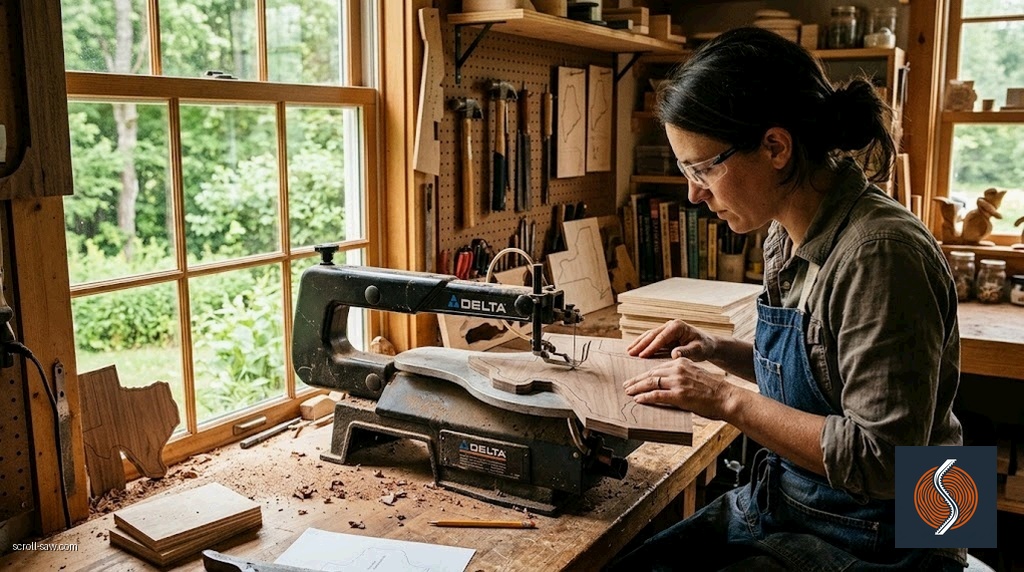
Scroll Saw State Patterns: Cutting US State Silhouettes
State silhouette patterns are one of the most reliable categories in scroll saw work. Every American has a state connection: birth state, home state, favorite vacation state, college state, state of a loved one. That personal connection makes state pieces resonate as gifts and home decor across a wide audience. Every craft show that features scroll saw work sees state pieces move consistently.
Each state has its own silhouette challenge. Some states have straightforward geometric borders (Colorado, Wyoming). Some have complex coastlines (Louisiana, Michigan, Maryland). Some have panhandles that need careful bridge planning (Oklahoma, Florida, Texas). Some have island territories that need decisions about inclusion (Hawaii, Alaska). Each state has its own cutting workflow, but the common thread is respect for the actual border rather than approximation.
State patterns show up in home decor for state residents, gifts commemorating home states, business signage for state-focused companies, university-themed pieces, and gallery walls celebrating specific regions.
Short answer: cut state silhouette patterns on 1/2-inch Baltic birch or hardwood, use a #5 reverse-tooth blade for outer profiles and a #3 for any coastal or panhandle detail, verify pattern accuracy against reference maps, and add personalization (city dots, home markers, university symbols) as separate cut features.
The rest of this guide covers state pattern work.
State pattern categories
Plain silhouettes. State border alone. Beginner-friendly. Reads clearly as the state.
Silhouette with heart/star marker. State outline with a heart or star at a specific city location (home city, birthplace). Simple personalization.
Silhouette with word/name overlay. State outline with the state name or a family name cut through. Requires bridge work on enclosed letters.
Silhouette with major cities marked. State outline with dots or stars for major cities.
State with abbreviation. Bold state abbreviation (TX, CA, NY) contained within or overlapping the state outline.
Themed state pattern. State outline combined with state-specific imagery (state bird, state flower, state motto).
University-themed. State outline in university colors or with university logo.
Themed set. All 50 state silhouettes as a coordinated collection.
Wood choice for state pieces
Baltic birch plywood. Practical for most state pieces. Consistent thickness, alternating plies protect fine coastal detail.
Cherry. Warm color. Good for gift pieces where wood tone contributes to the aesthetic.
Walnut. Dark, striking. Good for premium pieces or dramatic contrast.
Maple. Light, neutral. Takes stain evenly for state-color themed pieces.
Oak. Traditional. Its grain fights fine coastal detail but works for states with simpler outlines.
Match wood to intended aesthetic. Baltic birch for neutral pieces. Hardwood for premium gift pieces.
Stock thickness: 1/2-inch for wall pieces. 1/4-inch for ornaments or small display pieces.
Blade selection
Outer state profile: #5 reverse-tooth blade.
Coastal detail or panhandle work: #3 reverse-tooth blade.
Fine detail (city markers, small features): #2/0 blade.
Hardwood: Pégas Modified Geometry blades.
State pattern challenges by state
Geometric-border states (Colorado, Wyoming). Straight or nearly-straight border lines. Simplest to cut. No bridge planning needed for the profile itself.
Panhandle states (Oklahoma, Florida, Idaho, Alaska). Thin extending regions. Consider bridge planning if the panhandle is very thin at final scale.
Complex-coastline states (Louisiana, Maryland, Michigan, Alaska). Elaborate coastal detail. Requires patience for accurate cutting.
Island states (Hawaii). Multiple separate landmasses. Decide whether to cut as separate pieces or connect with bridges.
States with major peninsulas (Michigan Upper Peninsula, Massachusetts Cape Cod). Requires attention to peninsula structural strength.
States with major river borders (Mississippi, Missouri, Ohio). River-formed borders have organic curves rather than straight lines.
Common cutting sequence
Step one, verify pattern against a reference map. State borders sometimes get inaccurately drawn in patterns.
Step two, apply pattern to stock.
Step three, cut interior detail (city markers, cut-through text, decorative fretwork).
Step four, cut outer state border with a #5 blade.
Step five, work continuously around the border. Do not stop mid-border unless necessary.
Step six, save fragile projections (panhandles, coastal detail) for last.
Step seven, remove pattern paper.
Personalization on state pieces
Heart or star marker at city. Small heart or star cut through at the location of a specific city.
City dot. Simple dot marker at city location.
Cut-through name. Family name or personal name cut through the state.
Overlay pieces. Separate cut piece (heart, name) glued onto the state silhouette after finishing.
Painted accents. State colors, university colors, or team colors applied as paint before clear coat.
Wood-burned dates. Anniversary or move-in dates wood-burned before finishing.
Match personalization to intended use. Home decor pieces benefit from specific city markers. University-themed pieces benefit from university colors and dates.
Bridge planning for state patterns
Most state silhouettes do not need bridges on the state outline itself, but bridges are needed for cut-through text or interior details.
Letter bridges. Standard bridge planning for cut-through letters (see letter cutting guides).
Interior detail bridges. Any enclosed cutout inside the state needs bridge planning.
Island bridges (Hawaii, Alaska). Optional. Some patterns connect Hawaii’s islands or Alaska’s Aleutian Chain with narrow bridges; others cut them as separate pieces.
Panhandle attachment. No bridges needed since the panhandle is part of the main outline; but very thin panhandles may need structural support during cutting.
Finishing state pieces
Wipe-on oil. For hardwood pieces. Two coats. Preserves grain.
Painted state colors. For pieces in state colors or university colors. Water-based acrylic with clear coat.
Stained. Water-based dye stain for pieces in specific color themes.
Two-tone. Different color for state background and personalization overlay.
Matte clear coat. Water-based polyurethane over any base finish. Two coats.
Avoid heavy glossy finishes. State pieces work better in matte or satin.
Mounting state pieces
Sawtooth hanger. Simple mount for pieces under 12 inches wide.
D-ring hangers. Two hangers spaced across the top of pieces over 12 inches.
Standoffs. Brass or wood standoffs mount piece with additional wall depth.
Freestanding. Some state pieces stand on shelves with a small wooden base.
Common failures on state patterns
State border inaccurate. Cause: pattern designer drew border loosely. Fix: verify against reference map before cutting.
Panhandle breaks during cutting. Cause: cut too early or too fast. Fix: cut panhandle last, slow feed rate.
Coastal detail simplified beyond recognition. Cause: pattern too small at final scale. Fix: increase pattern size or accept some simplification.
City marker in wrong location. Cause: pattern didn’t verify city coordinates. Fix: use reference map to place markers accurately.
State reads as wrong state. Cause: silhouette too generic or proportions off. Fix: verify pattern against actual state map.
Islands not oriented correctly. Cause: Hawaii or Alaska pattern arrangement off. Fix: verify arrangement against reference.
FAQ
What is the easiest state to cut for a first project?
Colorado, Wyoming, or Utah. All have relatively straight or geometric borders. No panhandles or complex coastal detail.
Which state is the hardest?
Hawaii (multiple islands), Alaska (Aleutian Chain), Louisiana (complex coast), Michigan (Upper and Lower Peninsula) all present significant cutting challenges.
Should I include Alaska and Hawaii on a 50-state set?
Yes. Sets should be complete. Cut Alaska and Hawaii to scale relative to continental states.
Can I make state pieces for craft show sale?
Yes. State pieces are one of the most reliable-selling scroll saw categories at craft shows.
Should state pieces be finished on both faces?
Yes for wall pieces that can twist. Optional for pieces mounted directly to a backing board.
Do state patterns need to be exactly to scale?
Not to scale for pieces sold individually. But sets should be internally consistent (Rhode Island should not be the same size as Texas within a set).
How long does a state piece take?
Simple geometric state: 2 to 4 hours. Complex coastal state: 4 to 8 hours. With detailed personalization: 6 to 12 hours.
References
-
US Census Bureau state boundary reference maps
-
Steve Good, Scrollsaw Workshop archive on state and geographic patterns
-
Wood Magazine, tutorials on regional and state-themed pieces
-
Fine Woodworking, silhouette design and pattern accuracy


