
Cutting a Santa Sleigh Scroll Saw Pattern: Layout, Fragile Detail, and Assembly
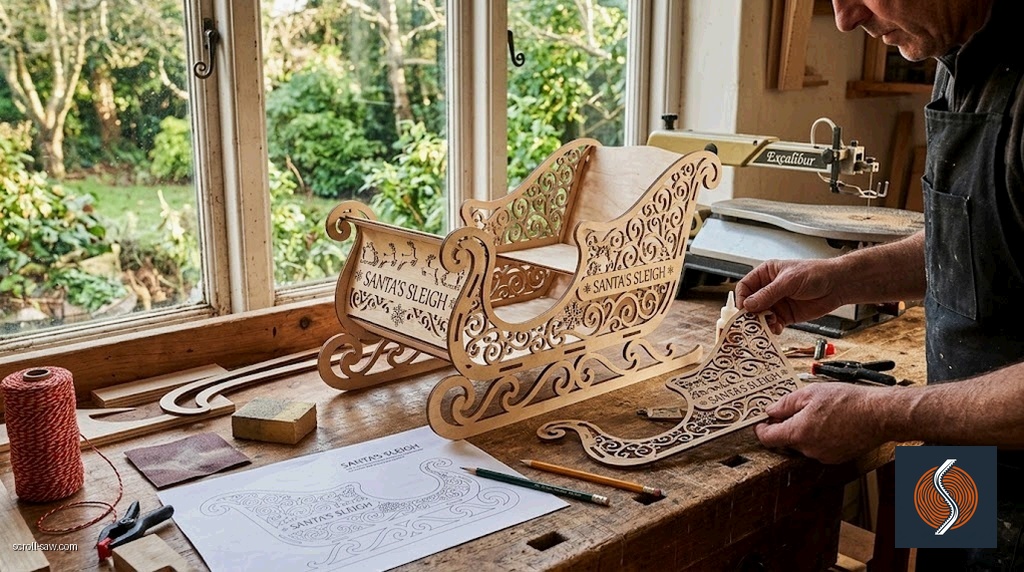
Cutting a Santa Sleigh Scroll Saw Pattern: Layout, Fragile Detail, and Assembly
A Santa sleigh pulled by reindeer across a moon is a Christmas silhouette that everybody recognizes and few builders execute cleanly. Every reindeer leg is fragile. The sleigh runners are thin strips extending in space. The connecting harness lines between reindeer and sleigh are structural bridges that hold the whole composition together and are drawn thin.
The piece works when planned around the fragility. It breaks when planned as if fragility didn’t exist.
A Santa sleigh scroll saw pattern is a Christmas silhouette or fretwork scene showing Santa’s sleigh with reindeer, often set against a moon or star background. Common variations: sleigh with one reindeer, sleigh with two reindeer, sleigh with the full team of eight (or nine, with Rudolph), sleigh with Santa figure visible, sleigh silhouetted against a large moon.
The four fragile details
Reindeer legs. Each reindeer has four legs in profile. At scroll saw scale, legs drawn thinner than 1/8 inch snap during finishing. Fix: thicken each leg to 3/16 inch minimum.
Reindeer antlers. Same fragility as any deer pattern (see the deer pattern article). Thicken tines to 1/8 inch minimum, blunt tips by 1/32 inch.
Sleigh runners. The curved runners at the bottom of the sleigh are thin strips. Fix: thicken to 3/16 inch minimum.
Harness lines. The lines connecting each reindeer to the sleigh and to each other are structural bridges. If drawn thin, they break and the composition falls apart. Fix: thicken all harness lines to 1/8 inch minimum.
Composition variations
Silhouette against moon. The classic composition. Full sleigh with reindeer silhouetted in front of a large circular moon. The moon provides structural support and negative space.
Sleigh with team, no background. Just the sleigh and reindeer without background elements. More fragile because there’s no moon backing to support the composition.
Sleigh with Santa figure visible. Santa’s figure visible in the sleigh, adding personality but adding fragile detail (Santa’s arm holding reins, Santa’s hat).
Sleigh in front of chimney or house. Sleigh landing on a rooftop. Provides structural support from the roof line.
Rudolph leading team. Rudolph in front position, sometimes with a fretwork red-nose detail (a small hole for a red backing paper or red glow effect).
Books and pattern sources
For a broad pattern library including Santa sleighs, Big Book of Scroll Saw Woodworking has a Christmas chapter with sleigh patterns.
Steve Good’s blog has multiple Santa sleigh patterns. Search scrollsawworkshop.blogspot.com for “sleigh” and “Santa.”
Stock selection
Baltic birch plywood (real Baltic, void-free) at 1/4 inch is the standard for Santa sleigh patterns. Cross-plied grain supports the fragile reindeer legs and sleigh runners.
Cherry at 1/4 inch for warm-toned clear-finished heirloom pieces. Beautiful when the piece survives.
Walnut at 1/4 inch for dark elegant pieces. The dark grain reads as night sky.
Basswood at 1/4 inch for painted pieces where colors are desired.
Avoid pine. The fragile reindeer legs and sleigh runners are especially vulnerable in pine.
Blade choice
For 1/4-inch stock with sleigh-scale detail, a #5 reverse-tooth blade is the daily driver. Reverse teeth reduce tear-out on the back face, which matters on a piece where both faces may be visible. From Olson FR49202 Reverse Tooth Scroll Saw Blades.
For tight interior corners at harness detail and antler intersections, a #3 reverse-tooth turns tighter.
A sleigh piece is often a single dramatic project, so Pegas Regular Scroll #7 is worth using for its consistent cut quality across the many small details.
Cutting sequence
Drill all interior entry holes first. Between reindeer legs, between reindeer bodies and harness lines, around the sleigh runners, negative space around Santa if a figure is included, moon or star background cutouts if any.
Cut interior fretwork first, smallest features to largest. Small negative-space details first, then larger cutouts, then the moon backing if using a moon composition.
Cut the perimeter last. Take smooth continuous cuts along the composition’s outer edge.
At reindeer antler tips, cut into each tine from one side, back the blade out, enter from the other side.
At reindeer leg tips (hooves), cut into each hoof from one side, back out, enter from the other side.
At sleigh runner ends, take slow careful cuts. These curved thin details are structurally weak.
Pattern attachment
Light 3M Super 77 Multipurpose Spray Adhesive. Two seconds from eight inches, ninety-second wait.
For hardwood pieces destined for clear finish, use ScotchBlue Painter’s Tape 2090 on the stock first, then adhere the pattern to the tape.
Finishing sleigh pieces
Clear finish on hardwood for heirloom pieces. Cherry and walnut both read as premium. Wipe-on polyurethane in two thin coats.
Painted realistic. Prime with shellac, base coat brown for reindeer, red for sleigh, red and white for Santa, yellow highlights for the moon. Complex piece to paint well; practice on scrap.
Silhouette black on white. Paint the whole piece black or clear-finish a dark wood, mount on a white backer for high-contrast silhouette art.
Stained warm. Walnut or cherry stain on basswood produces a warm heirloom look.
Display options
Wall plaque. Sleigh mounted on a rectangular or shaped wooden backer. Popular Christmas wall art.
Window suncatcher. Sleigh cut in Baltic birch, hung in a window where backlight shows the fretwork.
Freestanding shelf piece. Sleigh on a small wooden base for tabletop display.
Framed art. Sleigh mounted inside a shadow box frame with dark backing for high-contrast display.
Silhouette panel. Large sleigh silhouette on a light-colored panel for mantle or entryway display.
Frequently asked questions
How do I keep reindeer legs from breaking? Thicken each leg to 3/16 inch minimum. Cut into each hoof from both sides rather than continuously. Handle the piece carefully during finishing.
Can I make a sleigh with fewer than eight reindeer? Yes. Two or three reindeer read as a smaller team and are easier to cut. The full team of eight (or nine with Rudolph) is a more ambitious project.
Should the moon be part of the same piece or a separate backer? Same piece is stronger (the moon supports the reindeer legs structurally). Separate moon backer allows the two elements to be different colors but is more work.
How thick should the wood be? 1/4 inch is standard. Thicker (3/8 inch) for freestanding pieces or where the piece will be displayed prominently.
What’s the biggest beginner mistake on Santa sleigh patterns? Cutting reindeer legs and harness lines as drawn without thickening. Also cutting continuously around antler tips and hooves.
Can I add a red glow to Rudolph’s nose? Yes, cut a small hole where Rudolph’s nose would be. Back the piece with red paper or a small red LED to produce the glow effect.
How long does a full sleigh piece take to cut? A sleigh with two reindeer takes 2-3 hours. A full team of eight takes 6-8 hours or more.
References
-
Fox Chapel Publishing, Big Book of Scroll Saw Woodworking.
-
John Nelson, Scroll Saw Workbook, 3rd Edition, Fox Chapel Publishing.
-
Steve Good, Scrollsaw Workshop, scrollsawworkshop.blogspot.com.


