
Harbor Freight Tools Scroll Saw: Setup, Limits, and Service
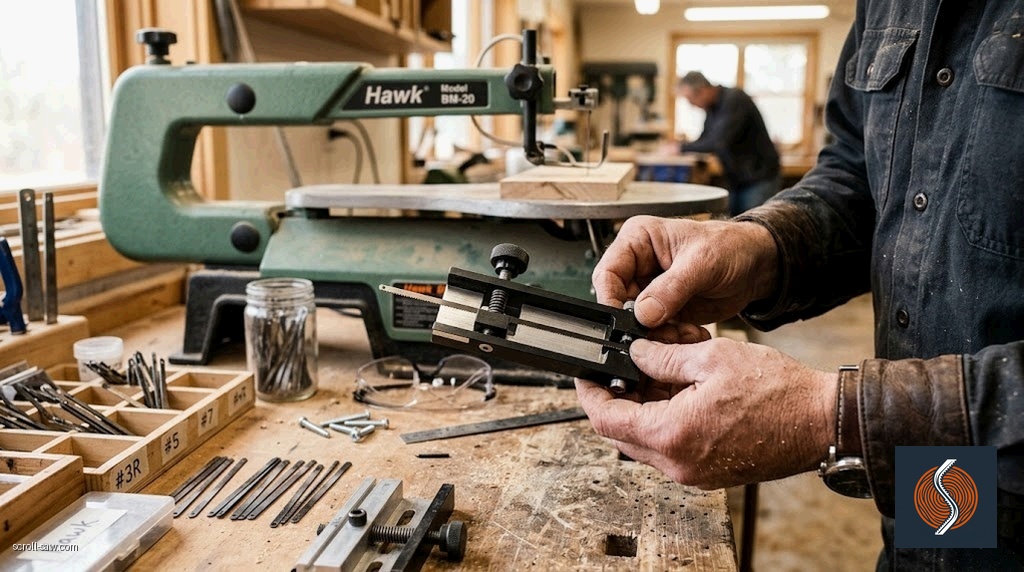
Harbor Freight Tools Scroll Saw: Setup, Limits, and Service
A scroll saw that costs less than a good pair of boots is going to give up something. The interesting question, if you are staring at the orange box on a Saturday morning, is what it gives up, and whether that matters for the projects sitting in your head. The Harbor Freight Central Machinery 16-inch variable speed scroll saw is the one almost everyone means when they say “the Harbor Freight scroll saw,” and it is a saw that rewards a patient owner and frustrates an impatient one.
This is a plain walkthrough of what you actually get when you unbox one: how to set it up so the first cuts do not embarrass it, which blades fit and which do not, and the service points that decide whether it stays useful for years or ends up on a garage sale table by winter.
What the Harbor Freight scroll saw actually is
The Harbor Freight scroll saw is a 16-inch throat, variable speed, parallel-arm hobby saw sold under the Central Machinery brand. Speed range runs roughly 550 to 1,600 strokes per minute. The table tilts to 45 degrees left. It accepts standard 5-inch pin-end blades out of the box, and with an inexpensive adapter it will also hold plain-end (pinless) blades. It is a beginner and light-hobby machine, not a production saw. Expect real vibration on softer benches, a bit of blade drift on tight curves, and a die-cast aluminum table that scratches if you drag work across it.
If your projects are Christmas ornaments, sign letters, puzzle pieces, small toys, and the occasional 3/4-inch hardwood cutout, this saw can do that work all day. If you want intricate portrait scrolling in half-inch walnut with hair-thin bridges, you will feel the machine’s limits within an hour.
First setup: the ten minutes that decide everything
Everything people complain about with this saw traces back to skipped setup. Do these in order, before you cut a real piece.
Level the table to the blade. Loosen the table tilt clamp, drop a small engineer’s square on the table with one edge against the blade, and zero the table so the blade sits flat against the square. The factory zero mark is close but rarely exact. If you cut angled joinery before you check this, every miter will be off by a degree or two and it will not be the blade’s fault.
Set blade tension by feel and pitch. Pluck the blade with a fingernail. A properly tensioned scroll saw blade rings a clear high note. A dull thud means it is loose and will wander. A shrill note that also lets you hear the arm creak means you are on the way to snapping blades. On this saw, most users land somewhere around three-quarters of the tension knob’s travel for a #5 blade.
Check the hold-down foot. Out of the box, the pressure foot on many units is set too high, which lets the workpiece lift on the upstroke and chatter. Lower it so it just kisses the top of the material with the arm at its highest point. Not pressing down hard, just touching.
Bolt it down. The single biggest cut-quality upgrade you can make to this saw is to stop letting the base wander. Bolt it to a heavy workbench or clamp it to a solid stand. Do this and vibration drops by roughly half.
Blow the packing grease out of the blade holders. The upper and lower blade clamps ship with a film of preservative oil that catches sawdust and turns to paste. Take a rag and mineral spirits to them before you install the first blade. Do this again every couple of months.
Blades that fit, and blades that do not
The stock blades that come with the saw are pin-end and are fine for the first afternoon. After that, you will want better ones. The saw was designed around universal 5-inch pin-end blades, and any brand that fits that spec will fit this saw.
A sensible starter kit is a pack of pin-end reverse-tooth blades in a couple of sizes, because reverse-tooth pin-end blades are the single upgrade that removes the fuzzy underside every beginner complains about. The Olson FR49202 5-inch reverse-tooth pin-end assortment covers the useful range for hobby scrolling in one box.
When you outgrow pin-end blades, add a pin-to-pinless conversion adapter. A universal scroll saw blade holder conversion kit drops into most 16-inch machines including this one and opens up the entire Olson and Pégas plain-end catalog. Once you can run plain-end blades, Olson SP46500 spiral blades let you cut 360 degrees without turning the workpiece, which is what makes portrait scrolling possible on a saw this size.
What does not fit: 6-inch jeweler’s blades and any of the DeWalt or Excalibur oversized pinless blades that require a proprietary clamp. If a blade description does not say “universal” or “5-inch pin-end” or “5-inch plain-end,” check twice.
Where the saw fights you, in plain terms
Every review that reads like a brochure skips this part, so here it is.
Vibration on the upstroke. The counterweight in this arm design is not perfectly balanced. Bolted down, it is fine. Sitting on rubber feet on a workbench with a laminate top, it will walk. Add a scrap of dense carpet under the base or a rubber router pad and you will feel the difference before you finish the first cut.
Aluminum table softness. The die-cast table scratches. If you slide a rough hardwood blank across it dozens of times, you will see silver-gray marks. A thin polycarbonate insert cut to fit the table, or a piece of adhesive-backed UHMW tape along your usual work path, prevents this. Waxing the table with paste furniture wax also helps feed.
Blade holder tolerance. Some units grip blades perfectly. Others have a slight burr in the clamp that lets a pin-end blade sit off-vertical, which shows up as a cut that leans. If your cuts consistently drift the same direction, take the blade holder off, look for a burr with a jeweler’s loupe, and file it down. This is a five-minute fix that transforms the saw.
Light and dust blower. The onboard light is dim and the flexible arm loses tension after a year. Assume you will add a proper task light. A Neatfi XL magnifying lamp at the front of the table adds magnification and real light in one clamp, and it survives shop use better than the built-in lamp.
Dust collection. The rear dust port is 1-1/2 inches and works, but the flexible dust blower is angled poorly for detail work. Bend it closer to the blade or add a length of stiff aquarium tubing wired to point exactly where you are cutting. This is a two-dollar mod that makes patterns readable.
Service points that keep the saw alive
Arm bushings. The parallel arm rides on two bushings that see every stroke. After about a hundred hours of use they can develop play, and you will feel it as a wobble in the blade at speed. A drop of light machine oil on each bushing every few months, applied through the small oil ports, extends their life by years. Do not use grease. Grease traps sawdust and hardens.
Motor brushes. The saw runs a brushed DC motor. If it starts to smell hot or the speed drops under load, the brushes are worn. Replacement brushes are cheap and easy to swap in maybe twenty minutes.
Speed control board. The variable-speed board is the single most common failure point on this family of saws. Symptoms are erratic speed, running only at full speed, or dying at low speed. If yours behaves this way, the board is a straightforward replacement, and Central Machinery-compatible boards are available through parts specialists.
Blade holder pins and screws. These loosen from vibration. Every few sessions, snug them by hand. A dab of blue thread-locker on the thumb screw threads prevents this permanently.
Comparison: when to keep it, when to move up
The Harbor Freight saw is not fighting the DeWalt DW788. That is not the comparison. The comparison that matters is against the WEN 3922, which sits in the same price neighborhood and shares the same 16-inch, 550 to 1,600 SPM class.
The WEN 3922 arrives with a side panel that flips open for easy blade changes and a blade holder that natively accepts pinned, pinless, and spiral blades without an adapter. The Harbor Freight saw is cheaper by roughly the price of a pizza and one takeout coffee, and it accepts the same blade sizes with an adapter added on. If you already have the Harbor Freight saw and it is running well, there is no reason to switch. If you are choosing today between the two, the WEN’s blade change design is meaningfully faster and more forgiving of blade tension mistakes, and that alone pays for itself the first time you break a #3 blade in the middle of an interior cut.
Where the Harbor Freight saw wins is availability. You can drive to the store, buy it, and be cutting the same afternoon. Ordering online means waiting for delivery. For anyone who wants to start this weekend and cannot wait, that is not a small thing.
Who should skip this saw entirely
If your goal is fine portrait scrolling, thin-line intarsia, or repeated production of the same pattern hundreds of times, this saw will disappoint you. The vibration and blade holder tolerance make hair-fine work possible but harder than it needs to be. Save up for a used DeWalt DW788, a Rikon 10-600VS, or a Hegner and you will be much happier.
If you plan to cut a lot of metal or plastic, this saw is not designed for those materials at production speed. It will do occasional metal work with the right blade at the right speed, but it is a wood-first machine and its motor cooling reflects that.
A last honest word on the saw
A Harbor Freight scroll saw is one of the least glamorous tools you will ever buy. It also happens to be one of the most forgiving entry points into a craft that costs a fortune to enter with the top-tier machines. Set it up carefully, feed it better blades than the ones in the box, keep it oiled, and it will teach you scrolling for the price of a night out. When you are ready for something better, you will know exactly what you want, and you will not have wasted much figuring it out.
FAQ
Is the Harbor Freight scroll saw any good for beginners? Yes, for basic hobby scrolling. It handles softwoods and hardwoods up to about 3/4 inch with the right blade, and it teaches you the fundamentals of tension, speed, and feed. Its rough edges also teach you what to look for when you upgrade.
What size blades does the Harbor Freight scroll saw take? Standard 5-inch pin-end blades out of the box. With a universal pin-to-pinless adapter, it also accepts 5-inch plain-end blades from Olson, Pégas, and other major brands.
Why does my Harbor Freight scroll saw vibrate so much? Almost always because the base is not anchored. Bolt or clamp it to a heavy workbench and vibration drops sharply. Loose blade tension and worn arm bushings are the other two common causes.
How do I stop the underside of my cuts from tearing out? Switch to reverse-tooth blades. The bottom teeth cut upward, which slices the underside cleanly instead of tearing it. Reverse-tooth pin-end blades fit this saw natively.
Can I cut metal with the Harbor Freight scroll saw? Thin non-ferrous metal like brass and aluminum sheet, yes, at low speed with a fine metal-cutting blade. Steel, occasionally, but the saw is not built to do it repeatedly. Reduce speed to the lowest setting and clamp the work securely.
How thick can this saw cut? Rated 2 inches at 90 degrees, but you will get much better results staying at 3/4 inch and thinner. Thicker stock demands a fresh, aggressive blade and slower feed, and pushes the motor harder than it likes.
Is the Harbor Freight scroll saw made by the same factory as WEN or Central Machinery? Central Machinery is Harbor Freight’s house brand. The saw shares a design lineage with several other budget 16-inch scroll saws that come out of the same overseas OEM families, though exact factory sourcing changes over the years. Parts sometimes cross-fit between brands.
How do I know when my blade is dull? Cutting takes noticeably more feed pressure, the cut edge burns or smokes, and the blade starts to drift off the line even at correct tension. A fresh blade cuts easily with light pressure. Change blades often, they are consumable.
Can I use spiral blades in the Harbor Freight scroll saw? Yes, once you install a pin-to-pinless conversion adapter. Spiral blades are plain-end only, so the stock pin-end clamps will not hold them.
Does Harbor Freight sell replacement blades? They sell a house-brand assortment that is workable but not premium. Most users switch to Olson or Pégas blades within their first few packs and never look back.
References
-
Olson Saw Company blade selection chart — official TPI and material guide from the largest US scroll saw blade manufacturer.
-
Popular Mechanics scroll saw buying guide — third-party comparison of scroll saws by class.
-
WEN 3922 product manual — reference specs for the closest direct competitor at the same price point.


