
A Closer Look at the Craftsman Auto Scroll Saw
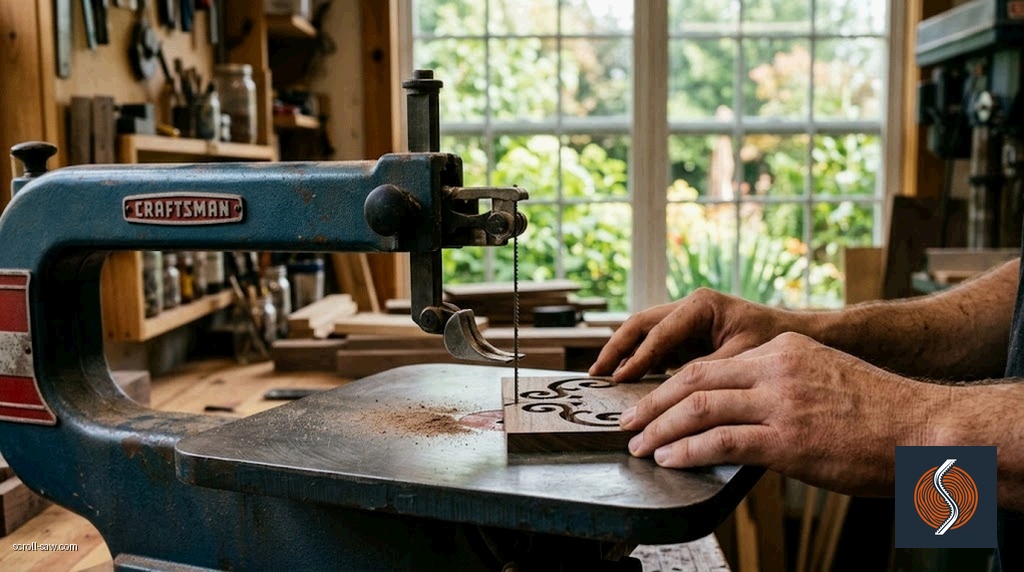
A Closer Look at the Craftsman Auto Scroll Saw
The first time you push the power switch on a Craftsman Auto Scroll Saw and the arm settles into its stroke, you understand why these machines have followed woodworkers around for decades. There is a mechanical honesty to them that new plastic saws never quite reach. There is also a set of design decisions from the 1980s that a modern owner has to work around, because scroll saw design has moved on and the Auto has not. This piece is what to know before you rescue one, restore one, or decide it is time to move on from one.
What the Craftsman Auto Scroll Saw actually is
The Auto Scroll Saw is Sears Craftsman’s mid-century-into-modern hobby scroll saw, sold under a handful of catalog numbers over the years and typically identified by the 16-inch throat and the two-speed or single-speed drive. It is a pin-end blade machine with a cast iron table, a rigid tubular arm, and a motor that is grossly overbuilt for the work the saw was ever asked to do. That last part is the reason so many of them still run.
The saw was aimed at hobbyists in the middle price band of its era. It is not a Hegner, and it never pretended to be. It is a machine that a Sears customer bought at Christmas, put in a basement shop, and used for puzzles and toys and the occasional intarsia project. Most surviving examples show almost no wear on the motor and significant wear on the blade holders and the tension mechanism, which is the exact pattern you would expect from that use profile.
What still works well
The motor. A well-kept Auto Scroll Saw motor is almost immortal. Even units that have sat for a decade generally start and settle into a steady stroke after a drop of oil in the bushings and a light cleaning of the commutator.
Cast table flatness. These tables are heavy, flat, and durable. They accept a magnetic base for hold-down accessories, and they do not scratch the way modern die-cast aluminum tables do. A well-cared-for Auto Scroll Saw table is one of the best working surfaces in the entire hobby scroll saw category.
Arm rigidity. The tubular arm design resists flex under moderate tension. It is not as rigid as a modern parallel arm, but it holds a blade steady enough for clean scrolling in wood up to 3/4 inch.
Where age catches up
Blade holders wear. The clamps that grip pin-end blades take every stroke and every blade change. Half-century-old blade holders are often out of round in the slot, which lets the blade rock and produces cuts that lean. Feeling the clamp with a jeweler’s loupe usually tells you whether it is savable.
Tension spring fatigue. The internal spring loses temper over decades. If tension is set correctly but the blade still bows in the cut, the spring is done.
Cord and switch. The original cord is often brittle and the switch contacts often pitted. Replace both as part of any restoration. This is a safety issue, not a preference.
Rubber isolation feet. The rubber feet under the base have crumbled on most surviving units. Replacements are trivial to source.
Aluminum blade guide, when present. Some variants have an aluminum blade guide that has been bent by a snapped blade at some point in its life. Straightening or replacing this is worth the small effort.
The blades this saw takes
The Auto Scroll Saw uses standard 5-inch pin-end blades. Any universal pin-end blade fits, from Olson to Pégas to Flying Dutchman. Because the saw was designed for pin-end blades, the fastest path to good cuts is a fresh pack of quality pin-end blades, not a conversion attempt.
For everyday scrolling, an Olson FR49202 5-inch reverse-tooth pin-end assortment is the single most useful blade upgrade you can make. Reverse-tooth pin-end blades cut the bottom edge cleanly, which removes the fuzz that older pin-end saws are famous for producing. If you want a broader tooth-count range in one box, the Olson FR49400 skip-tooth pin-end assortment covers #5, #7, and #9 blades for hardwood work.
If you want to run plain-end blades on this saw for finer detail or for spiral blades, a universal pin-to-pinless conversion adapter works, though it is not strictly a repair. It is an upgrade to the blade selection you can run.
Setup for the Auto Scroll Saw, in order
Clean and oil. Ten minutes with a rag and a can of light machine oil. The bushings on the arm pivots want a drop of oil, not grease. Grease traps sawdust and hardens.
Level the table to the blade. Cast tables on these saws are usually still true. What is not true is the factory tilt-zero mark. Set an engineer’s square against a fresh blade with the table nominally zeroed, then adjust and re-mark.
Set tension by ear. Pluck the blade after installation. A clear ring is right. A dull thud means loose. A shrill note is too tight.
Bolt it down. These saws vibrate less than most modern budget scroll saws because the mass is real, but bolting the base to a bench takes the last of the walk out of the machine.
Update the light. The original work light, if it still exists, is dim by modern standards. A Neatfi XL magnifying lamp clamped to the bench edge gives you real light and useful magnification at the blade.
Comparison against alternatives
Rebuilding an Auto Scroll Saw is a choice against buying new. The comparison worth making is against a current entry-level saw in the same class.
Compared with a WEN 3922 at similar total cost after a modest rebuild, the Auto Scroll Saw has a heavier and more stable table, a longer-lived motor, and a slightly less refined blade change process. The WEN’s easy-access side panel is a real quality-of-life improvement, and the WEN natively accepts pinned, pinless, and spiral blades without an adapter. If your priority is fast blade changes and modern convenience, the WEN wins. If your priority is a heavy stable saw that will still be cutting when the WEN’s plastic panels have yellowed, the Auto Scroll Saw wins.
Compared with a used DeWalt DW788, the DeWalt is a step up in every measurable way except sentimental value. A DW788 in decent condition costs more than a rebuilt Auto but delivers noticeably smoother cuts and a wider blade selection.
Who should skip the Auto Scroll Saw
Anyone who plans to do heavy portrait scrolling or repeated production cuts. The Auto is a general hobby saw, not a fine-detail machine. The blade holders do not tension a #2/0 blade with the precision needed for portrait work, and even with a conversion adapter you will fight the saw.
Anyone whose Auto Scroll Saw has a cracked arm casting or a scored table. Those are parts you cannot replace. If the core structure is compromised, the saw is not worth the parts to bring it back.
FAQ
What blades does the Craftsman Auto Scroll Saw use? Standard 5-inch pin-end scroll saw blades from any brand. Olson, Pégas, and Flying Dutchman universal pin-end blades all fit.
Can I still buy parts for the Craftsman Auto Scroll Saw? Sears parts availability has narrowed over the years, but many wear parts cross-reference to universal or aftermarket equivalents. Sears PartsDirect still lists parts for many Craftsman scroll saw models, and specialty parts houses fill in the gaps.
How thick can it cut? Softwood to about 3/4 inch cleanly, hardwood to about 1/2 inch cleanly. It will cut thicker stock with a fresh #7 or #9 blade and patience, but it is not designed for production hardwood work.
Why does my Auto Scroll Saw wander off the line? Usually one of three causes: a dull blade, worn blade holder clamps, or under-tensioned blade. Check tension by ear first, then swap the blade, then inspect the clamps.
Is the Craftsman Auto Scroll Saw the same as the Craftsman 16 inch? Not always. The Auto is a specific model line within the broader Craftsman 16-inch scroll saw family. Model number on the plate tells you which you have.
Can I convert this saw to pinless blades? Yes, with a universal pin-to-pinless adapter. It slots into the existing blade holders and opens up the plain-end blade catalog.
Should I restore an old Auto Scroll Saw or buy a new one? If the motor, arm, and table are healthy, restore. If two or more major parts need replacement and the saw already vibrates or leans, spend the money on a new machine.
Is the Auto Scroll Saw made in the USA? Depending on the era, yes or no. Earlier units were domestically produced. Later Craftsman scroll saws were manufactured under contract overseas. Model plate and date code identify the origin.
What is the best light setup for this saw? A clamp-on LED magnifying lamp. The original saw light is inadequate for any modern detail work and the fixture is often the first thing that fails.
What speed should I run for hardwood? The Auto is typically two-speed. Use the lower speed for hardwood over 1/2 inch, and the higher speed for softwoods and thinner stock. If you have a variable-speed variant, run 900 to 1,200 SPM for hardwood.
References
-
Sears PartsDirect Craftsman scroll saw parts — factory parts lookup by model number.
-
Olson Saw scroll saw blade selection chart — reference for pin-end blade sizing and material match.
-
OWWM (Old Woodworking Machines) archived Craftsman scroll saw threads — detailed restoration and dating information from long-time owners.


