
RBI Scroll Saws: Models, Specifications, and Blade Compatibility
RBI Scroll Saws: Models, Specifications, and Blade Compatibility
Walk into a serious scroll saw enthusiast’s shop and there is a reasonable chance you will find an RBI Hawk sitting in the place of honor. RB Industries built these saws in Missouri for decades, and they earned a reputation for smoothness, blade tension, and repairability that budget saws never approached. The company changed hands, and later new production, but the machines on the used market are still the ones people talk about. If you own one, or you are looking at one, this is the practical version of what they are.
What an RBI Hawk actually is
An RBI Hawk is a parallel-arm scroll saw with a rigid cast base, a heavy motor, and a blade tension system that clamps and releases with a single lever. The throat depth varies by model, running from 220 (which is the 20-inch class) up through the larger 26-inch and 30-inch industrial variants. Every Hawk uses standard 5-inch plain-end (pinless) blades, and every Hawk was designed to hold blade tension high enough that the fine-detail work happens without the blade wandering the way it does on lighter machines.
The short version of what makes a Hawk different: mass, blade grip, and stroke geometry. A Hawk sitting on a bench with the motor off weighs enough to notice. Once running, the arm produces a stroke that is straight and repeatable, which is what makes accurate portrait and intarsia work possible.
The models most owners actually see
Hawk G4 220. The 20-inch throat machine that anchors the Hawk lineup for most hobby scrollers. Variable speed, foot-operated tension release, standard 5-inch pinless blades. Sold new for years and common on the used market.
Hawk G4 226. The 26-inch throat variant. Same core mechanics as the 220, more throat depth for larger projects.
Hawk 220 VS and Hawk Ultra. Earlier variable-speed variants. The 226 Ultra was a widely admired flagship.
Hawk 216 and 216 Bushmaster. Compact 16-inch throat variants, less common but still capable.
Older single-speed and two-speed Hawks. Variants sold before the current variable-speed platform became standard. Motor and arm are still excellent, they simply lack variable speed control.
Each model varies in detail, but the blade fit, the tension mechanism, and the general operating envelope are consistent enough that a scroller who learns one Hawk can move to another without much retraining.
Blade compatibility, in one paragraph
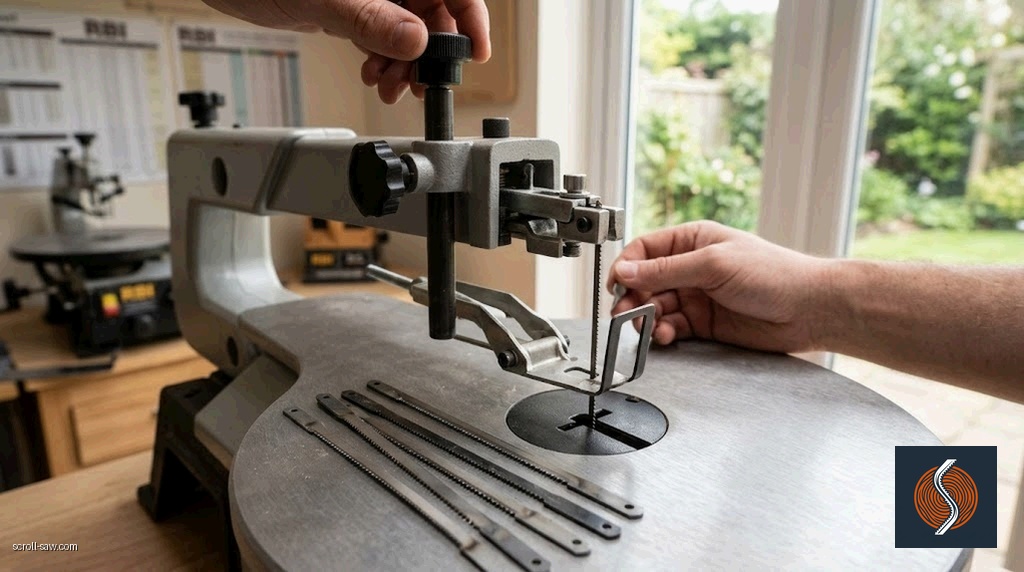
Every RBI Hawk uses standard 5-inch plain-end (pinless) scroll saw blades. Universal plain-end blades from Olson, Pégas, Flying Dutchman, or any quality maker fit. There is nothing proprietary about the blade itself. The clamps are designed for a plain blade end that seats against a small stop and locks with a thumb screw or lever.
A sensible working blade shelf for a Hawk covers three needs. General scrolling in wood up to 3/4 inch uses Olson skip-tooth blades or the equivalent from Pégas. Cleaner underside cuts come from Olson FR44802 reverse-tooth blades or the Olson FR49202 reverse-tooth assortment (which, despite being sold as pin-end, is available in equivalent plain-end packs). Fine detail and portrait scrolling benefit from Pégas #7 regular blades for their consistent tooth geometry, and Pégas SK7 fret saw blades for the finest work the saw is capable of. Spiral cuts and 360-degree work run on Olson SP46500 spiral blades.
One honest note on blade brands. Pégas Swiss blades cost more per pack than Olson blades and last measurably longer in hardwood on a Hawk that can tension them properly. Because a Hawk holds tension so well, you notice the difference. Casual users may not care. Portrait scrollers do.
Setup on a Hawk
Owners who buy a Hawk usually already know how to run a scroll saw. The setup notes worth repeating on a Hawk are the ones that differ from lighter machines.
Tension goes higher than you expect. The Hawk’s clamping system is designed for real tension. New Hawk owners coming from a WEN or a Craftsman routinely under-tension their first blades and then wonder why the cut feels loose. A properly tensioned #5 blade on a Hawk rings a higher note than on a WEN, because the arm supports it.
Foot-operated tension release changes how you work. The pedal on the front of the machine drops tension instantly. This is the Hawk feature that makes fretwork so much faster than on any other saw. Practice the motion. Blade change speed on a Hawk with the pedal is measurably faster than on any lever-only saw.
Stroke length is longer than budget saws. Hawks run a longer stroke than most 16-inch scroll saws, which uses more of each blade. Rotate blade position occasionally to extend blade life.
Level the table carefully. A cast table on a Hawk is very flat and holds its zero, but the initial tilt zero is worth confirming with an engineer’s square.
Bolt it down. Even a Hawk cuts more smoothly when the base is bolted to a heavy bench.
Parts and service
Parts availability for RBI Hawks depends on the era and the current parts network. Recent Hawks have parts support through the manufacturer’s current service arrangement. Older Hawks are supported by a mix of factory-original stock, aftermarket parts specialists, and long-term owner networks. Common wear items (blade clamps, tension components, motor brushes, cord and switch) are generally sourceable.
Terminal failures on a Hawk are rare. The cast arm and motor are essentially permanent. What fails is small: blade clamp components, tension linkage bushings, the occasional motor brush set. These are all replaceable.
Comparison against everything else
Against a DeWalt DW788, the Hawk is a step up in mass, blade tension, and pedal-operated blade change. The DW788 costs a fraction of a used Hawk and is a very capable saw. If your budget allows a Hawk, take the Hawk. If not, the DW788 is not a compromise you will regret.
Against a Rikon 10-600VS, the Hawk is another level of machine entirely. Mass, arm rigidity, and blade tension are all in a different category. The Rikon is a fine mid-range saw. The Hawk is a lifetime machine.
Against a Hegner, the two brands sit in the same tier and both have devoted followings. Hegner tends toward a slightly heavier build and a European service pattern. RBI tends toward slightly better blade change ergonomics and a longer domestic parts history. Both are excellent.
Who should skip an RBI Hawk entirely: a casual weekend scroller who cuts a few Christmas ornaments a year. The Hawk is designed for people who scroll seriously, and its price reflects that. A WEN 3922 or a Shop Fox W1872 will do casual hobby work perfectly well at a fraction of the price.
A last word on used Hawks
A used Hawk almost always retains its value. That is unusual for power tools, and it says something about how these machines were built. If you find one at a fair price, from an owner who used and cared for it, you are buying a machine that will still be scrolling in twenty years. The blade clamps will need service occasionally. The motor will keep going. That is the whole story.
FAQ
Are RBI scroll saws still being made? RB Industries changed hands and production configurations over the years. Current-production Hawks are available through the current corporate iteration of the company. Used Hawks are available on the secondary market and are highly sought after.
What blades does an RBI Hawk use? Standard 5-inch plain-end (pinless) scroll saw blades from any quality maker. Olson, Pégas, Flying Dutchman all fit.
How thick can an RBI Hawk cut? Up to 2 to 2-1/4 inches depending on model. Comfortable working thickness is 1 inch and thinner for clean fine-detail work, though the saw handles thicker stock better than lighter machines.
Is the RBI Hawk 220 better than the DeWalt DW788? In mass, blade tension, and pedal-operated blade change, yes. The DW788 remains a very capable saw at a fraction of the price. Both are widely admired.
Can I buy parts for an older RBI Hawk? Yes, through the current manufacturer service arrangement and aftermarket parts specialists. Availability varies by era. Most wear parts are still sourceable.
Why is an RBI Hawk so expensive? Mass, cast construction, blade tension range, foot-operated blade change, and long-term parts support. These are not budget-saw features and the price reflects that.
What speed range does the Hawk cover? Variable-speed Hawks run approximately 400 to 1,700 SPM. Older two-speed variants offer fixed low and high speed positions.
Should I buy a used Hawk or a new WEN? Different tools for different scrollers. A used Hawk in decent condition is a lifetime machine and a joy for serious scrolling. A new WEN 3922 is an affordable saw that does most hobby work perfectly well. Pick based on how much you plan to scroll.
What is the foot-operated tension release for? It drops blade tension instantly so you can thread a blade through an interior cut hole and re-tension quickly. On fretwork with dozens of interior cuts, this feature saves real time and hand strain.
Do I need special blades for a Hawk? No, standard 5-inch plain-end blades fit. Higher-quality blades (Pégas, PGT, Flying Dutchman Ultra Reverse) show their advantage more on a Hawk than on lighter saws because the Hawk actually holds them at the tension they were designed for.
References
-
Olson Saw scroll saw blade selection chart — the blade sizing reference used across scroll saw brands including the Hawk.
-
Scroll Saw Village and Scroll Saw Association of the World archives — owner community references for Hawk models and service history.
-
OWWM archived RBI threads — restoration and dating notes from long-time Hawk owners.


