
Craftsman 16in Scroll Saw: Speed Range, Blades, and Setup
Craftsman 16in Scroll Saw: Speed Range, Blades, and Setup
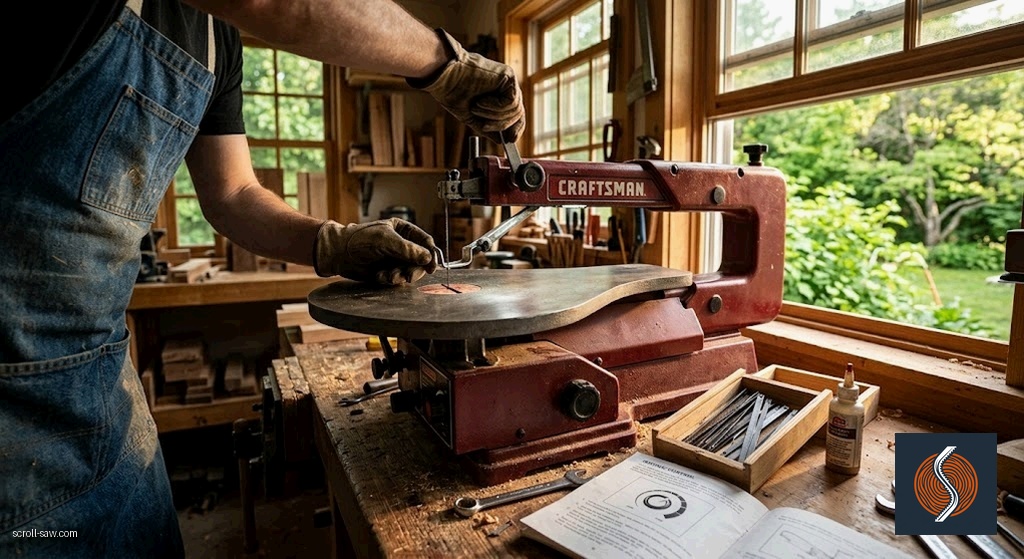
A Craftsman 16 inch scroll saw is a common shop find because Sears sold them for decades under many model numbers. Some are two-speed, some are variable-speed, and almost all of them use standard 5-inch pin-end blades from the factory. If yours has landed on your bench with no manual and no idea which speeds it runs or which blades it likes, this is the plain answer.
What the Craftsman 16 inch family actually is
Craftsman 16-inch scroll saws share a common footprint: 16-inch throat, parallel-arm design, cast table (aluminum on later saws, iron on some earlier variants), and a two-speed or variable-speed drive. Sears sold these under 113.xxx and 315.xxx model numbers over the years, with Emerson Electric building the older ones and later OEMs building the newer ones. The plate on the motor tells you which era yours is from, and Sears PartsDirect can look up parts by that model number.
Blade fit is universal 5-inch pin-end on nearly every Craftsman 16-inch saw. Later variants added pinless capability. A handful of the newest Craftsman 16-inch saws accept both natively.
Speed range and what it means
Two-speed Craftsman 16-inch saws typically run around 850 and 1,725 strokes per minute. The low speed is for hardwood over 1/2 inch and for plastic. The high speed is for softwood and general scrolling.
Variable-speed Craftsman 16-inch saws cover roughly 400 to 1,700 SPM. This range is broad enough for everything from thick hardwood at the low end to thin softwood at the high end.
A quick guide by material:
-
Softwood, 1/4 to 3/4 inch: 1,200 to 1,500 SPM.
-
Hardwood, up to 1/2 inch: 900 to 1,200 SPM.
-
Hardwood, over 1/2 inch: 800 to 1,000 SPM.
-
Plywood: 1,000 to 1,300 SPM.
-
Plastic or acrylic: 550 to 800 SPM. Leave the protective film on.
-
Non-ferrous metal: 400 to 700 SPM with wax lubricant.
Speed is not the whole story. Feed pressure and blade choice matter as much. The right speed with the wrong blade produces worse cuts than the right blade at a slightly wrong speed.
First-session setup
Clean and oil. A drop of light machine oil at each arm pivot bushing. Wipe the table with paste wax. Ten minutes.
Square the table to the blade. Install a fresh blade, set an engineer’s square against it with the table at nominal zero, and adjust the tilt lock. Mark the true zero position with a paint pen so bevel cuts do not lose their reference.
Tension the blade by ear. Pluck it after installation. A clear high note is right. A dull thud is under-tensioned. A shrill note is over-tensioned and will snap.
Set the hold-down foot. It should touch the workpiece at the top of the stroke, only preventing lift, not pressing down hard.
Bolt it down. Any 16-inch saw benefits, but Craftsman 16-inch saws are heavy enough that bolting to a solid bench eliminates the last of the walk.
Update the light. The original clip-on lamps have aged out on most units. A Neatfi XL magnifying lamp at the bench edge is the single biggest quality-of-life upgrade.
Blades for a Craftsman 16 inch scroll saw
Any universal 5-inch pin-end blade fits the factory arm. Skip the Craftsman-branded blade packs unless they are cheap. Aftermarket brands cost less per blade for the same or better quality.
A sensible working shelf:
-
General work: Olson FR49400 skip-tooth pin-end assortment.
-
Cleaner underside: Olson FR49202 reverse-tooth pin-end assortment.
-
Fine detail: Olson FR44802 fine reverse-tooth blades.
-
Hardwood finish: Olson DT49300 double-tooth blades.
If your Craftsman accepts pinless blades or you add a pin-to-pinless conversion adapter, the plain-end blade catalog opens. Olson SP46500 spiral blades allow 360-degree cutting without turning the workpiece, and Pégas #7 regular blades leave a noticeably cleaner finish than budget blades in hardwood.
The three problems Craftsman 16 owners run into most
Cuts drift off the line. Usually a dull blade or a worn blade holder. Try a fresh blade first. If drift continues, inspect the blade holder slots with a loupe. Worn holders let the blade rock.
Excessive vibration. Usually a loose mounting. Bolt the saw down. If vibration continues at speed, arm bushings may be worn. This is a fixable repair.
Blades snap. Almost always over-tension. Set tension by the pluck test, not by cranking the knob until it feels tight.
Small upgrades that pay for themselves
Foot switch. Craftsman 16-inch saws never shipped with one. Running the saw hands-free changes how you work with the tool.
Stiffer dust blower tube. The original flexible tube stiffens or falls off. Replacement aquarium tubing is two dollars and delivers a targeted air stream at the blade.
Table wax. Paste furniture wax on the cast table makes feed noticeably smoother.
Magnifier lamp. The single biggest change to how the saw feels to use. The Neatfi XL magnifying lamp puts real light and useful magnification at the blade.
Limits worth accepting
Thick hardwood is not the strong suit. Rated to about 2 inches, but comfortable working thickness is 3/4 inch softwood and 1/2 inch hardwood.
Fine portrait scrolling requires an adapter and quality blades. Possible but not the natural fit. If portrait work is your primary interest, look at a DeWalt DW788 or a Hawk.
Blade holder alignment is imperfect. Even a well-maintained Craftsman blade holder allows more blade rock than a modern precision saw. Cuts drift slightly more than on a factory-fresh WEN or DeWalt.
Comparison against alternatives
Against a WEN 3922, a healthy Craftsman 16 has more mass and a smoother stroke but a less refined blade change. The WEN’s side-panel access makes blade changes far faster.
Against a used DeWalt DW788, the DeWalt is a step up in every measurable way except sentimental value.
Against the Shop Fox W1872, the two are close peers. The Shop Fox has a slightly better dust blower and a factory foot switch. The Craftsman has broader used availability.
Who should skip a Craftsman 16 entirely: anyone whose specific example has a cracked arm casting or a scored table. Those are terminal problems.
FAQ
How thick can a Craftsman 16 inch scroll saw cut? Rated to about 2 inches. Comfortable working thickness is 3/4 inch softwood and 1/2 inch hardwood.
What speed range does the Craftsman 16 variable speed cover? Roughly 400 to 1,700 SPM. Two-speed variants run at approximately 850 and 1,725 SPM.
What blades fit a Craftsman 16 inch scroll saw? Standard 5-inch pin-end blades on most models. Later Craftsman variants accept pinless blades natively.
Why does my Craftsman scroll saw wander off the line? Usually a dull blade or worn blade holder. Try a fresh blade first, then inspect the holder slots.
Can I convert my Craftsman 16 to pinless blades? Yes, with a universal pin-to-pinless adapter. It fits into the existing pin-end clamps and opens up the plain-end blade catalog.
What speed should I use for hardwood? 900 to 1,200 SPM for hardwood under 1/2 inch, 800 to 1,000 SPM for thicker hardwood.
Are Craftsman scroll saw blades the same as universal blades? Craftsman scroll saws use standard 5-inch blades. Any universal blade of the right pin or pinless format fits.
Should I bolt my Craftsman scroll saw to the bench? Yes. Vibration drops noticeably and cut accuracy improves.
How do I set blade tension? By ear. Pluck the blade after installation and listen for a clear ring. That is right. Dull thud is loose, shrill note is too tight.
Can I cut metal on a Craftsman 16 scroll saw? Thin non-ferrous sheet, yes, at the lowest speed with a metal-cutting blade and wax lubricant.
References
-
Sears PartsDirect — model-number parts lookup for Craftsman scroll saws.
-
Olson Saw scroll saw blade selection chart — the reference for blade sizing and material match.
-
OWWM archived Craftsman scroll saw threads — practical setup and restoration notes from long-time owners.


