
A Practical Ryobi 16 Variable Speed Scroll Saw Setup Guide by Material and Thickness
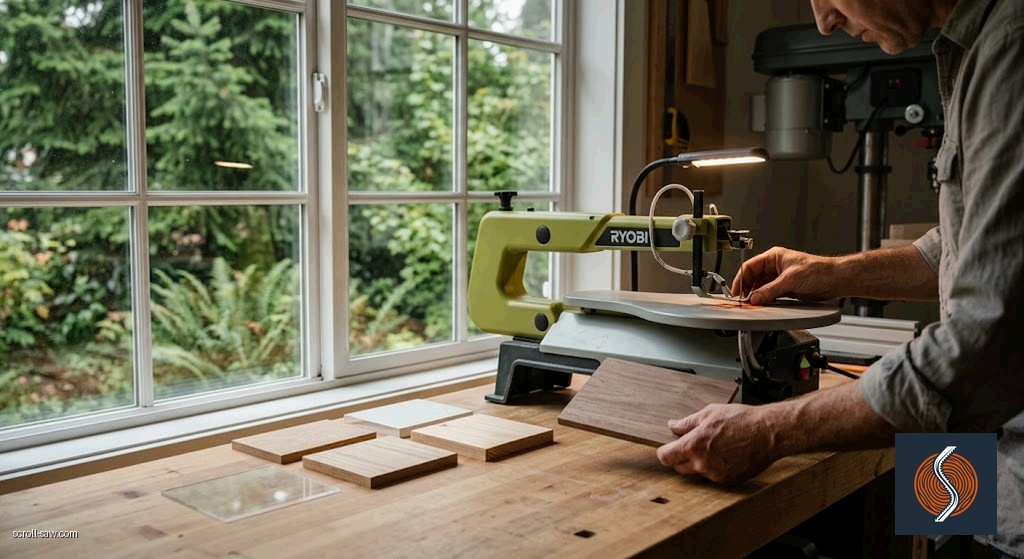
A Practical Ryobi 16 Variable Speed Scroll Saw Setup Guide by Material and Thickness
A Ryobi 16 variable speed scroll saw arrives from Home Depot in a small carton, weighs less than most 16-inch scroll saws in its price bracket, and feels a little plastic on the first blade change. It also cuts perfectly well once it is set up, and it will keep cutting for years if you treat it kindly. The trick that separates a Ryobi that produces clean fretwork from a Ryobi that fights you on every cut is the setup, the blade choice, and the speed match. This is that guide.
What the saw actually is
The Ryobi 16 variable speed scroll saw is a 16-inch throat parallel-arm hobby machine, variable speed from roughly 550 to 1,600 SPM, with a die-cast aluminum table, a cast base, and a blade change system that accepts both pin-end and pinless 5-inch blades depending on the specific variant. Older Ryobi 16-inch saws are pin-end only. Newer variants accept both.
The saw is aimed at the middle of the hobby market. It is not a DW788 and it never pretended to be. What it does is cut wood up to about 1-1/2 inch, run quietly enough for a garage or basement shop, and cost less than nearly every alternative.
First-session setup
Unbox and inspect. Ryobi ships these saws with a factory-installed blade that is fine for the first cuts but is not the blade you want for good work. Check the arm for shipping-related misalignment by sighting from the front. Upper and lower blade holders should be in the same vertical plane.
Bolt the saw down. Ryobi 16-inch saws vibrate on rubber feet enough to notice. Bolt or clamp the base to a solid bench. This is not optional if you want fine cuts.
Square the table to the blade. Install a fresh blade, hold an engineer’s square against it, and adjust the tilt lock until the blade sits flush along the square. The factory tilt zero is often slightly off. Mark the true zero position with a paint pen.
Set blade tension by ear. Pluck the blade after tensioning. A clear high note is right. A dull thud is under-tensioned and will let the blade wander. A shrill note is over-tensioned and will snap at the clamp face.
Set the pressure foot. It should touch the workpiece at the top of the stroke without pressing down hard.
Wax the table. Paste furniture wax makes feed noticeably smoother on the die-cast aluminum surface.
Update the light. The onboard lamp is dim. A Neatfi XL magnifying lamp at the bench edge puts real light and useful magnification at the blade.
Speed by material and thickness
The Ryobi’s variable speed range is wide enough to cover almost every hobby scroll saw material. What you want is speed that matches the material, not maximum speed on everything.
| Material | Thickness | Speed (SPM) | Blade |
|---|---|---|---|
| Softwood (pine, cedar) | Under 1/2 in | 1,300 to 1,500 | #5 skip-tooth |
| Softwood | 1/2 to 3/4 in | 1,200 to 1,400 | #5 or #7 skip-tooth |
| Hardwood (oak, maple) | Under 1/2 in | 1,000 to 1,200 | #5 reverse-tooth |
| Hardwood | 1/2 to 1 in | 900 to 1,100 | #7 skip-tooth |
| Hardwood | 1 to 1-1/2 in | 800 to 1,000 | #7 or #9 skip-tooth |
| Plywood | 1/4 to 1/2 in | 1,100 to 1,300 | #5 reverse-tooth |
| Plywood | 1/2 to 3/4 in | 1,000 to 1,200 | #7 reverse-tooth |
| Acrylic or PVC | 1/8 to 1/4 in | 600 to 800 | #5 skip-tooth |
| MDF | 1/4 to 3/4 in | 1,000 to 1,300 | #7 skip-tooth |
| Non-ferrous metal sheet | Under 1/16 in | 400 to 700 | Metal-cutting pin-end |
Blades for the Ryobi 16 VS
The Ryobi 16 variable speed uses standard 5-inch blades. Pin-end or pinless depending on your variant. Any universal blade of the right format fits.
A working blade shelf covers four needs:
General work. Olson FR49400 skip-tooth pin-end assortment if pin-end, or the equivalent plain-end skip-tooth pack if pinless.
Cleaner underside. Olson FR49202 reverse-tooth pin-end assortment removes bottom-edge tearout. This is the upgrade that most changes how your work looks.
Detail work. Olson FR44802 fine reverse-tooth blades for tight curves in thin stock.
Spiral cuts. For pinless-capable Ryobi variants (or any Ryobi with a pin-to-pinless conversion adapter), Olson SP46500 spiral blades cut in every direction without turning the workpiece.
Feed technique
A Ryobi 16 variable speed rewards a light hand. If you are pushing the workpiece, either the blade is dull or you are running the wrong speed and blade combination. The blade should pull itself through the wood with the workpiece gently guided rather than shoved.
Common mistakes on this saw:
Pushing too hard on hardwood. Slow down or step up to a lower TPI. Do not force feed.
Running too fast on plastic. Plastic melts and welds to the blade. Slow the saw down and take your time.
Forgetting to slow down for tight curves. A curve that a #5 blade cannot make at speed usually can be made at half speed. If not, step down to a #3 blade or a spiral.
Small upgrades
Foot switch. Not shipped from the factory. Running hands-free changes how you work.
Stiffer dust blower tube. The stock tube is soft and does not aim well. Aquarium tubing is two dollars and delivers a targeted stream at the blade.
Magnifier lamp. Any project involving detail benefits from the Neatfi XL magnifying lamp.
Bolt the saw down. Already mentioned. Worth repeating because it is the single biggest change in cut quality.
Comparison against alternatives
Against a WEN 3922, the WEN’s side-panel access for blade changes is measurably faster. Cut quality is roughly equivalent. The two saws sit at similar prices and both are honest budget hobby machines.
Against a Shop Fox W1872, the Shop Fox has a slightly better dust blower and a factory foot switch. The Ryobi has broader Home Depot availability and a friendlier warranty network.
Against a used DeWalt DW788, the DeWalt is a step up in mass, blade tension, and cut smoothness at a used price that is often close to a new Ryobi.
Who should skip a Ryobi 16 variable speed entirely: serious portrait scrollers, intarsia specialists, and anyone who plans to run a small production shop. The saw is a general hobby machine, not a fine-detail specialist.
FAQ
What is the speed range of the Ryobi 16 variable speed scroll saw? Approximately 550 to 1,600 SPM on the current variant, with slight variation across model years.
What blades fit the Ryobi 16 VS? Standard 5-inch scroll saw blades. Pin-end on the classic 16-inch arm, plain-end on later variants with pinless clamps.
How thick can it cut? Rated to about 2 inches. Comfortable working thickness is 1 inch hardwood and thinner.
Why does my Ryobi scroll saw vibrate? Almost always the base is not bolted down. Ryobi 16-inch saws vibrate more than heavier scroll saws until secured to a solid bench.
What blade for 3/4 inch pine? #5 skip-tooth at 1,200 to 1,400 SPM.
What blade for 3/4 inch oak? #5 or #7 skip-tooth at 900 to 1,100 SPM. Reverse-tooth if underside cleanliness matters.
Can I use pinless blades? On later Ryobi variants natively. On older pin-end Ryobis, with a universal pin-to-pinless adapter.
How do I set blade tension? Pluck test. Clear high note is right. Dull thud is loose, shrill note is too tight.
What speed for cutting acrylic? 600 to 800 SPM. Slow down further if the plastic starts to melt or weld to the blade.
Should I buy the Ryobi 16 VS or wait for a better saw? For hobby scrolling and occasional detail work, the Ryobi 16 VS is a fine buy. For serious portrait work, save for a DeWalt DW788 or a used Hawk instead.
References
-
Ryobi scroll saw product support — factory documentation for current and legacy Ryobi scroll saw models.
-
Olson Saw scroll saw blade selection chart — reference for blade sizing and material match.
-
Scroll Saw Village archived Ryobi threads — practical setup notes from long-time owners.


