
Craftsman 16 Inch Variable Speed Scroll Saw: Match Blade Speed to Material and Cut Radius
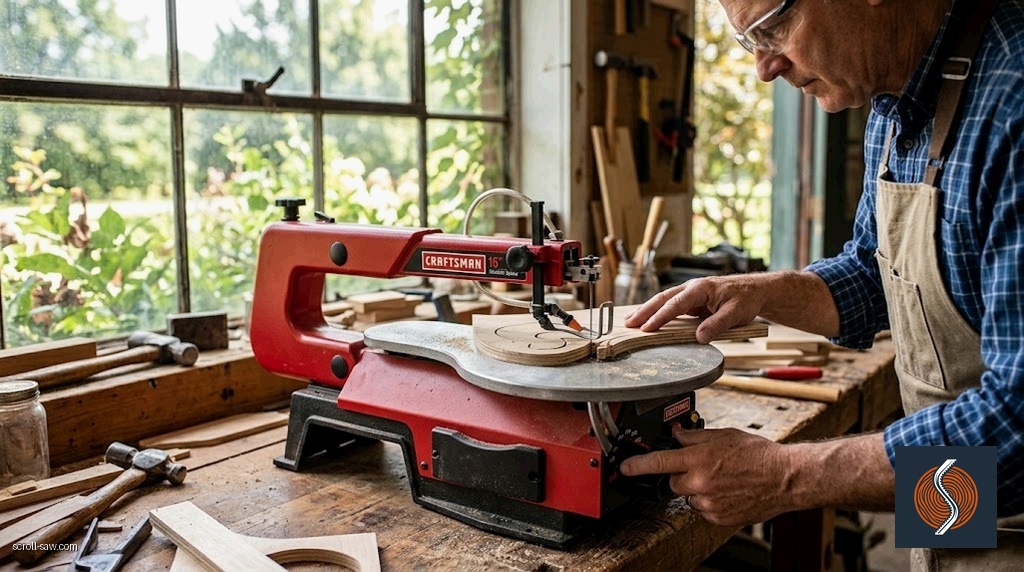
Craftsman 16 Inch Variable Speed Scroll Saw: Match Blade Speed to Material and Cut Radius
A Craftsman 16 inch variable speed scroll saw has a wide speed dial for a reason: no single speed cuts every material well. What most owners do on the first day is set the dial in the middle and leave it there. What produces consistently clean cuts is matching speed to material, to thickness, and to how tight the curve is. This is that guide, written for the Craftsman 16 inch variable speed family (113 and 315 prefix saws with a variable-speed drive), and applied in a way that carries over to any variable-speed 16-inch scroll saw.
The saw, in one paragraph
Craftsman variable-speed 16-inch scroll saws cover roughly 400 to 1,700 SPM. Every one of them uses standard 5-inch blades. Pin-end in factory configuration on most models, pinless on later variants, and pinless on any Craftsman with a universal pin-to-pinless conversion adapter installed. The saw is aimed at hobby scrollers and does that job well when the setup is right.
Speed by material and thickness
Start with material. Then adjust for thickness. Then adjust again for cut radius (tighter curves want slower speed and finer teeth).
Softwood (pine, cedar, poplar): These cut fastest and burn slowest.
-
Under 1/2 inch: 1,300 to 1,500 SPM, #5 skip-tooth.
-
1/2 to 3/4 inch: 1,200 to 1,400 SPM, #5 or #7 skip-tooth.
-
Over 3/4 inch: 1,000 to 1,200 SPM, #7 skip-tooth.
Hardwood (oak, maple, walnut, cherry): Slower speeds prevent burning at tight radii.
-
Under 1/2 inch: 1,000 to 1,200 SPM, #5 reverse-tooth for clean bottom edge.
-
1/2 to 1 inch: 900 to 1,100 SPM, #7 skip-tooth.
-
Over 1 inch: 800 to 1,000 SPM, #7 or #9 skip-tooth.
Plywood: Glue lines dull blades faster. Expect shorter blade life.
-
1/4 to 1/2 inch: 1,100 to 1,300 SPM, #5 reverse-tooth.
-
1/2 to 3/4 inch: 1,000 to 1,200 SPM, #7 reverse-tooth.
MDF: Cuts cleanly but produces a lot of fine dust.
- 1/4 to 3/4 inch: 1,000 to 1,300 SPM, #7 skip-tooth. Wear a mask.
Acrylic and other plastics: Speed control matters most here because heat welds plastic to the blade.
-
1/8 to 1/4 inch: 600 to 800 SPM, #5 skip-tooth. Leave protective film on.
-
Over 1/4 inch: 500 to 700 SPM. Stop periodically to let the blade cool.
Non-ferrous metal sheet (brass, aluminum, copper): Slowest speeds only.
- Under 1/16 inch: 400 to 700 SPM, metal-cutting pin-end blade, wax lubricant, light feed.
Adjusting for cut radius
The speed table above assumes gentle curves and straight cuts. Tight radii change the calculation.
Straight cuts and gentle curves (radius over 1 inch). Use the table speed and a #5 or #7 blade for general work.
Moderate curves (radius 1/4 to 1 inch). Same speed, step down one blade size (from #7 to #5, or from #5 to #3) for tighter turning.
Tight curves (radius under 1/4 inch). Reduce speed 20 percent and use a #3 or #1 blade. Consider a spiral blade for the tightest work.
Interior cutouts and fretwork. Drill an entry hole, thread the blade, and re-tension. If your Craftsman has pin-end clamps, this is where the pin-to-pinless conversion adapter and a pack of Olson SP46500 spiral blades change your workflow. Spiral blades cut in every direction without turning the workpiece.
Blade choice, in short
-
General work: Olson FR49400 skip-tooth pin-end assortment.
-
Clean underside: Olson FR49202 reverse-tooth pin-end assortment.
-
Fine detail: Olson FR44802 fine reverse-tooth blades.
-
Hardwood finish: Olson DT49300 double-tooth blades.
-
360-degree cutting: Olson SP46500 spiral blades.
-
Premium hardwood detail: Pégas #7 regular blades.
Setup that makes the speed dial matter
The speed dial only produces clean cuts if the mechanical setup around it is right.
Bolt the saw down. Speed changes are less useful when the whole saw is walking across the bench.
Square the table to the blade. A miscalibrated table produces beveled cuts regardless of what speed you dial.
Tension the blade correctly. Pluck test. Clear ring is right.
Set the pressure foot. It should touch the workpiece at the top of the stroke without pressing down hard.
Wax the table. Feed becomes noticeably smoother, which lets you feel what the blade is doing.
Add real light. A Neatfi XL magnifying lamp at the bench edge shows you exactly what the blade is doing at the cut line.
Reading the cut, and adjusting the dial
A scroll saw cut tells you whether the speed is right if you know what to look for.
Chatter or bouncing. Speed is too high for the material. Slow down.
Burning or brown lines in the cut. Speed is too high or blade is too fine. Slow down first, step up one blade size second.
Fuzzy underside. Wrong blade style, not wrong speed. Switch to a reverse-tooth blade.
Blade squealing or singing loudly. Blade is over-tensioned. Reduce tension slightly.
Blade wandering off the line. Either dull blade, worn blade holder, or under-tensioned blade. Change one variable at a time.
Slow feed with clean cut. Right speed, right blade. Enjoy the afternoon.
Comparison against alternatives
Against a WEN 3922, the WEN’s side-panel blade change is faster. Cut quality at matched speeds is comparable. The Craftsman has more mass and a slightly smoother stroke in a healthy example.
Against a used DeWalt DW788, the DeWalt is a step up in blade tension, stroke smoothness, and blade selection. If you find a healthy DW788 for a similar dollar value to a used Craftsman variable-speed, the DW788 is the better buy.
Against a Shop Fox W1872, the two saws are close peers. The Shop Fox has a slightly better dust blower and a factory foot switch.
Who should skip a Craftsman 16 variable speed entirely: someone whose specific example has a cracked arm casting, a scored table, or a motor that hums but does not spin freely. Those are terminal problems.
FAQ
What speed range does the Craftsman 16 variable speed scroll saw cover? Roughly 400 to 1,700 SPM depending on the model.
What speed should I use for oak? For 3/4 inch oak, 900 to 1,100 SPM with a #5 or #7 blade. Reverse-tooth if underside cleanliness matters.
What speed for pine? For 3/4 inch pine, 1,200 to 1,400 SPM with a #5 skip-tooth.
What blade for tight curves? A #3 blade or a spiral blade. Reduce speed 20 percent from the table setting.
Can I cut plastic on this saw? Yes, at 500 to 800 SPM with a #5 skip-tooth. Leave protective film on and expect to stop occasionally to let the blade cool.
Why does my blade burn the wood? Speed is too high, blade is too fine for the material, or feed is too slow. Try slowing the saw and stepping up one blade size.
What blade for 1 inch hardwood? #7 skip-tooth at 900 to 1,000 SPM. Feed light. Let the blade pull itself through the wood.
How do I know my speed dial is working correctly? Set the dial to minimum. The saw should stroke slowly and steadily. Rotate to maximum. Speed should climb smoothly. Erratic speed changes point to a speed control board that is failing.
Is the Craftsman variable speed better than the two-speed? For most work, yes, because it lets you match speed to material precisely. The two-speed is fine for owners who cut mostly one type of material.
Should I stock multiple blade sizes or just #5? Start with #5 in both skip-tooth and reverse-tooth. Add #7 for hardwood over 1/2 inch. Add #3 for detail work in thin stock. That covers 90 percent of hobby scrolling.
References
-
Sears PartsDirect — model-number parts lookup for Craftsman variable-speed scroll saws.
-
Olson Saw scroll saw blade selection chart — blade sizing and material match reference.
-
OWWM archived Craftsman scroll saw threads — practical setup and speed notes from long-time owners.


